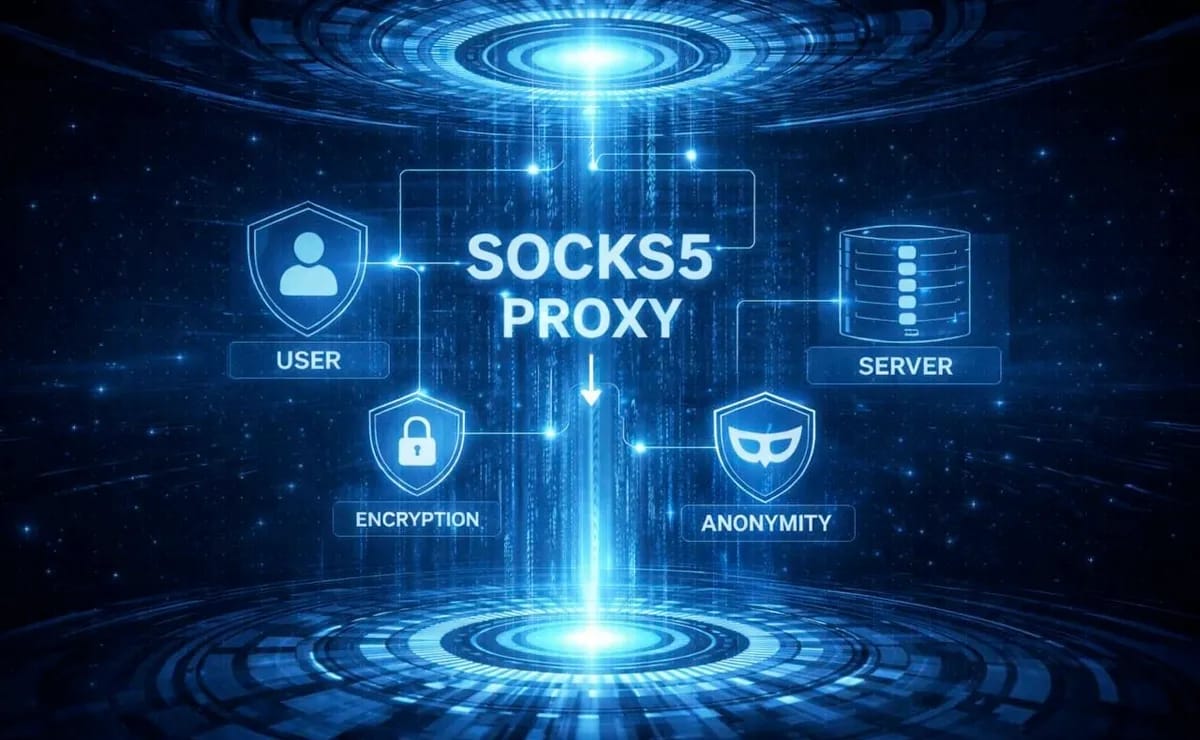
SOCKS5 Proxy: What it is, How it Works, and How it Differs from HTTP
When working with proxies, the question of choosing the right protocol often arises. Some proxies are designed to work only with HTTP and HTTPS requests, while others are suitable for transmitting any type of network data. SOCKS5 belongs to the latter category.
In this article, we will analyze how SOCKS5 works, its advantages, and how it differs from HTTP proxies.
What is the SOCKS5 Protocol?
SOCKS5 is a fifth-version network proxy protocol designed to transmit internet traffic through an intermediate server between the user and the target resource. In this scheme, the application does not interact directly with the website or service: first, a connection is established with the SOCKS proxy, and it is the proxy that takes over the connection to the desired address and data exchange.
The interaction process when using SOCKS5 looks like this:
- The client connects to the proxy server and negotiates the authentication method.
- After successful connection, a request is sent to establish a connection with a specific IP address or domain name.
- The proxy server initiates a connection with the target resource and begins bidirectional data transfer.
This mechanism allows you to implement SOCKS5 authentication and proxy connections over both TCP and UDP, depending on the task. Security is provided by the protocol or technology that is used on top of SOCKS5, such as HTTPS, TLS, or secure tunnels.
Advantages of Using the SOCKS5 Protocol
Proxy servers based on the SOCKS5 protocol have gained widespread adoption due to their versatility and technical flexibility. Unlike specialized proxies designed only for HTTP and HTTPS requests, SOCKS5 was originally created as a general-purpose protocol.
One of the main advantages of SOCKS5 is that it is not tied to specific data types or applications. Such a proxy does not analyze the content of the traffic and does not depend on which protocol is used on top of it. This allows SOCKS5 to be used for browsers, mobile applications, messengers, game clients, P2P networks, API requests, and specialized software where HTTP proxies simply do not work or are severely limited.
Another important advantage is support for both TCP and UDP connections. This is necessary where non-standard network exchange is used: streaming, online games, VoIP, torrents, parsing with a high frequency of requests. Many alternative proxy solutions simply cannot handle UDP traffic at all. UDP support is implemented through the UDP ASSOCIATE mechanism, which is especially important for real-time connections.
In terms of anonymity, SOCKS5 also wins. The proxy server replaces the client's real IP address with its own. It does not interfere with the structure of requests and does not add headers; the probability of leaking extra information is lower compared to HTTP proxies. With correct DNS resolution settings, requests to domains also pass through the proxy, which further reduces the risk of deanonymization. In this scheme, the proxy acts as a network intermediary, providing IP address masking without changing the structure of requests.
Separately, we note the flexibility in matters of authentication and access control. SOCKS5 supports different authentication methods, including working with a login and password, which allows you to restrict access to the proxy, distribute the load between users, and safely use it even for commercial purposes.
SOCKS5 does not encrypt data. However, this is often an advantage: the proxy does not create unnecessary load and does not conflict with HTTPS, TLS, or other security protocols, which means it provides stable and predictable operation.
What tasks is it suitable for?
SOCKS5 proxies are used in cases where versatility is required without restrictions on connection types and applications. Unlike HTTP proxies, it is not tailored for browser logic and is therefore suitable for more complex tasks where connection stability, TCP and UDP support, and compatibility with various software are important. That's why SOCKS5 is used in tasks where broad compatibility with various software is important.
Below are the key areas where SOCKS5 is most often and most effectively used:
- Traffic arbitrage and affiliate marketing. In arbitrage, SOCKS5 is used as a basic tool for separating working environments. Proxies are connected to anti-detect browsers, trackers, allowing you to work with different GEOs, sources, and sessions without direct IP overlaps. SOCKS5 is valued here precisely for its versatility: it works equally correctly with both the browser and external tools that are used in bundles.
- Multi-accounting and account management. SOCKS5 is well suited for long-term work with accounts on social networks, marketplaces, and various online services. Due to the lack of interference in traffic, SOCKS5 does not break the logic of services and works correctly with authorization and cookies.
- Parsing, scraping, and automation. For data collection and automated scenarios, SOCKS5 is convenient because it does not limit the type of requests and does not depend on HTTP headers. It is often used in parsers, bots, and scripts where scaling, high request frequency, and work with non-standard connections are required. Many automation tools initially support SOCKS5 as one of the basic proxy options.
- P2P networks and torrent clients. SOCKS5 is suitable for P2P and torrents, as it proxies traffic without encryption and additional processing, without increasing delays or reducing connection speed.
- Online games, VoIP, and services with UDP traffic. Thanks to this, it is used in real-time scenarios: online games, voice communication, streaming, and other applications sensitive to delays. HTTP proxies are often useless in such tasks.
- Working with GEOs and testing service availability. SOCKS5 is used to access the internet from IP addresses of the required regions: checking search results, testing websites, analyzing localized content, and accessing services with geographical restrictions. The proxy allows you to emulate a presence in the desired country or city without changing the network settings of the entire system.
In general, SOCKS5 proxies are suitable for tasks where stable operation with various applications, protocols, and traffic types is important. That's why SOCKS5 is often chosen as a universal "for everything" solution.
What is the difference between SOCKS5 and HTTP proxies?
The difference between SOCKS5 and HTTP proxies lies in the level of interaction with traffic and the scope of application. These two types of proxies solve similar tasks (redirecting connections and substituting the IP address), but they do it differently, so they are suitable for different scenarios.
Operating principle and protocol level
An HTTP proxy works at the HTTP/HTTPS level. It understands the structure of web requests, processes headers, can modify them, cache responses, filter content, and manage access to websites. In fact, an HTTP proxy is built into the logic of the web and is primarily intended for browsers and web applications.
SOCKS5, on the other hand, works at the network connection level, not a specific protocol. It does not analyze the content of the traffic and does not interfere with it, but simply transmits data between the client and the server. For SOCKS5, it does not matter whether HTTP, HTTPS, FTP, SMTP, WebSocket, or any other protocol is used.
Traffic types and UDP support
An HTTP proxy is focused exclusively on web traffic and only works with TCP connections. If the application uses non-standard connections or UDP, an HTTP proxy becomes useless.
SOCKS5 supports both TCP and UDP, which makes it more versatile. That is why it is used in online games, VoIP services, streaming, P2P networks, and other real-time scenarios.
Application compatibility
An HTTP proxy works well in browsers and services that are initially designed for HTTP logic. However, many programs, bots, scripts, parsers, and client applications either do not support HTTP proxies at all, or work with them unstably.
SOCKS5 is supported at the network settings level and is therefore compatible with a much wider range of software: from anti-detect browsers and trackers to parsers, automation, and account management systems.
Interference with traffic and anonymity
An HTTP proxy can add or change headers (for example, X-Forwarded-For), which sometimes simplifies user identification. In addition, due to the analysis of HTTP requests, such proxies are more often flagged by anti-fraud systems.
SOCKS5 does not add HTTP headers and does not modify traffic, which makes it more neutral from the point of view of detection. With correct DNS resolution settings, SOCKS5 provides a cleaner proxying scheme.
Performance and load
An HTTP proxy performs additional work: parsing requests, processing headers, sometimes caching. This can be a plus for corporate networks, but in user and professional tasks it creates unnecessary load.
SOCKS5 works simpler — it does not process data, but only forwards it. Due to this, the connection is more predictable and stable, especially during long sessions.
Conclusions
SOCKS5 is a versatile proxy protocol that operates at the network connection level and is independent of the type of traffic or application. It supports TCP and UDP, does not interfere with data, does not add headers, and works correctly with browsers, software, automation, and P2P. Unlike HTTP proxies, SOCKS5 is suitable for complex and professional scenarios — traffic arbitrage, multi-accounting, parsing, games, and working with GEOs — where stable sessions, compatibility, and predictable proxy behavior are important.
Frequently asked questions
- No, SOCKS5 itself does not encrypt data. It only redirects traffic through a proxy server, and encryption is handled by the protocol that is used on top of SOCKS5, such as HTTPS, TLS, or secure tunnels. Therefore, SOCKS5 is not a substitute for encryption technologies.
- SOCKS5 and VPN solve different tasks. SOCKS5 is suitable for proxying individual applications and sessions, but does not encrypt traffic and does not protect the entire system. VPN, in turn, creates an encrypted tunnel for all internet traffic of the device.
- Yes, SOCKS5 supports UDP traffic through the UDP ASSOCIATE mechanism. This allows it to be used in real-time scenarios, such as online games, VoIP, streaming, and some P2P applications, where HTTP proxies do not work. SOCKS5 UDP support is implemented at the protocol level and does not depend on the type of application.
- Yes, SOCKS5 is often used in torrent clients and P2P networks. It proxies traffic without additional encryption or processing, which allows you to maintain a stable connection speed. When properly configured, the client transmits all P2P traffic through the proxy, hiding the real IP address.
- Sites do not see the SOCKS5 protocol itself, but they can restrict access by the IP addresses of the proxy. If the proxy IP is blacklisted or used by a large number of users, access to the service may be restricted regardless of the type of proxy.
- The standard SOCKS5 port is considered to be 1080, although other values may be used in practice.

Why Google Blocks Accounts and What Your Antidetect Has to Do With It
Google has once again complicated the mechanisms of digital identification by deploying a new, more sophisticated layer of protection based on proprietary HTTP headers. This quiet change caught most of the market off guard, triggering a wave of rushed updates. While others hastily released superficial 'fixes', we realized that we were dealing not with a minor issue but with a fundamental shift that required deep and comprehensive analysis.

The Best Alternative to OBS Studio
Working with a webcam on many online platforms can turn into a real challenge. A strict oval or rectangular frame appears on the screen, but your image doesn’t align perfectly with it. As a result, the system blocks further progress, demanding perfect alignment, and your workflow is disrupted before it even begins.

What is The Difference Between a VPN and a Proxy?
Let's figure out the differences between VPNs and proxies and how to choose the right one to protect your privacy.