
What is browser fingerprinting and how does it work?
Do you regularly change your IP address and cookies, but the site still recognizes you? It seems you've left your fingerprints — and not finger ones, but browser ones. A browser fingerprint is one of the key concepts in privacy, tracking, and personalized advertising, and it's how systems recognize a user. Let's delve into the details of what browser fingerprints are, how they are collected, how you can hide your fingerprint, and what tools you can use to check it.
How browser fingerprints work: explaining the technical aspects
A browser fingerprint is a unique set of technical characteristics specific to a particular user's device. Neither VPNs nor other anonymization tools hide them: many parameters are unique and specific to only one device. To explore the issue in more detail, let's break down the fingerprint collection process step by step.
Collecting user information
So, first, you visit a certain website — at this moment, your device transmits a lot of data about itself to the resource:
- User Agent (UA). This is an identification text string that your browser sends to the site, a kind of attempt to "introduce" itself when first meeting it. It includes the browser itself and its version, operating system, device, and its architecture. Today, UA is less used for fingerprinting, as it is not unique. For example, hundreds of millions of real devices on Windows that use the current Chrome version 144 will have the same UA:
Mozilla/5.0 (Windows NT 10.0; Win64; x64) AppleWebKit/537.36 (KHTML, like Gecko) Chrome/144.0.0.0 Safari/537.36
2. HTTP headers. These are lines of text in the "key: value" format that the browser and server exchange with each request. For example, Accept-Language is a request for the languages used on the client's device.
3. JavaScript API. This is a programming interface that is originally built into the browser, and it reveals dozens of system parameters to the site. It collects information about the display, time zone, language, RAM size, battery status, and installed plugins and extensions on the device that the visitor is using.
4. Installed fonts. They provide specifics on the OS and its version being used, detected via Flash/Java or JavaScript.
5. Hardware (CPU, graphics processor). The number of threads (cores) is collected through JS into the fingerprint. In general, the main information about the GPU comes through WebGL or its newer analogue WebGPU.
Perhaps the main source of information about the user is the JavaScript API, but together with other data, it further increases the likelihood of identifying a unique data set that no one else on the internet has.
Hashing and identification algorithms
The browser transmits a huge array of diverse data to the site's server, which cannot be worked with in its raw form. At this point, hashing algorithms come into play: the data is brought to the same format, sorted, and filtered. The output is a string in a template that is convenient to use for working with all fingerprints, but the process does not end there.
The resulting string is passed through a cryptographic hash function and takes on a certain form depending on the hashing format, for example, MD5:
a1b2c3d4e5f6g7h8i9j0k1l2m3n4o5p6
Now the information about the client's browser fingerprint is hashed and completely ready for storage and further use. You can see it in a similar form on browser fingerprint checker sites — don't be surprised: they also use hashing.
Storing and using fingerprints
Sites use client browser fingerprints for a variety of purposes:
- Personalizing content for a specific person.
- Setting up targeted advertising based on the user's interests.
- Preventing fraud and any untrustworthy behavior.
Moreover, sites subsequently exchange browser fingerprints with each other through advertising networks and trackers. Thus, for example, you can visit one site and see personalized advertising on the second — all because they are both tied to the Facebook pixel, which initially identified your fingerprint, saved it in its database, and used it as soon as it recognized you again.
Hashed fingerprints are stored in several ways: in the server's database, on the client side, or in cookies. Regardless of the method chosen, the web resource has now remembered you and will be able to successfully identify you on your next visit.
How to hide fingerprints
Among the popular but ineffective ways to hide browser fingerprints are:
- Using VPN and Tor: these anonymization tools do not cover the entire set of data that makes up a browser fingerprint, so they cannot cope with the task completely.
- Disabling JavaScript: this will negatively affect the functionality of the site, and you will not be able to use all of its features.
- Clearing cache and cookies: the data will be deleted, but the browser fingerprint will remain the same, and the system will still recognize you.
A possible option for hiding fingerprints is the use of special browser extensions. They will significantly reduce the performance of the browser and will not cover all the necessary parameters, but sometimes this approach works. But what will definitely allow you to hide fingerprints is anti-detect browsers: they completely replace all digital data about the user and provide a new digital identity, while being unique and realistic.
How to check fingerprints
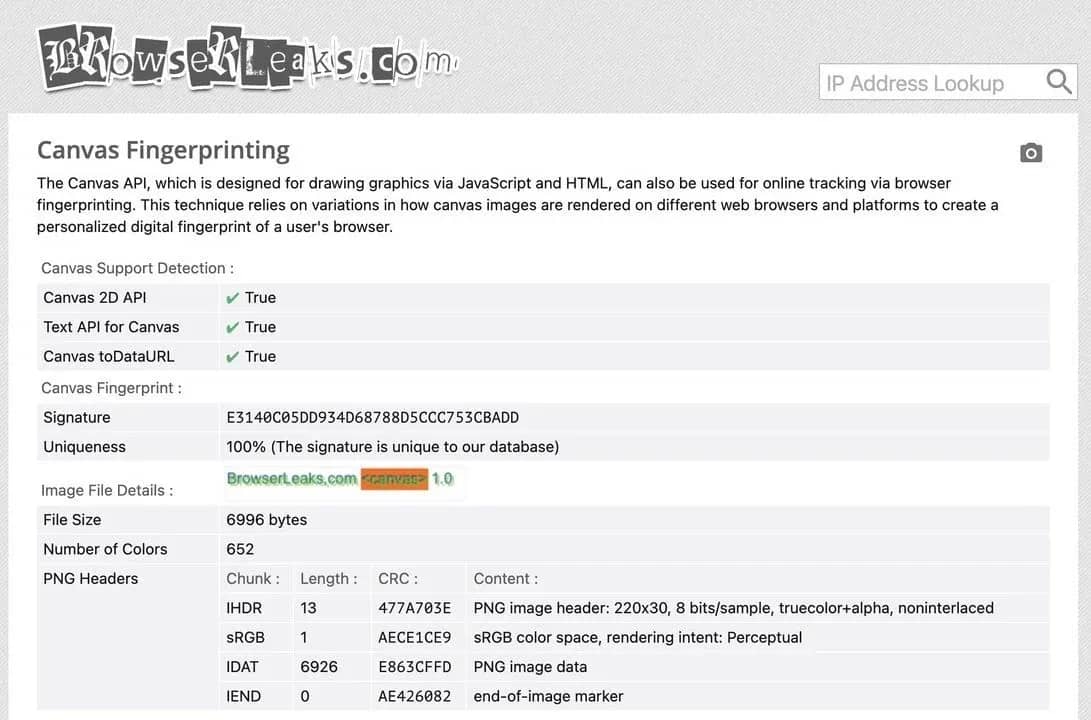
To see all the current parameters of your device, you can use a specialized service, of which there are dozens on the internet to choose from. Here are a couple of examples:
Conclusion
A browser fingerprint is a set of unique data specific to a particular user. Internet sites collect and use them for various purposes, from showing ads to blocking unwanted users. You can always check your fingerprint, and if necessary, hide it, and the most reliable solution to this problem will be an anti-detect browser.
Frequently asked questions
- Practice shows that more than 99% of users have unique fingerprints. There is a probability of a complete match of your fingerprint with another person, but it is negligible: statistics say that complete matches occur in approximately 1 in 286,777 cases.
- Some web resources do not track user data, but the share of those who do is growing every year. Advertising networks and marketplaces almost entirely track user fingerprints. And, unlike cookies, obtaining a fingerprint does not require your consent, so it is much more difficult to track. But there are specialized extensions — for example, Privacy Badger from EFF — with which you can track and block hidden data trackers.
- In 2026, JavaScript is the main tool of websites in terms of interactivity, animation, and functionality. By disabling this technology, you will largely protect your browser fingerprint from tracking, but you will not be able to use most modern internet resources.
- No. An encrypted tunnel between your device and the internet will replace the IP address and encrypt the traffic stream, but it will not change the vast majority of device parameters, and it will be recognized.
- This data set is not static: for example, updating the browser can change the User Agent and Canvas rendering. Moreover, you can trivially change the font of the device or connect a second monitor—and now your data has already changed. But creating a new fingerprint from scratch in this way is impractical: you can't keep up with all aspects, and some old characteristics will most likely still remain, so it is better to entrust the protection of your digital anonymity to an anti-detect browser.
Why Google Blocks Accounts and What Your Antidetect Has to Do With It
Google has once again complicated the mechanisms of digital identification by deploying a new, more sophisticated layer of protection based on proprietary HTTP headers. This quiet change caught most of the market off guard, triggering a wave of rushed updates. While others hastily released superficial 'fixes', we realized that we were dealing not with a minor issue but with a fundamental shift that required deep and comprehensive analysis.

The Best Alternative to OBS Studio
Working with a webcam on many online platforms can turn into a real challenge. A strict oval or rectangular frame appears on the screen, but your image doesn’t align perfectly with it. As a result, the system blocks further progress, demanding perfect alignment, and your workflow is disrupted before it even begins.

What is The Difference Between a VPN and a Proxy?
Let's figure out the differences between VPNs and proxies and how to choose the right one to protect your privacy.