
Top spy tools for ad arbitrage on Facebook, TikTok, Google, push notifications, and native ads
Updated: September 2026
Testing hypotheses in affiliate marketing and digital marketing blindly is the fastest way to drain your budget. Coming up with angles from scratch, ordering hundreds of creatives from designers, and launching tests across dozens of geos is simply too expensive. Manually browsing social media feeds via proxies does not solve the problem either: you only see a random, personalized sample rather than systematic market volumes. The situation is further complicated by the fact that there is no universal spy tool for all traffic sources.
In this guide, we will break down how spy services work, look at relevant solutions for specific traffic sources, compare current pricing plans, and provide a step-by-step algorithm for finding active, profitable funnels.
What is a spy service and how does it work
A spy service is a specialized platform that collects, structures, and analyzes competitors' active ad campaigns across designated traffic sources in real time. Simply put, it is a search engine for other people's advertising campaigns, legally allowing you to inspect creatives, ad copy, landing pages, and campaign run times.
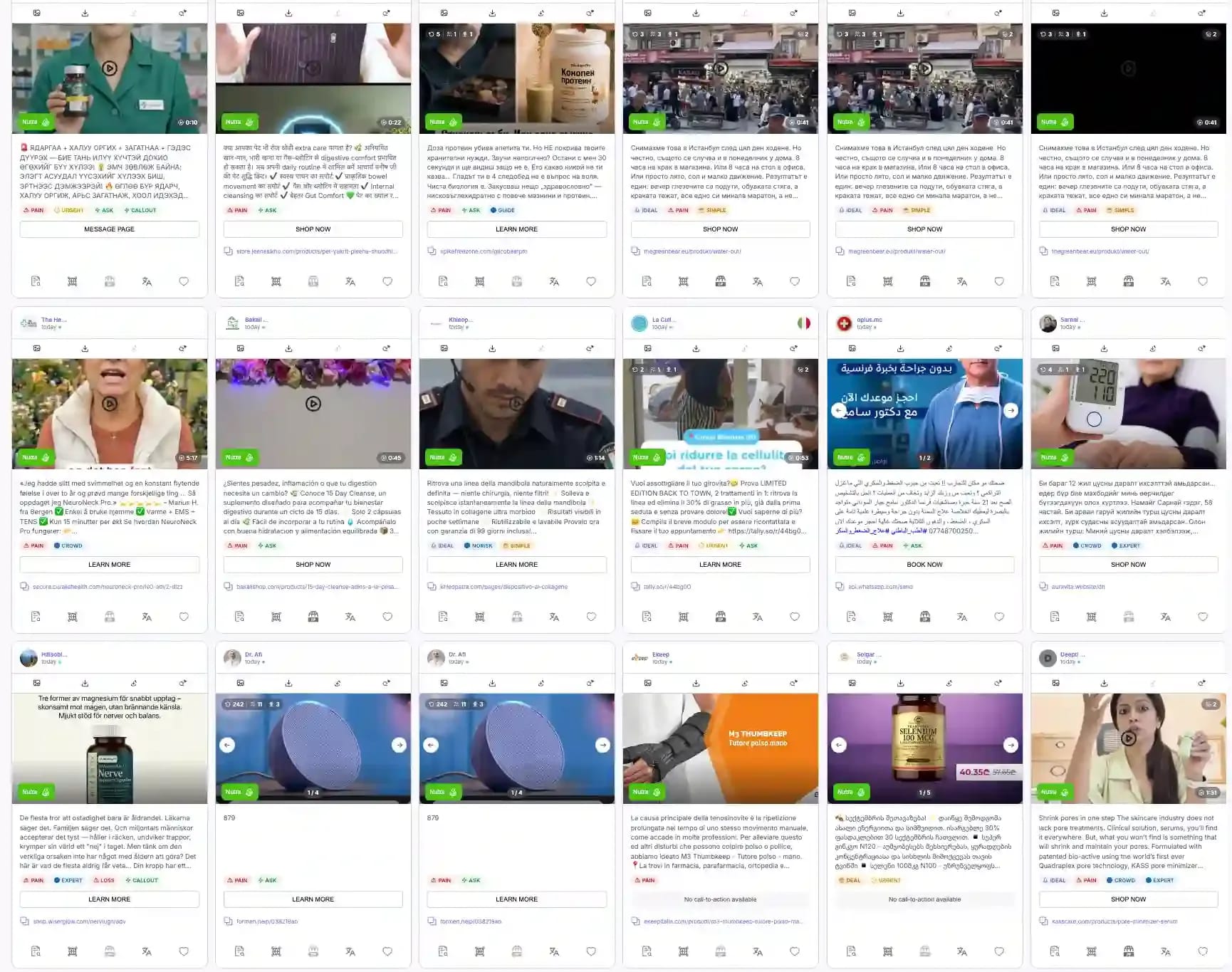
A spy service is an automated database equipped with a flexible filtering system: by country, language, device type, ad publish date, landing page domain, placement, and keywords.
Data collection mechanics are based on three components:
- Distributed farms of bots and emulated users. Services deploy thousands of isolated profiles with varied digital fingerprints, interests, and residential IP addresses in target countries. Bots scroll social media feeds, visit ad network partner websites, query search engine result pages, and intercept incoming push notifications.
- Network parsing and ad exchange inspection. In push, pop, and native ad networks, spy service parsers directly query ad exchanges, emulating clicks and transitions.
- Official APIs and public libraries. Part of the data is fetched directly from public repositories — Meta Ad Library, TikTok Creative Center, and Google Ads Transparency Center.
A spy service shows:
- high-quality graphic and video creatives with direct download capabilities;
- headlines, ad copy, and emojis used;
- target delivery geos, languages, ad formats, and operating system types;
- duration of continuous ad delivery and ad activity trends;
- destination page URLs (pre-landers, landers) and final redirect chains;
- employed funnels (including links to Telegram channels or mobile apps).
A spy service does NOT show:
- the real campaign budget, cost-per-click, or cost-per-mille;
- the actual number of completed conversions, deposits, and leads;
- the final funnel ROI and the net profit earned by the affiliate;
- campaign settings (selected custom audiences, pixel optimization settings, lookalike segments).
A spy tool reflects ad activity, but it does not guarantee financial success. An ad running for 1–2 days might just be someone else's failed, negative-ROI test.
Spy services are useful not only for finding winning combinations — although taking the structure of an approach proven by a long run time, adapting it to your requirements, and launching with a higher probability of turning a profit is a major benefit. Spy tools are also essential when you need to identify market trends, fresh offers, and emerging verticals. By tracking shifts in the creative database, you can discover new affiliate products before affiliate managers even feature them in digests.
Deconstructing a competitor's funnel reveals the complete audience warming logic, while regularly reviewing hundreds of creatives helps spark unique ideas and allows you to quickly write clear briefs for designers and copywriters.
The main takeaway is to keep the golden rule in mind: a spy tool is designed for borrowing ideas, angles, and concepts, not for blind copying. Re-uploading someone else's creative will not bring profit; instead, it will lead to an immediate ban for unoriginal content or a drained budget caused by audience fatigue.
Spy services for different traffic sources
Advertising platforms differ fundamentally in content delivery formats and moderation policies, which is why different traffic sources require different spy tools.
Facebook / Instagram (Meta Ads)
The most competitive segment with the fastest angle rotation.
- AdHeart. Historically one of the most popular and affordable monitoring services for Facebook and Instagram. The database contains over 900 million ads worldwide. Over 20 filter parameters are available (by text, domain zone, app, CTA button type, creation date, and running duration). It allows one-click downloading of original video assets and high-res previews. Subscription cost: from $69 per month.
- Tyver. A modern Meta ad monitoring service tailored for affiliate teams. In addition to standard filters by geo, placements, and dates, it features a built-in AI creative uniqueizer, text auto-translator, and redirect chain detection. A basic free plan with limited search queries is available; paid plans start at $79 per month.
- AdSpy. The largest English-language ad database for Facebook and Instagram. The service deeply indexes not only ad copy but also user comments, helping assess actual audience reactions to an offer. It supports searching by affiliate network and pixel integration type. Fixed pricing: $149 per month.
- Niche solutions: PowerAdSpy (from $69/mo), XSPY (from $49/mo), MTWSPY (from $70/mo). For high-risk verticals, specialized databases are used: SpyOwl (in-depth crypto offer monitoring, from $300/mo) and Gamler.io (a creative aggregator for gambling and betting with a free tier and an advanced PRO plan for $59/mo).
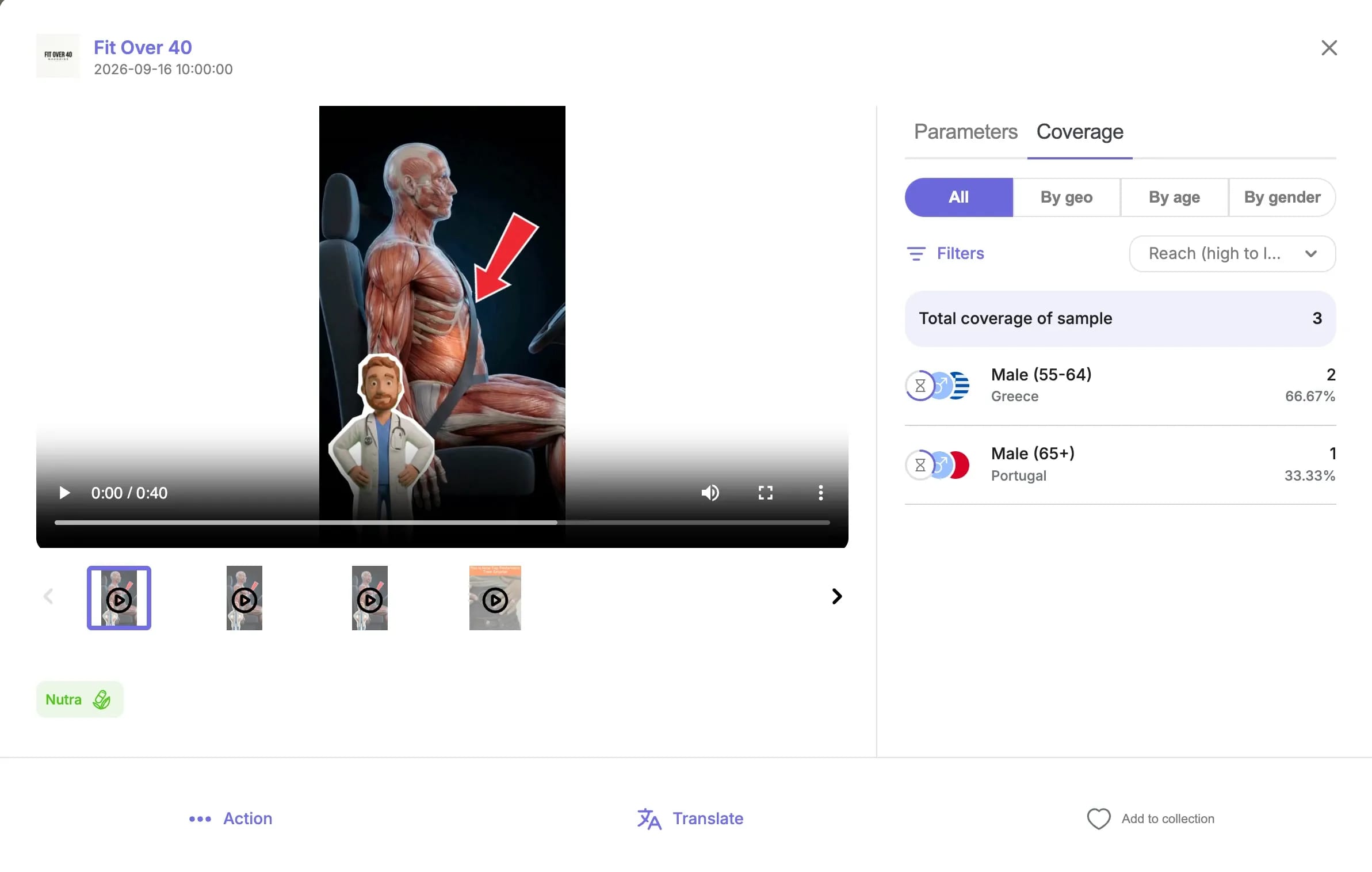
Spy services for Facebook: a selection of the best tools for media buyers.
TikTok Ads
TikTok requires constant video refreshes due to rapid creative fatigue.
- PiPiAds. The leader in TikTok ad monitoring. The platform indexes millions of video ads from TikTok Ads, as well as ads from related networks, including Meta. It delivers detailed analytics on impressions, estimated spend, engagement, trending music tracks, and top-selling E-commerce products. A built-in editor allows you to trim and adapt creatives. Plans start from $49 per month depending on search depth.
- BigSpy. A multi-platform spy tool covering TikTok, YouTube, Instagram, Facebook, and X. Useful for tracking global brand trends and cross-platform rollouts. Offers free access for 5 search queries per day. Paid plans start at $69 per month for solo users.
Native advertising and teaser networks
Native traffic relies on strong emotional hooks and long-form story-based pre-landers.
- AdPlexity Native. The recognized benchmark in the native advertising market. Monitors major international networks: Taboola, Outbrain, Yahoo Gemini, Revcontent, MGID. Enables tracking redirect chains, downloading landing page archives with all scripts intact, analyzing hidden landers, and bypassing basic cloaking. Module cost starts at $149 per month.
- Anstrex Native. The main competitor to AdPlexity with a budget-friendly pricing policy. Scans over 27 native networks across dozens of countries. Features a built-in WYSIWYG landing page editor, allowing you to edit a downloaded page and upload it directly to your server. Pricing starts at $79.99 per month.
- Alternative tools: Advault, Native Ad Buzz, and SpyOver (offers limited free samples and PRO access).
Push and In-Page networks
The nature of push traffic lies in the short lifecycle of the creative (headline, icon, and teaser image).
- SpyPush. A specialized spy service focused exclusively on push and in-page formats. Gathers data from more than 20 leading networks (RichAds, PropellerAds, PushGround, TacoLoco, etc.). Offers a Russian-language interface, along with quick sorting by impression volume and creative lifespan. Base plans start at $49 per month.
- Anstrex Push. A powerful push monitoring tool covering mobile and desktop networks. Supports searching by mobile carrier, device, browser, and affiliate network. Includes a pre-lander download option. Pricing starts from $89.99 per month (or available at a discount when bundled with Native).
- Additional tools: AdPlexity Push, Spy.House (a hybrid spy tool for Push, In-page, TikTok, and FB starting at $29 per month).
Pop / Popunder
In pop traffic, there are no creatives: the user lands directly on the target page.
- AdPlexity Pop and Anstrex Pops. These solutions analyze URL paths, landing pages, and user retention scripts across pop networks. They help you uncover high-performing landers for sweepstakes, utilities, VPNs, and software without burning budget testing hundreds of sources.
Mobile / In-app
Monitoring in-app and in-game ads served via mobile ad SDKs (Unity, AppLovin, ironSource, Vungle).
- AdMobiSpy. A mobile ad intelligence tool. Displays interstitials, playable ads, and rewarded video formats. Allows you to analyze app promotion trends across the App Store and Google Play. Pricing starts at $49 per month.
- AdPlexity Mobile. In-depth analysis of mobile web campaigns and in-app ads across all popular mobile carriers and geos.
Adult traffic
A highly profitable vertical with strict format and placement constraints.
- Spyteg. A dedicated adult ad intelligence platform. Scans major tube sites, adult networks, and video players. Enables analysis of banners, teasers, and landing pages for dating, webcam, and related offers. Subscription cost: from $149 per month.
- AdPlexity Adult. An enterprise-grade solution for working with adult ad networks, popunders, and native widgets on adult websites.
2026 Trend: Spy services for AI assistant advertising
In 2026, ad units began actively integrating into AI chats and conversational search engines. The first monitoring utilities (such as gptads.app and similar tools) are emerging on the market to capture sponsored ad placements, recommendations, and promotional prompts inside generative answers. This nascent segment is set to become a standard tool in media buyers' arsenals in the coming years.
Comparison table of top spy services
| Service | Primary traffic sources | Monthly price (September 2026) | Free access | Best for |
| AdHeart | Facebook, Instagram | From $69 | Demo search (limited) | Solo buyers and FB teams |
| Tyver | Facebook, Instagram | From $79 | Yes (basic plan) | Media buyers in gray and white-hat verticals |
| AdSpy | Facebook, Instagram | $149 | No (trial on request only) | Professional Tier-1 teams |
| PiPiAds | TikTok, Meta Ads | From $49 | Yes (limited credits) | E-commerce and TikTok affiliate marketing |
| BigSpy | Multi-platform (7+ networks) | From $69 | 5 queries per day | Beginners for general research |
| AdPlexity | Native, push, pop, mobile | From $149 per module | No | Pros in native and push networks |
| Anstrex | Native, push, pop | From $79.99 per modul | No | Network media buyers, E-com |
| AdMobiSpy | Mobile, In-App, Google Play | From $49 | Demo mode | Mobile buyers and app developers |
| SPY.HOUSE | FB, TikTok, push, In-page | From $29 | Free sample queries | Budget-conscious buyers across multiple networks |
Free spy services and official ad libraries
With a limited starting budget, you can get a baseline market overview without paid subscriptions:
- Meta Ad Library — the official open repository of all ads running across Meta platforms. Allows you to search campaigns by keywords or Fan Page names. Cons: no filtering by run time, no landing page downloads, and no performance analytics (except for social issue/political ads in the EU and US).
- TikTok Creative Center — the official TikTok trends portal. Showcases top-performing video ads broken down by region, industry, and engagement metrics (CTR, first-few-seconds retention). Does not allow downloading watermark-free raw video assets and hides affiliate redirect links.
- Google Ads Transparency Center — the official ad database for campaigns launched via the Google ad network. Great for verifying creative angles used by major brands and tracking video ad formats.
- Freemium plans from commercial platforms (BigSpy, Gamler, SpyOver) provide between 3 and 10 search queries per day with stripped-down results.
Free tools are useful for building creative intuition, checking specific brand activities, and formulating initial hypotheses. However, for systematic workflows, regular asset downloading, and tracking campaign lifespan, they fall short.
Step-by-step scenario for finding a winning funnel in a spy tool
To make a spy service turn a profit, stick to a structured operational workflow:
- Configure basic parameters. Select your target geo, ad language, and format — static banner, carousel, or video.
- Filter by run duration. This is your most critical analytical filter. Filter for ads that have been running continuously for 4–5 to 15 days. If an ad has been active for over a week, the buyer is profitable and scaling budget. Filter out ads that have run for only 1–2 days — in 80% of cases, these are unsuccessful tests. Selecting ads that are too old (running for over a month) is also risky: the angle may be completely saturated.
- Identify recurring patterns. Look for 5–10 similar ads from different advertisers utilizing the same angle — matching footage, similar headlines, or identical hooks. Pattern repetition confirms the presence of a working trend.
- Analyze the funnel. Click through the link in the ad. Examine the pre-lander: what news angle is used, what reviews are shown, how the persuasion flow is built. Download the landing page.
- Adaptation and uniqueization. Never copy the creative directly. Rewrite the headline, change the video hook, re-voice the video using AI audio tools, and clean all third-party analytics scripts and pixels from the downloaded lander.
- Launch your test. Deploy the adapted funnel on a conservative test budget and evaluate your own conversion performance.
Conclusion
A spy service in 2026 is not a magic money-making button; it is a foundational competitive intelligence tool. It prevents your budget from burning on unviable hypotheses and cuts funnel testing cycles down from weeks to a few days.
The optimal onboarding strategy: start your research with free official ad libraries, determine your primary traffic source, and subscribe to a single specialized paid tool. Before committing to an annual plan, test the platform's capabilities on a monthly subscription or take advantage of a trial period to verify the depth of the database for your specific niche. Better yet, check out our partners section, where you’ll find discounts on spy services.
Frequently asked questions
- It is an ad database with advanced search and filtering tools that aggregates and displays the creatives, copy, and landing pages currently used by competitors across various advertising networks.
- There is no single universal solution. For Facebook, AdHeart and Tyver are optimal; for TikTok, PiPiAds; for native and push networks, AdPlexity and Anstrex. The best choice depends strictly on your traffic source and budget.
- Yes, there are official ad repositories: Meta Ad Library, TikTok Creative Center, and Google Ads Transparency Center, as well as limited free plans in services like SPY.HOUSE and Gamler. However, they feature significant filter limitations and do not allow tracking campaign lifespan.
- Pricing ranges from $29 per month for budget-friendly tools up to $149 for specialized AdPlexity modules. Professional niche tools (e.g., crypto-focused) can cost upwards of $300 per month. Most services offer 20–40% discounts when billed annually.
- No. Services display ad impressions, approximate reach, geo, and run duration, but have no access to an advertiser's financial data or back-end conversion rates. Profitability is inferred indirectly through continuous run duration.
- The primary indicators are a continuous run duration between 4 and 14 days and the presence of multiple duplicates across different accounts. If an ad ran for less than 2 days, it likely failed to break even and was stopped.
- You cannot hide ads 100% because scraper bots continuously rotate user profiles and IP addresses. However, implementing robust cloaking, dynamic link parameters, and frequent visual hook rotation will reduce funnel visibility and buy you enough time to capitalize on the campaign.
Why Google Blocks Accounts and What Your Antidetect Has to Do With It
Google has once again complicated the mechanisms of digital identification by deploying a new, more sophisticated layer of protection based on proprietary HTTP headers. This quiet change caught most of the market off guard, triggering a wave of rushed updates. While others hastily released superficial 'fixes', we realized that we were dealing not with a minor issue but with a fundamental shift that required deep and comprehensive analysis.
SOCKS vs HTTP Proxy: What’s the Real Difference and Which One to Choose?
There are times when you don’t want a website to link the request back to your device. That’s where a proxy comes in, it acts like a middle layer and sends the request for you. The site sees the proxy’s info instead of yours. It’s a go-to trick when you’re trying to see a page that’s not available in your region, pull content that’s restricted by location, or avoid hitting a wall when sending lots of requests.
The Best Alternative to OBS Studio
Working with a webcam on many online platforms can turn into a real challenge. A strict oval or rectangular frame appears on the screen, but your image doesn’t align perfectly with it. As a result, the system blocks further progress, demanding perfect alignment, and your workflow is disrupted before it even begins.