Account Blocking on Bybit: How to Avoid Freezes and Protect Your Account
Updated: September 2026
In niche Telegram channels and crypto chats, panic has flared up again: the catalyst was news regarding a list of services and exchanges with which interaction leads to the immediate freezing of balances and addresses on Bybit. Users fear receiving a transfer that will turn their account into a "brick," while forum threads multiply with screenshots bearing the identical notification: "Your Bybit account has been temporarily restricted."
The main difficulty is uncertainty: the exchange does not immediately explain which exact transfer triggered the algorithm, support responds for days with generic boilerplates, and scammers are already trying to cash in on panicked users.
Let's break it down objectively: which platforms and transactions raise suspicion at Bybit, how to determine the reason for a restriction, how to protect your balance from unexpected limits, and what to do if your funds are already locked up.
What is happening with Bybit account freezes: event digest
What many perceive as sudden nitpicking targeted at individual users is, in reality, a systematic tightening of screws across the entire crypto market. Exchanges are adapting to regulatory mandates by rolling out increasingly stringent wallet verification algorithms.
| Period | Event | What it means for the user |
| March 2026 | Deployment of deep on-chain analysis | Audits of historical transactions began. If your wallet accidentally received crypto a year ago that passed through a dubious mixer or exchange, the system now detects it and places a hold |
| April – May 2026 | Coordinated regulatory reviews | According to analyst estimates, a total of over $16 million was frozen across Bybit, Binance, and Bitget for detailed inquiries into the sources of funds |
| May 24–26, 2026 | The EU's 20th sanctions package and expansion of UK lists | Direct prohibition on interacting with infrastructure and services associated with sanctions lists and designated persons |
| Summer 2026 | Scoring model updates across | Chainalysis and Elliptic Algorithms became stricter: while several "degrees of separation" from a dubious service were previously tolerated, now even a distant link elevates ban risk |
| September 1, 2026 | Update to the list of jurisdictions and compliance policies | Bybit updated its roster of restricted countries and tightened scrutiny over counterparties through which crypto enters the exchange |
The conclusion is simple: account freezes are not a one-time campaign or an accidental glitch, but the new normal. Therefore, the security of your account must be built proactively, without waiting for an unwelcome notification.
Bybit's official Restricted Counterparty List
Bybit maintains a regulatory document — the official Restricted Counterparty List. This is an inventory of platforms, exchanges, payment gateways, and protocols with which any transactions are prohibited by internal platform rules. A wallet entering a transaction chain with these services guarantees an immediate security trigger:
- Sanctioned and unregulated platforms — any services subject to direct restrictions by OFAC, the European Union, or the United Kingdom. This includes Garantex, Suex, Chatex, and several other platforms categorized as high-risk.
- Mixers and anonymization protocols — addresses associated with Tornado Cash, Blender.io, Sinbad, and similar smart contracts. Even if you utilized a mixer "for privacy reasons" two years ago, the algorithm will tag the address with a toxic label.
- Darknet marketplaces and scam resources — addresses implicated in raising funds for phishing sites, ransomware, or illicit trading venues.
- Unlicensed P2P and crypto exchange desks lacking AML controls — platforms that disregard customer identification and process arbitrary volumes of cash without verifying sources.
If you send crypto to Bybit directly from a service on this list, or receive funds into an external wallet and subsequently forward them to the exchange without sanitization, the account automatically undergoes a rigorous compliance audit.
What "Your Bybit account has been temporarily restricted" means
When the exchange restricts account actions, a templated text arrives via email and the application: "Your Bybit account has been temporarily restricted." This is an umbrella phrase that can conceal anything from a trivial request to refresh a selfie to a full-blown investigation by the compliance department.
What the system statuses actually signify:
- Under Review / Risk Control — an automated risk filter was triggered. This typically occurs during a suspicious deposit, an attempt to rapidly withdraw the entire balance to zero, or a sharp surge in trading volume. The deposit is held pending manual review by an agent.
- Security Verification — a temporary hold designed to protect against unauthorized access. It activates if you sign in from a new browser, reset a password, change 2FA, or connect a new device. Withdrawals are generally blocked for 24 hours.
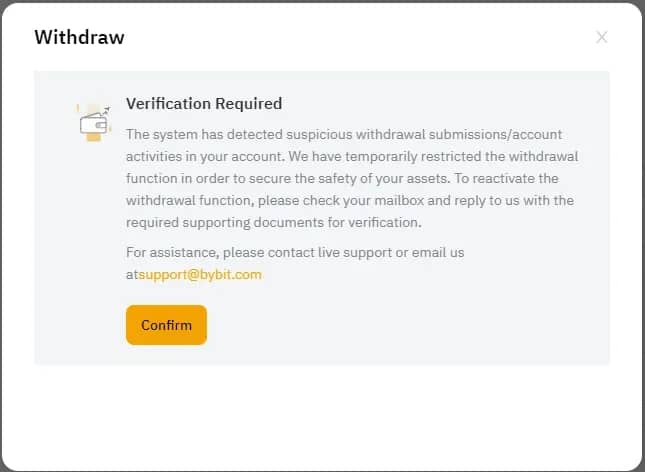
- Withdrawal Restricted — withdrawals are shut down, but trading within the terminal remains active. This indicates that an issue arose regarding a specific transaction or that KYC documents are missing, though internal trading functionality has not yet been severed.
Do not attempt to guess the severity of the situation from the opening lines of a system email. The real situation can only be discerned through support, once an agent specifies the concrete reason or requests documentation.
To avoid chaotic actions and preventable mistakes, identify immediately which tier of restriction your account currently occupies.
| Tier | How it looks in the dashboard | What is disabled | What support requests | Resolution timeline |
| Verification request | Banner in profile requesting data confirmation | Withdrawals exceeding base limit, P2P transactions. Trading is active | Fresh passport, selfie, bank statement or utility bill not older than 90 days | 1–3 days |
| Withdrawal freeze | Shows Withdrawal failed when attempting to withdraw. Balance remains visible | Withdrawal of cryptocurrency and fiat to external wallets | Information regarding a specific incoming transaction, screenshot of sender wallet | 3–7 business days |
| AML-related block | Cannot place orders, balance is inaccessible, orders canceled | Complete stop: neither trading nor withdrawals permitted | Proof of funds documentation: tax returns, contracts, account statements | 2–4 weeks |
| Sanctions block | Error upon login Account suspended, dashboard access denied | Full account termination without interface access | Official responses via legal counsel or account closure per protocol | From several months to permanent closure |
For quick self-diagnostics, answer two questions: is trading accessible, and what precise documents did support request (a routine selfie with an ID, or an exhaustive six-month income trail).
Why Bybit freezes accounts
Direct links to the Restricted Counterparty List and elevated Risk Score
Prior to crediting funds, the exchange runs incoming transaction hashes through automated AML databases. If a transaction originates from a sanctioned venue, mixer, or unverified exchange platform, the system halts the deposit immediately. The tolerance threshold for sanctions tags is minimal: a 3–5% link within the transaction graph is sufficient to trigger a stop signal.
Historical links and retroactive audits of legacy transfers
An unpleasant surprise: audits are not confined exclusively to recent transfers. If you received USDT on the Tron network from an acquaintance a year ago, and today their wallet address lands on a sanctions or darknet registry, the system recalculates that history retroactively. The result is an unexpected demand to account for a legacy transaction.
Source of Wealth inquiries on substantial sums
If you deposit a substantial amount or your trading turnover escalates sharply, the exchange is obligated under international standards to verify the origin of capital. You will need to prove that these are legitimate personal assets rather than an attempt to launder funds.
"Dirty" crypto from P2P and gray-market exchange services
Purchasing USDT from unvetted P2P counterparties or over-the-counter physical cash desks without compliance checks exposes you to coins tainted by hacks, scams, or gambling platforms. Alongside the coins, you inherit their illicit history, which instantly contaminates your personal deposit address on Bybit.
P2P disputes, "triangle" schemes, and banking complaints
Within the P2P section, restrictions frequently stem from fiat-side complications. If a counterparty sends funds from a drop card, a bank flags the payment, or a buyer files a fraud chargeback with their bank post-trade, Bybit will freeze the trade amount or the entire account balance pending the outcome of an investigation.
Suspicious account behavior
Logging in from disparate IP addresses within short intervals, withdrawing all funds immediately within minutes of depositing, structuring transfers into small batches to bypass thresholds, or operating multiple accounts from a single browser.
The freeze is always initiated by an automated algorithm. The bot disregards how long you have held the account or your VIP tier: if the risk index breaches acceptable thresholds, the account enters a freeze automatically.
How to avoid restrictions: account protection checklist
Adhering to straightforward hygiene rules mitigates 95% of potential compliance pitfalls.
- Do not store all funds on the exchange. An exchange is an operational platform for trades and conversions, not a vault. Keep long-term reserves in your own non-custodial or hardware wallets.
- Screen wallets through AML tools. Before accepting crypto from a counterparty or routing it to the exchange, evaluate the address via AMLBot, AMLSEC, or Crystal. If the risk level exceeds 25–30% or flags for Sanctions / Darknet / Mixer appear, sending those assets to Bybit is out of the question.
- Utilize an intermediate buffer wallet. Do not transfer funds directly from unvetted exchange desks straight to a Bybit deposit address. First move them to your private non-custodial address, audit the transaction for purity, and only then route the operational volume to the exchange.
- Enforce discipline in P2P trading. Select merchants with a history of at least 500 completed trades and an execution rate of 98% or higher. Never accept third-party payments: the sender name on the bank transfer confirmation must correspond character-for-character with the legal name on the Bybit profile. Dedicate a segregated bank card to P2P trades and consistently archive payment receipts.
- Do not jump between geographic locations. The core flaw of mainstream VPN services is dynamic IP rotation. Connecting via Frankfurt today, reconnecting via the Netherlands two hours later, and showing an IP in Singapore or the United States by evening (jurisdictions strictly prohibited on Bybit) will be flagged. To an exchange security system, this appears as an account takeover: the infrastructure assumes the profile has been breached and applies a 24–72 hour security hold. In such cases, an anti-detect browser paired with a dedicated static residential proxy from the required country helps significantly. Every time you launch the profile, you maintain an identical home IP, consistent time zone, matching system clock, and stable WebRTC without leakages.
- Enable all protection layers. Configure Google Authenticator (eliminate insecure SMS verifications), activate an anti-phishing code in security settings, and turn on the withdrawal address whitelist.
- Prepare documentation ahead of time. Compile tax declarations, freelance agreements, bank statements covering recent months, and screenshots of realized profit records from external platforms into a secure folder. Should compliance request proof of income, you can reply within hours rather than assembling paperwork for weeks.
What to do if an account is already restricted
If a restriction notice has already arrived, the vital rule is to avoid panic and refrain from erratic actions.
Step 1. Take screenshots of all available data
Preserve current state evidence immediately: capture screenshots of balances across all sub-accounts (spot, derivatives, earn), logs of recent deposits and withdrawals, and active positions. Record the transaction hashes (TXIDs) of recent transfers, the precise timestamp when restrictions were imposed, and the ticket Case ID in a separate document.
Step 2. Request concrete specifics from support
Do not draft lengthy, emotional messages filled with threats or complaints. Submit a concise, polite, and clearly structured inquiry:
"Hello. My account UID [your_number] has been temporarily restricted. Please clarify:
- Which specific transaction (TXID) or operation triggered this review?
- What is the explicit regulatory reason for the restrictions?
- What documentation must be provided to clear the hold successfully?"
Step 3. Audit the disputed transaction independently
Once support specifies the TXID of the problematic transfer, run it through an independent AML screener and download the comprehensive analysis report in PDF format. You must independently ascertain where the algorithm identified illicit exposure: whether it was a direct transfer from a prohibited venue or an indirect trace via third-party hops. This informs how to calibrate your response.
Step 4. Assemble documentation tailored to your scenario
Trading — historical order records from alternative exchanges establishing that the crypto was generated via trading operations.
Salary or freelance — contractual agreements with an employer or client, service acceptance certificates, invoices indicating your payout wallet, and corroborating bank statements.
Savings — official income certificates (tax declarations) and bank statements evidencing that you maintain documented, legitimate fiat income to acquire crypto assets.
P2P trades — banking statements for the card used, exhaustive screenshots of the order chat on the exchange, and transaction payment receipts.
Step 5. Submit a structured appeal
Convert all documentation into legible PDF format. Adopt intuitive English filenames (01_Bank_statement_2026.pdf, 02_Contract_freelance.pdf). In the cover communication, outline a coherent trail of the capital: how it originated in fiat, how it was converted, why it was transferred to Bybit, and that you are a bona fide owner acting in good faith.
Expected response timeframes:
- 24–48 hours — resolution of minor technical issues and baseline KYC inquiries;
- 5–7 business days — standard response turnaround for a compliance officer managing an active ticket;
- up to 30 days — comprehensive AML audit involving intricate transaction chains;
- over 30 days — escalation required via official outreach channels or legal counsel.
Panicking users frequently make missteps that convert a temporary hold into a permanent ban. Actions to avoid entirely:
- Spamming dozens of duplicate tickets. Every new submission resets your queue placement in helpdesk systems back to the end. Furthermore, multiple first-line agents may issue conflicting guidance, complicating the audit.
- Opening a secondary account to withdraw funds. Creating a new profile registered to a family member or acquaintance to siphon off locked funds via internal transfers is classified by fraud prevention systems as evasion. The outcome is a permanent ban on both accounts without the right to appeal.
- Submitting manipulated documentation. Editing statements in graphic software is fatal. Compliance teams inspect file metadata and cross-verify records against interbank verification channels. Falsified records trigger an immediate, irreversible lifetime ban.
Scammers targeting frozen accounts: how illicit "recovery agents" operate
The moment you post about your issue in public exchange communities, self-proclaimed "asset recovery specialists" will flood your private messages.
Obvious indicators of fraud:
- "I have an inside contact in Bybit compliance." Complete fabrication. Restriction determinations are rendered collectively by automated risk systems and senior compliance officers; no insider possesses a unilateral manual toggle.
- Requests for passwords, 2FA credentials, or seed phrases. No legitimate legal advisor or exchange employee will ever ask for credentials or authentication codes. This is an attempt to drain whatever liquid assets remain untouched.
- Demands to deposit an "unfreezing fee." You are told that releasing the hold requires crediting an additional 20% of the stuck balance from a "clean" wallet. The exchange never demands fees or deposits to clear restrictions.
Legitimate legal support follows an entirely different framework: formal engagement contracts with vetted counsel, submissions via official pre-litigation notices, and compensation based on milestones without relinquishing account access credentials.
How to withdraw assets under restrictions
If an account is subject to partial limits, proceed with caution.
If external withdrawals remain functional, systematically migrate assets to your private non-custodial wallet. Initiate the process with a nominal test transaction. Prioritize established base layer networks (Bitcoin, Ethereum, Arbitrum) and avoid attempting to sweep the entire balance in one single second.
If external withdrawals are disabled, attempting to liquidate the entire crypto balance via the internal P2P module to obtain fiat will be interpreted by risk scoring as an urgent liquidation of compromised capital. This immediately escalates your case to a comprehensive account freeze.
Under a total lock, the only viable course of action is awaiting formal updates within the support ticket and sequentially delivering requested compliance documents. No alternative workarounds exist.
Conclusion
A funds freeze on Bybit is an inconvenient but, in the majority of cases, solvable operational event. If the cryptocurrency has a legitimate economic background and you avoid panic, addressing support with verified facts and formal documents yields a high probability of successfully removing all restrictions.
Frequently asked questions
- Baseline KYC and operational security checks are resolved within 1–3 days. Comprehensive inquiries into the source of funds and intricate transaction histories span from one to four weeks.
- No, pending the conclusion of the compliance review, withdrawals are technically disabled. Neither front-line chat support nor third-party services can bypass this protocol lock.
- It is preferable to utilize an anti-detect browser paired with a dedicated static IP address. Frequent country switching across free commercial VPNs can trigger automated account takeover alarms. Strictly avoid establishing connections through nodes in the United States, Canada, and Singapore (jurisdictions expressly restricted by Bybit).
- Employ external analytics tools (AMLBot, AMLSEC, etc.). Input the sender wallet address and review the diagnostic report. If the platform flags an elevated risk score or direct connections to prohibited counterparties, you must not proceed with depositing to the exchange.
- Do not open duplicate tickets. Post a polite follow-up message in the existing ticket thread requesting a status update, or reach out to Bybit's verified official handle on X citing your Case ID.
- If compliance renders a final determination to terminate the terms of service (Permanent Suspension), reinstating the account for further trading is impossible. In such scenarios, the user is typically allocated a designated operational window to execute a one-time withdrawal of verified clean residual balances to an external address, following which the profile is deactivated permanently.

Why Google Blocks Accounts and What Your Antidetect Has to Do With It
Google has once again complicated the mechanisms of digital identification by deploying a new, more sophisticated layer of protection based on proprietary HTTP headers. This quiet change caught most of the market off guard, triggering a wave of rushed updates. While others hastily released superficial 'fixes', we realized that we were dealing not with a minor issue but with a fundamental shift that required deep and comprehensive analysis.

SOCKS vs HTTP Proxy: What’s the Real Difference and Which One to Choose?
There are times when you don’t want a website to link the request back to your device. That’s where a proxy comes in, it acts like a middle layer and sends the request for you. The site sees the proxy’s info instead of yours. It’s a go-to trick when you’re trying to see a page that’s not available in your region, pull content that’s restricted by location, or avoid hitting a wall when sending lots of requests.

The Best Alternative to OBS Studio
Working with a webcam on many online platforms can turn into a real challenge. A strict oval or rectangular frame appears on the screen, but your image doesn’t align perfectly with it. As a result, the system blocks further progress, demanding perfect alignment, and your workflow is disrupted before it even begins.