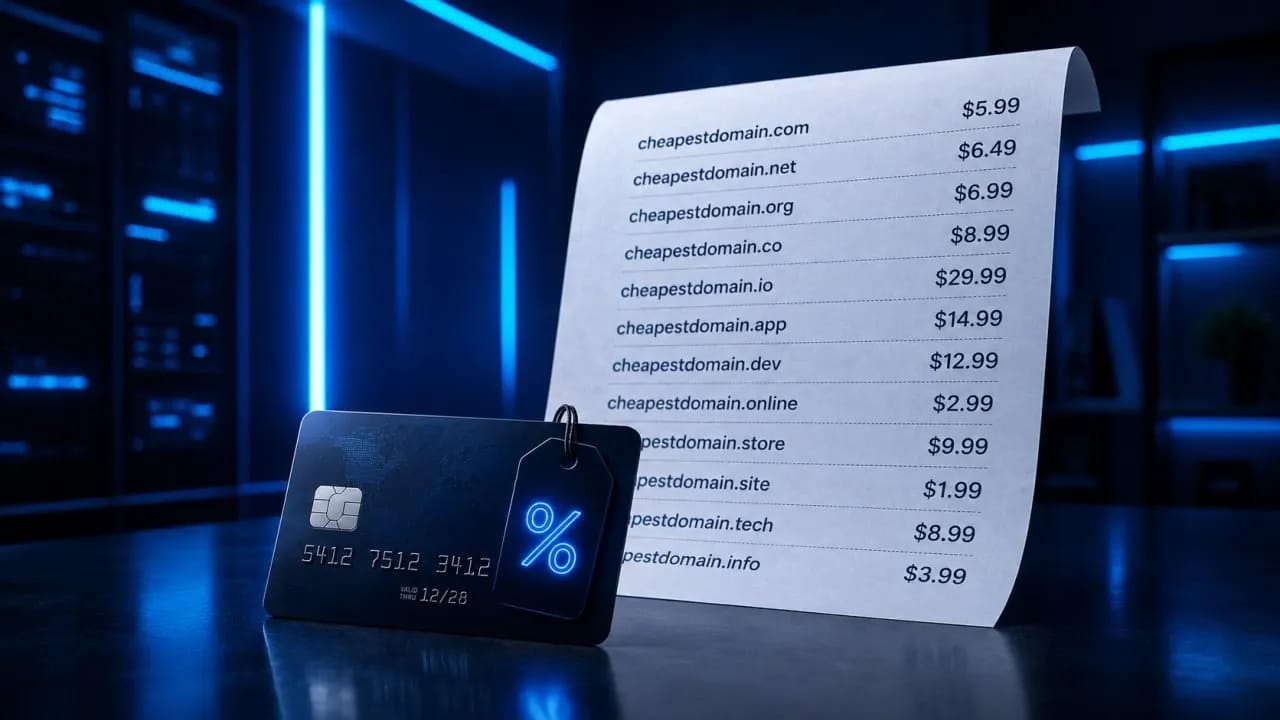
Cheap Domain vs. Cheap Renewal: Which Is Better and How to Avoid Overpaying
Registered a domain for $1, and a year later got an invoice for $20 for renewal? A story nearly every webmaster or business owner has gone through. A catchy banner offering "Domain for just $1" seems like a great way to save money, but after 12 months, the registrar presents a renewal bill exceeding the initial price by 5, 10, or even 15 times.
It all comes down to the mechanics of the domain business. Registrars heavily engage in price dumping, as their primary goal is to acquire the customer and lock them into their platform. They know very well: once the website launches, starts receiving traffic, and accumulates backlinks, it becomes psychologically and technically difficult for the owner to abandon the domain name. That is the exact moment when the core monetization kicks in.
To avoid falling into this financial trap, you need to choose a domain based on the Total Cost of Ownership (TCO) rather than an attractive initial price tag. In this article, we will:
- Analyze the mechanics of registrar pricing in detail;
- Calculate which strategy is more profitable over time;
- Share working methods for cheap domain renewal.
Let's dive in!
Why Domain Renewal is More Expensive Than Registration
The "first year on promotion" marketing model is standard for most major registrars. The entry price is artificially suppressed: the registrar intentionally operates at a loss on the initial sale, planning to offset costs and generate a margin in subsequent years through high renewal rates.
What makes up the final price of a domain:
- Registry base rate (wholesale price). Each domain zone registry (for instance, country-code TLD registries or companies like Verisign for .COM) sets a fixed wholesale cost for registration and renewal for all accredited registrars.
- Registrar margin. The company's markup for account servicing, providing DNS servers, technical support, and the control panel.
- Payment processing and acquiring fees. Transaction costs, which are frequently factored into the final tariff.
Renewal prices do not stay static and grow annually. This is driven by regular wholesale rate increases by the registries themselves (for example, ICANN and Verisign regularly adjust the cost of .COM upward), currency fluctuations, and global inflation.
An additional overpayment factor comes from hidden or automatically enabled add-ons. Registrars often quietly append auto-renewals for premium DNS, advanced SSL protection, WHOIS privacy (in zones where it is paid), or SMS notifications to the final invoice. If you do not uncheck these extra options in the cart, a standard renewal bill increases by another $3–10.
Cheap Domain: When a Low Registration Price is Actually Beneficial
It cannot be said that promotions with $1–2 registrations are always bad. There are scenarios where purchasing a cheap domain completely justifies itself:
- Test and technical environments. If you need an address for debugging scripts, testing new layouts, or deploying a prototype.
- One-time promo pages and events. Landing pages for specific events, seasonal sales, or short-term ad campaigns that lose relevance in 2–3 months.
- PBN networks, satellites, and media buying setups. In industries where domains are treated as consumables and live anywhere from a few weeks to a few months before getting banned or exhausting the campaign's lifespan.
- Hypotheses and startup experiments. When testing demand for a new niche and there is a high probability of abandoning the idea if it fails to gain traction in the first few months.
The main rule: if a project is guaranteed to live less than 12 months, saving on registration is fully justified. You do not care about the renewal cost in this case, as nobody plans to renew the domain.
The primary risk of this strategy is forgetting to disable auto-renewal in time or leaving a payment card linked, which might be charged the full renewal amount for a "disposable" domain a year later without advance warning.
When Cheap Renewal Takes Priority
If you are launching a long-term project, priorities change. In this case, you must focus on the renewal cost:
- Brand websites and commercial projects. An e-commerce store, corporate website, information portal, or SaaS service is built to last for years. Over 5–10 years of operation, initial registration costs will account for less than 2–5% of the total domain expenditure, while the remaining 95–98% goes strictly to renewals.
- Domain portfolios. If a webmaster or investor holds 20, 50, or 100 domains on their balance, a price difference of just $3–4 per renewal turns into an annual overpayment of $150–400.
- SEO value and history. For search engines, domain age and accumulated backlink profile are critical ranking factors. Losing an established domain due to an inflated renewal price or letting it drop to an auction is a critical error capable of destroying a business.
For any active, long-term project, the renewal price is always more important than the promotional registration price.
Crunching the Numbers: Total Cost of Ownership Over 5 Years
To clearly visualize the difference, let's use the concept of Total Cost of Ownership (TCO).
TCO = Registration Price + (Renewal Price × (n − 1)) + Add-ons + Fees
where n is the number of years of ownership.
Example 1: Standard Domain Zone (Promotional Registrar vs Transparent Registrar)
Registrar A: Registration = $2, Renewal = $20/year.
- TCO for 1 year = $2
- TCO for 3 years = $2 + ($20 x 2) = $42
- TCO for 5 years = $2 + ($20 x 4) = $82
Registrar B: Registration = $11, Renewal = $11/year.
- TCO for 1 year = $11
- TCO for 3 years = $11 + ($11 x 2) = $33
- TCO for 5 years = $11 + ($11 x 4) = $55
Over a 5-year period, the "cheap" domain with a $2 entry price ends up costing the owner significantly more ($82 versus $55).
Example 2: New gTLD Zones (.SITE, .ONLINE, .STORE)
Many new thematic zones attract users with ultra-cheap registration but carry astronomical renewal fees:
- Registration .STORE = $2
- Renewal .STORE = $36/year
- TCO for 5 years = $2 + ($36 \times 4) = $146 for a single domain
Example 3: International .COM Zone
High-margin registrar:
- Registration = $10
- Renewal = $30/year
- TCO (5 years) = $10 + ($30 \times 4) = $130
Low-margin registrar:
- Registration = $16
- Renewal = $18/year
- TCO (5 years) = $16 + ($18 \times 4) = $88
Domain Zone Traps: Where Renewal is Most Expensive
Many new thematic zones use aggressive marketing: registration in the first year costs between $0.99 and $3, but starting from the second year, the price jumps to $30–70. If you are launching a long-term project, such a "discount" will turn into substantial overpayments.
Zones with the highest gap ratio between the first year and subsequent renewal:
| Domain Zone | Average Registration Price (1st year)* | Average Renewal Price (from 2nd year | Gap Ratio |
| .STORE | $0.99 – $1.99 | $44.00 – $67.00 | 25–45x |
| .ONLINE / .SITE | $0.99 – $2.88 | $32.00 – $44.0 | 15–30x |
| .TECH | $2.99 – $9.99 | $58.00 – $78.00 | 8–15x |
| .HOST | $1.98 – $9.99 | $47.00 – $109.00 | 10–25x |
| .ART / .BEAUTY | $3.99 – $5.0 | $32.00 – $40.00 | 7–10x |
| .LIVE / .FUN / .SPACE | $0.98 – $3.98 | $32.00 – $48.00 | 10–20x |
* Registration prices reflect standard promo discounts for new customers at major registrars.
Zones with Honest and Stable Pricing
Traditional domain zones (.COM, .NET, .ORG), as well as certain regional zones (.DE, .UK, .EU), do not use marketing traps. The initial purchase price and the renewal price are nearly identical (the difference is usually no more than $1–3 depending on the registrar's margin):
- .COM: registration ~$9–$11 / renewal ~$10–$14
- .ORG: registration ~$7–$10 / renewal ~$10–$13
- .DE / .UK: registration ~$3–$7 / renewal ~$5–$10
Premium Domains
An inverse situation also exists: a short or memorable name is sold by the registry as "premium" for $100–5,000 in the first year, while standard renewal from the second year costs a regular $10–15. However, be cautious: in some new gTLDs (such as .AI or rare niche zones), the Premium status applies to the annual renewal as well.
How to Check the Renewal Price Before Buying
Registrars frequently mask renewal costs behind fine print or hidden footnotes. To avoid falling into a trap:
- Look for a link to the "Full TLD Price List" or "Renewal Pricing" on the registrar's website before adding the domain to your cart.
- Use independent comparison platforms and renewal trackers: TLD-List, Query.Domains, or TLDPrice.
Registrar Comparison: Who is Truly Cheaper Over Time
Data in the table is collected and updated as of July 2026 (sourced from TLD-List and DomainDetails).
| Registrar | .COM Registration | .COM Renewal | .NET / .ORG Renewal | WHOIS Privacy | Transfer Cost (.COM)* | Features and Pitfalls |
| Spaceship | $4.99 – $5.48 | $9.98 – $10.18 | $12.48 / $12.48 | Free | $8.17 – $9.68 | Namecheap's subsidiary project offering some of the lowest renewal prices below wholesale |
| Cloudflare Registrar | N/A (transfer only) | $10.44 | $11.84 / $11.74 | Free | $10.44 | Sold strictly at registry cost (At-Cost). Requires using Cloudflare DNS |
| Dynadot | $10.88 | $10.88 | $12.88 / $12.88 | Free | $10.88 | Fixed flat pricing without marketing tricks or hidden markups |
| Porkbun | $10.99 | $10.99 | $12.99 / $12.99 | Free | $9.74 – $10.99 | High trust score, free phone support, and full transparency |
| NameSilo | $10.99 | $10.99 | $12.99 / $12.99 | Free | $10.99 | Bulk discounts (50+ domains permanently reduce the price to $9.89/year) |
| Namecheap | $5.98 – $6.99 | $13.98 – $18.48 | $18.58 / $18.98 | Free | $11.68 – $15.18 | Popular registrar, but renewal is noticeably higher than competitors |
| IONOS | $1.00 | $20.00 | $20.00 / $20.00 | Free | $17.00 | Classic "promo trap": attracts with a $1 entry price, then raises the rate by 20x |
| GoDaddy | $0.99 (promo) | $21.99 – $23.98 | $23.99 / $23.99 | Free | $11.99 | Most expensive renewal on the market; forced add-on services during checkout |
* In international zones (.COM, .NET, .ORG), transfer payment always includes a +1 year domain extension added to the current expiry date.
If you manage a portfolio of 20, 50, or 100+ domains, retail prices can be reduced significantly:
- NameSilo allows you to automatically receive a discount down to $9.89 for .COM renewal upon reaching 100+ domains on your account.
- Dynadot offers VIP tiers for bulk buyers featuring a dedicated API and account manager.
- Resellers and control panels — platforms like Openprovider or LogicBoxes — offer wholesale rates for agencies and web studios.
Disclaimer: ICANN registry operators periodically index base rates (for example, Verisign regularly increases .COM prices). The presented data is current as of July 2026. Always check the active pricing matrix on the official websites of registrars prior to making payments.
8 Ways to Renew a Domain Cheaply
- Transfer to a registrar with lower rates. If your current registrar inflates renewal costs, request an Auth-Code and transfer the domain to another provider. In .COM zones, transfers are paid, but the fee always includes an additional +1 year of renewal added to your registration.
- Renewing for multiple years at once. In international domain zones (.COM, .NET, .ORG), you are permitted to extend a domain name up to 10 years in advance. This allows you to lock in current pricing and protect yourself against currency fluctuations and annual registry price increases.
- Tracking promo codes and sales. Major events such as Black Friday, New Year sales, or company anniversary sales are accompanied by renewal promo codes offering 20–40% discounts.
- Upgrading to partner/wholesale status. If you have accumulated more than 5–10 domains in a single account, contact support to request a partner rate. Most platforms accommodate users by lowering the renewal fee.
- Free renewal bundled with hosting. If your website is hosted on paid shared hosting or a VPS, many providers offer bonuses when paying for an annual plan — such as promo codes for free renewal of 1–2 domains.
- Cleaning the invoice from forced add-ons. When generating a renewal invoice, carefully inspect the line items: disable paid SMS notifications, automatically added SSL certificates, and third-party DNS modules.
- Selecting an "honest" zone at launch. Give preference to TLDs where the renewal cost is inherently equal to or close to the registration cost.
- Planned monitoring and timely transfers. Start preparing for renewal 30–45 days before the delegation expiration date. Domain transfers in international zones can take up to 10–14 days, making last-minute transfers right before expiry risky.
Conclusion
Cheap domain registration is ideal for short-term needs: temporary promo pages, testing hypotheses, or specialized media buying tasks. In these cases, minimizing upfront costs is completely justified. However, for any full-fledged website, blog, commercial, or brand project, a cheap renewal rate is always more important than a low starting price. Buying an address for $1 followed by a $30 renewal is a direct overpayment over a 3–5 year period.
Calculate the Total Cost of Ownership, do not hesitate to switch registrars via transfer when faced with unreasonable price hikes, and regularly audit your domain assets.
Frequently asked questions
- Because selling a domain at a reduced initial price is a customer acquisition method. The registrar sells you the registration at a promotional rate (sometimes at a loss to themselves) and bakes their primary profit margin into the cost of subsequent annual renewals.
- Yes. The most effective way is to switch registrars by executing a domain transfer to a company with lower renewal rates. In most zones, this process is seamless and does not cause website downtime. You can also search for promo codes or request a discount from your current service's support team.
- From a financial perspective, purchasing a new name for the first time is almost always cheaper than renewing an old one. However, from an SEO and business perspective, abandoning an old domain is unprofitable: you will lose website history, search engine rankings, indexed pages, returning visitors, and backlink authority. Rebuilding these metrics will cost tens of times more than the renewal fee.
- It is optimal to renew a domain 10–30 days prior to the delegation expiration date. With a standard renewal at the same registrar, unused days do not expire: the new paid year is simply added to the current expiration date.
- Laws and domain registry regulations strictly govern transactions. Once a renewal procedure has been officially submitted to the registry, the service is considered fully rendered, and it is impossible to refund money for the paid period.

Why Google Blocks Accounts and What Your Antidetect Has to Do With It
Google has once again complicated the mechanisms of digital identification by deploying a new, more sophisticated layer of protection based on proprietary HTTP headers. This quiet change caught most of the market off guard, triggering a wave of rushed updates. While others hastily released superficial 'fixes', we realized that we were dealing not with a minor issue but with a fundamental shift that required deep and comprehensive analysis.
SOCKS vs HTTP Proxy: What’s the Real Difference and Which One to Choose?
There are times when you don’t want a website to link the request back to your device. That’s where a proxy comes in, it acts like a middle layer and sends the request for you. The site sees the proxy’s info instead of yours. It’s a go-to trick when you’re trying to see a page that’s not available in your region, pull content that’s restricted by location, or avoid hitting a wall when sending lots of requests.

The Best Alternative to OBS Studio
Working with a webcam on many online platforms can turn into a real challenge. A strict oval or rectangular frame appears on the screen, but your image doesn’t align perfectly with it. As a result, the system blocks further progress, demanding perfect alignment, and your workflow is disrupted before it even begins.