
Farm accounts vs agency accounts: what to choose
Working with paid traffic in 2026 has become noticeably more difficult. Facebook, Google, TikTok, and other sources constantly update anti-fraud, analyze user behavior, and increasingly use AI to search for suspicious activity. Because of this, the lifespan of accounts in many verticals has noticeably decreased, and restrictions and bans have long become part of everyday work.
The question arises: work through self-registered and farm accounts, or immediately switch to agency cabinets? The approaches differ greatly in terms of costs, account lifespan, and the number of problems in work.
How advertising platforms evaluate advertiser profiles
First, it is worth understanding how advertising platforms evaluate accounts. Checks have long been automated: algorithms collect data, analyze activity, and based on this, form a trust level.
Security systems analyze:
- Digital fingerprint. Platforms collect dozens of device and browser parameters: IP address, system, language, screen resolution, time zone, WebGL, Canvas, and other data. If the fingerprint has already been spotted in suspicious activities or the fingerprint parameters do not match each other, the account will fall under manual review and end up in a ban.
- Account behavior. Platforms analyze not only technical parameters, but also regular user behavior: visit history, transitions across sites, watching videos, time on pages, activity, and cookies. If on a new account right after registration you enter Ads Manager, link a card and start ads a few minutes later, the anti-fraud will quickly send it for an additional check.
- Payment reputation. This is the strictest filter: algorithms check the BIN of the issued card. If the card is virtual, issued in a suspicious GEO, or there were previously unpaid bills from this BIN, the account instantly flies off for a check or receives a Risk Payment ban.
How farm accounts are created and warmed up
A farm account is an account that is prepared in advance for launching ads. After registration, the profile is gradually warmed up so that the platform perceives it as a regular user's page.
The warming up of farm accounts most often stretches out over several weeks. Over 14–30 days, the profile gradually gains activity and a history of actions.
Days 1-3. Registration and cookie gathering. The profile is created through an antidetect browser using high-quality mobile or residential proxies. The farmer first visits large news sites, online stores, forums where FB/Google pixels are located.
Days 4-10. Social activity. We log into social networks and begin to gradually add regular actions. We upload 2–3 neutral photos, subscribe to several public pages, scroll through the feed, watch videos, and occasionally put likes. You can open comments, follow a few pages, or linger on content. The number of actions is increased gradually: without hundreds of subscriptions and sudden activity on the very first day.
Days 11-15. Working with the ecosystem. Registration on third-party sites via the «Login with Facebook» or «Login with Google» button. The account gets an additional history of actions and connections within the ecosystem, which over time positively affects the trust level.
Days 16-20. Preparation for ads. We create a Fan Page and add a few regular posts. After this, you can proceed to creating a Business Manager or ad cabinet, connect a payment method, and launch a simple white campaign with a minimal budget.
Days 21+. Main launch. Now you can launch ads. At the same time, it is better to farm for as long as possible.
When preparing accounts, it is important not to mix data between profiles. For each account, they usually create a separate profile in the antidetect, connect its own proxy, use a separate number and payment method.
How agency cabinets work
Agency cabinets are usually issued to official partners of advertising platforms. After verification, the agency gains access to additional features and can create separate accounts for clients.
Advantages of agency accounts:
- High trust. The platform sees that the cabinet operates within the agency infrastructure with history and turnover. Due to this, the moderation is more loyal.
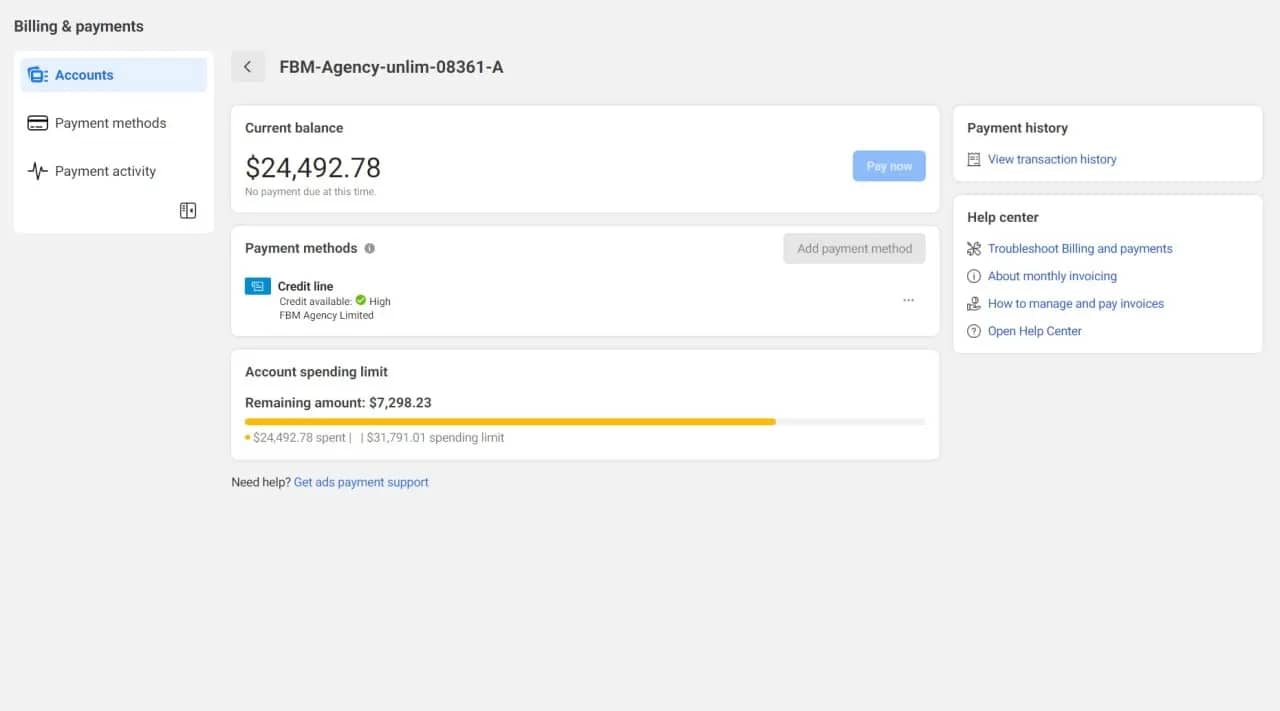
- Unified balance and credit lines. When working with a large number of cabinets, you do not have to constantly bother with cards. Money is deposited into a general balance and then distributed among the accounts. Some agencies additionally have credit lines.
- Direct support. Many agencies have separate communication channels with platforms, so many issues regarding cabinets and restrictions are resolved faster.
- High start limits. On regular accounts, spending limits have to be gradually built up: first, small amounts, then the thresholds grow as you work and gain history. For agency cabinets, starting limits are much higher.
- Early access to new features. Some agencies gain access to new advertising tools, formats, and settings before mass launch. This may apply to campaign types, targeting settings, or specific features within the ad cabinet.
Where are fewer problems: farm vs agency
For clarity, let's compare both options by main parameters: trust, limits, moderation, and other working moments using Facebook as an example.
| Parameter | Farm accounts | Agency cabinets |
| Trust level | Low or medium at the start. Depends on account age, warm-up, history, and spend | Usually start with a high trust level |
| Passing moderation | Checks are often stricter, especially on fresh accounts | Moderation is easier, but platform rules still apply |
| Spend limits | You have to gradually build up limits from $25–50 a day | Start limits are usually higher, so you can reach $1000+ per day faster |
| Consequences of a ban | After a block, you usually have to launch a new account and set everything up again | In case of a ban, a normal agency can quickly issue a new cabinet to continue work |
| Unban / appeals | Standard support and the usual appeal process | Agencies have managers and additional communication channels with platforms |
The agency cabinet does not remove platform restrictions. Moderation rules continue to work, so running ads for gray offers and violating advertising policies will sooner or later lead to bans.
How payment methods differ
When working with large volumes of traffic, costs also increase. In addition to the ad budget, cards, commissions, payment services, and additional costs are added.
Farm accounts
Items like cards are constantly needed for such accounts, and with large volumes, their number quickly grows.
Economics features:
- Expenses. Card issuance and maintenance add costs. Over time, some BINs start working worse on advertising platforms, and some cards may catch restrictions.
- Commissions. Services often charge an additional commission for top-ups. A lot depends on the GEO: in some regions, VAT and other taxes are higher.
- Working with budget. The more accounts and cards appear in work, the more time is spent controlling balances and payments.
Agency cabinets
Here the scheme usually looks simpler: instead of dozens of separate cards, the work goes through a unified balance.
Economics features:
- Payment. Money is deposited into the agency's cabinet, after which it is distributed among the accounts. Top-ups are often available even via crypto.
- Commissions. Agencies usually earn on a percentage of the spent budget. The commission size depends on the platform, GEO, vertical, and the conditions of the service itself.
- Working with budget. When working through an agency, you don't have to constantly switch between dozens of cards and cabinets. Controlling expenses and distributing budgets is much easier.
Which account to choose
The choice usually depends on the vertical, budget, and future plans.
Farm accounts are more often chosen if:
- working with gray verticals — gambling, betting, crypto, nutra, and other directions are often run through farm accounts;
- budget is limited — working through agency cabinets often starts with a large deposit. With a small budget, it is easier to enter through self-regs, auto-regs, or ready-made accounts;
- constant tests — if combinations regularly change and there is a constant launch of new hypotheses, the number of accounts in work begins to grow rapidly.
Agency cabinets are more often chosen if:
- working with white verticals — e-commerce, apps, games, and info-business are usually designed for a long advertising cycle, so agency cabinets are more often chosen here;
- large volumes are needed — when working with large budgets on farm accounts, you quickly hit limits and restrictions. Agency cabinets help reach large volumes faster;
- less technical work — cards, warm-ups, accounts, proxies, and constant preparation take a lot of time. When working through agency cabinets, the service usually takes on part of such tasks.
Conclusion
Farm accounts and agency cabinets solve different tasks. The first option is more often used during constant tests and working with a large number of accounts, the second — during stable launches and scaling of white directions. Ultimately, the choice usually comes down to numbers and tasks, and a universal solution simply does not exist.
Frequently asked questions
- Theoretically, yes, but in practice, agency accounts are usually granted to advertising agencies and companies that work with the platform as partners. This requires documents, turnover, work history, and compliance with the platform's requirements. Therefore, most affiliate marketers gain access through services and intermediaries.
- Manual farming takes time. It can take several weeks to warm up a single account. If you need to launch now, it's easier to buy pre-built accounts with a history and get started right away.
- Yes. Some services additionally check creatives, pre-landing pages, and the offers themselves. The terms and conditions vary by agency.
- It depends on the service's terms. Most often, the balance is transferred to a new account, or the agency helps with the refund. For regular accounts, this process is much more complicated.
- There's no universal timeframe. Everything depends on the traffic source, account quality, aging, vertical, and the link itself. One account might last a few days, while another might last for months.
Why Google Blocks Accounts and What Your Antidetect Has to Do With It
Google has once again complicated the mechanisms of digital identification by deploying a new, more sophisticated layer of protection based on proprietary HTTP headers. This quiet change caught most of the market off guard, triggering a wave of rushed updates. While others hastily released superficial 'fixes', we realized that we were dealing not with a minor issue but with a fundamental shift that required deep and comprehensive analysis.
SOCKS vs HTTP Proxy: What’s the Real Difference and Which One to Choose?
There are times when you don’t want a website to link the request back to your device. That’s where a proxy comes in, it acts like a middle layer and sends the request for you. The site sees the proxy’s info instead of yours. It’s a go-to trick when you’re trying to see a page that’s not available in your region, pull content that’s restricted by location, or avoid hitting a wall when sending lots of requests.

The Best Alternative to OBS Studio
Working with a webcam on many online platforms can turn into a real challenge. A strict oval or rectangular frame appears on the screen, but your image doesn’t align perfectly with it. As a result, the system blocks further progress, demanding perfect alignment, and your workflow is disrupted before it even begins.