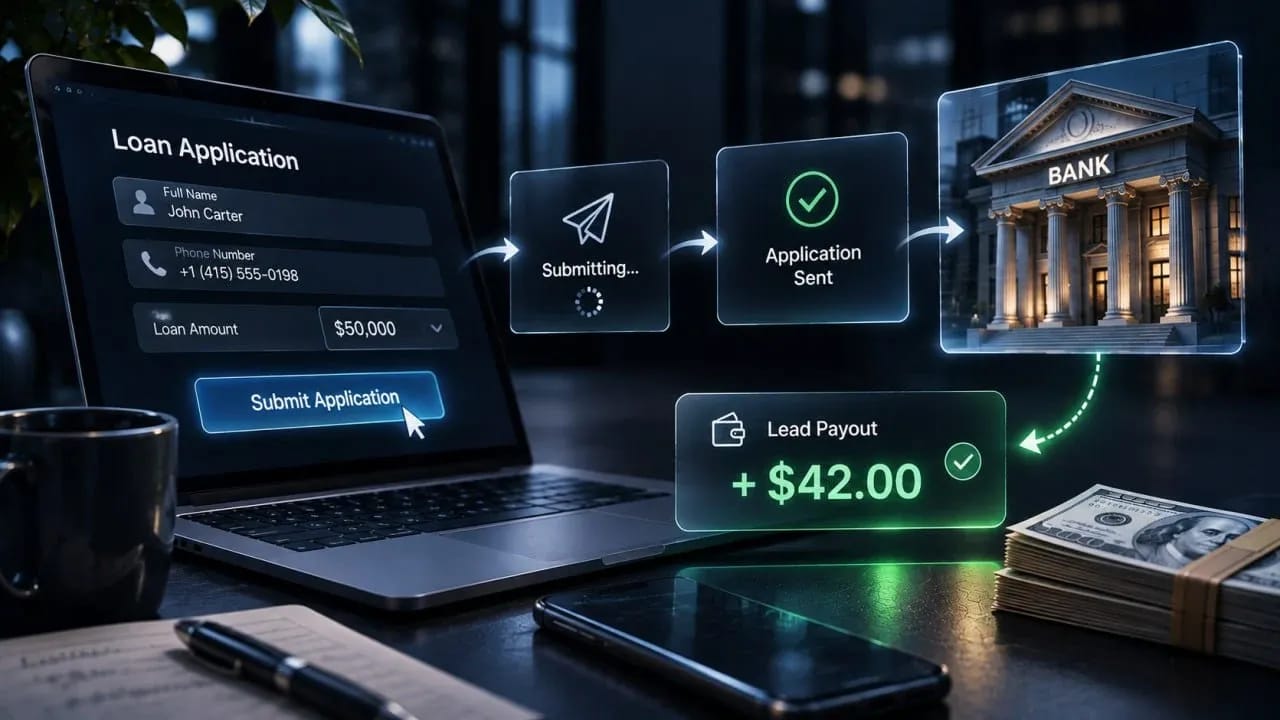
Financial Offers: How to Profit from Other People’s Loans and Credits in Traffic Arbitrage
Updated: November 2026
Financial offers are affiliate programs from banks, microfinance organizations (MFIs), credit brokers, insurance firms, and legal companies within CPA networks, where an affiliate marketer earns a fixed payout for every referred client. Depending on the advertiser's terms, payouts are credited either for a completed valid application form or for a specific target action: issuing a microloan or personal loan, receiving and activating a bank card, opening a business bank account, or signing a debt relief agreement.
In 2026, the financial vertical remains one of the most stable and high-margin niches in affiliate marketing. People need money every day, and in an environment of expensive credit and high inflation, demand for refinancing, cards with long interest-free grace periods, and fast payday loans only continues to grow.
Key things to know about the financial vertical in 2026:
- For an issued microloan to a new client, an affiliate earns from $20 to $65 in the CIS and from $25 to $120 in international GEOs; for an activated debit card — $12–35; for a credit card — $40–90; and for opening a business account, issuing a secured loan, or referring a bankruptcy client — from $120 to $280.
- Affiliates stopped driving traffic directly to the website of a single bank or MFI long ago. Primary revenue is built on credit showcase websites and cascading follow-up funnels, where a single user submits applications to 3–5 organizations at once and brings the affiliate two or three payouts from a single ad click.
- Due to strict regulatory limits on debt-to-income ratios, traditional banks approve only a small fraction of applications. Therefore, the main profit has shifted toward smart showcases with automated matching, subscription services, personal bankruptcy offers, and microlending in emerging markets across Asia and Latin America.
In this article, we break down how the economics of banking payouts work, what financial offers are currently available, and which traffic sources to use for generating leads.
How the economics of financial offers work
Beginners in affiliate marketing are always surprised by the basic math of the microfinance market: a person takes out their first interest-free loan from an MFI for $80 "at 0% for 7 days," pays back exactly $80, and yet the microfinance company pays the webmaster a $45 net commission. At first glance, the deal seems like a guaranteed loss for the advertiser, but the entire financial vertical is built on LTV — Customer Lifetime Value.
According to internal microfinance market statistics in 2026, over 65–70% of new borrowers either fail to meet the interest-free grace period and pay for a contract extension, or return for a second, third, and fifth loan within six months. Starting from the second application, the standard interest rate applies to the client, along with additional paid options: job loss insurance, telemedicine, credit score monitoring, and legal assistance. As a result, customer acquisition costs are fully recouped by the second month of the borrower's lifecycle, after which they generate pure profit.
For traditional banks, the unit economics work in a similar way:
- On debit cards, the bank earns money from acquiring fees (interchange) on every supermarket purchase made by the cardholder, from minimum account balances, and from subsequently cross-selling that client a credit card, deposit, or mortgage inside the mobile app.
- On credit cards with a 100–120 day grace period, the calculation is based on the fact that more than half of cardholders violate the interest-free terms at least once, withdraw cash for a fee, or switch to making minimum monthly payments at the full interest rate.
Because running their own in-house ads on search engines and social networks costs banks even more due to bloated marketing departments and paying for impressions without guaranteed results, it is far more profitable for them to buy ready-made, pre-scored clients from affiliates at a fixed rate.
Types of financial offers and how much they pay in 2026
The financial vertical is diverse: every product has its own borrower profile, decision-making speed, and hold period — the time it takes the advertiser to verify traffic. In 2026, all offers fall into five key segments.
Microloans
This is the powerhouse of financial affiliate marketing with the fastest capital turnover. The client needs money right here and right now, so the decision is made impulsively straight from a smartphone.
Target action: issuing a loan to a new client who has not previously borrowed money from that specific MFI. Less common are tiers offering a small bonus payout for repeat loans to existing clients.
Payouts: from $20 to $65 in Russia and Kazakhstan, and from $25 to $120 in international markets (Spain, Poland, Mexico, Vietnam, the Philippines, the USA).
Key features: automated scoring takes 2–3 minutes, funds hit the borrower's card instantly, and the hold period in affiliate networks is just 7–14 days. The main downside is the high debt burden of the audience: any single MFI approves an average of only 10–18% of incoming applications, making it profitable to drive traffic only through showcase sites featuring multiple offers.
Debit and credit cards
A white-hat, straightforward sub-niche that performs great both with broad audiences on social media and with coupon or cashback traffic.
Target action: in 95% of banking offers in 2026, you get paid not just for a completed application form or a courier meeting, but for card activation — making a first real purchase in-store or online for an amount starting at $3–5 within 30 days of receiving the physical card.
Payouts: debit cards — $12–35 (kids and youth cards — $8–15); credit cards — $40–90.
Key features: debit cards have the highest approval rate on the market — up to 75–85%, since the bank does not check the person's credit history or debt burden. However, an affiliate needs to budget working capital for a long deal cycle: from the moment of the click to courier card delivery, the first in-store purchase, and the bank reconciliation upload, it takes anywhere from 20 to 45 days.
Personal cash loans, refinancing, and secured loans
A heavyweight segment with the largest one-time payouts, but also the strictest requirements for borrower quality.
Target action: actual loan disbursement to the client's account, or a verified application that passes initial pre-scoring.
Payouts: traditional personal loans — $80–220 per disbursement or $2.50–8 per valid application on a CPL basis; loans secured by a car or real estate — from $150 to $350 per deal.
Key features: due to strict central bank requirements regarding debt-to-income ratios, the average approval rate from an online application to actual disbursement of an unsecured personal loan in banks stands at 3–7% in 2026. On the other hand, secured loan offers demonstrate a much more stable conversion rate among a mature, solvent audience.
Business offers
The premium segment of the financial vertical, where the target audience consists of aspiring entrepreneurs, marketplace sellers, and freelancers legalizing their income.
Target action: opening and activating a business bank account (cash and settlement services) or submitting documents for sole proprietorship/LLC registration through a banking service.
Payouts: from $60 to $280 per opened account (banks also pay extra bonuses for connecting merchant acquiring, a corporate card, or accounting services).
Key features: a completely white-hat vertical that easily passes moderation in Telegram Ad. The audience here is narrow, and a click in search ads can cost $5–15, so the main profit goes to owners of specialized B2B portals, YouTube/Telegram channels for marketplace sellers, and accounting platforms.
Credit brokers and personal bankruptcy
When banks and MFIs reject a borrower due to delinquencies and a high debt load, declined-traffic monetization products take center stage:
- Paid loan matching services — credit brokers with recurring billing. The user fills out a single application on a matching website and links a bank card, which is charged between $0.01 and $0.20 to check their credit rating, while agreeing to the terms of a paid subscription costing $10–20 per month. The affiliate receives either a fixed CPA payout ($6–15 per linked card) or a RevShare percentage (50–70% of all recurring charges). The biggest advantage is that conversion here does not depend on the person's credit history.
- Personal bankruptcy. If a person already has loans and delinquencies totaling $3,000–5,000 or more, it is impossible to approve them for a new loan, but bankruptcy law firms will gladly buy the lead. They pay from $15 to $45 for a qualified lead, and up to $200–250 for a signed legal contract.
To choose the right sub-niche for your starting budget and traffic source, compare the key metrics across each category:
| Offer Category | Target Action | Average Payout (2026) | Average Approval Rate | Hold Period | Recommended Starting Budget |
| Microloans | First loan disbursement | $20–65 in CIS, $25–120 in international GEOs | 10–22% on a single offer, up to 45% on a showcase | 7–14 days | Medium (from $500–1,000) |
| Debit cards | Delivery + first purchase from $3 | $12–35 | 55–80% | 20–40 days | Low (from $150–300 / free traffic) |
| Credit cards | Delivery + activation purchase | $40–90 | 12–25% | 25–45 days | Medium (from $800–1,500) |
| Personal loans | Loan disbursement / Application | $80–220 (CPS) / $3–8 (CPL) | 3–7% (on disbursement) | 15–30 days | High (from $1,500) |
| Business accounts | Opening a business bank account | $60–280 | 25–45% | 14–30 days | High (expensive ad auction) |
| Paid brokers | Card linking | $6–15 CPA or 50–70% RevShare | 30–60% | 1–7 days | Low / Medium (ideal for follow-up monetization) |
| Personal bankruptcy | Valid lead with debt over $3,000 | $15–45 per lead, up to $250 per contract | 35–65% (call center qualification) | 7–14 days | Medium (from $500–800) |
How affiliates earn multiple times from a single borrower
The main reason beginners lose their budget on financial offers is trying to drive traffic directly to the landing page of a single specific MFI or bank.
Let's do some simple math. Suppose you bought 100 targeted clicks from search ads at $1.20 per click and sent them directly to an MFI website paying $40 per issued loan. Out of 100 people, 25 filled out the application. However, 15 of them already have an account with that company — and you don't get paid for existing clients — plus another 8 people were rejected by automated scoring. In the end, only two people were approved for a loan: you earned $80 on $120 in ad spend and ended up $40 in the red, even though you brought in a hundred real people who genuinely needed money.
Professional affiliates solve this problem using financial showcases and follow-up funnels. Instead of direct linking, the user enters a multi-stage funnel that squeezes the maximum value out of every click:
- Smart financial showcase. The user lands on an aggregator page ("Top MFIs of November 2026: 0% loans to your card in 5 minutes without rejection") featuring 6–8 offers sorted by EPC — earnings per click. A prominent rule is displayed right on the page: "To increase your approval probability to 98%, submit applications to 3–4 companies at once." The person clicks on three or four cards, gets approved by two MFIs simultaneously, and takes out both small loans — as a result, the affiliate earns not $40, but $80–90 from the exact same visitor.
- Lead capture and duplicate checker rotation. If the user enters their phone number on a pre-lander before viewing the showcase or launches a loan-matching Telegram bot, the system queries advertiser databases via API in a split second and removes from the top spots those MFIs where the person is already registered, pushing to the top only the companies where they are guaranteed to be a new client.
- Follow-up monetization via SMS, push notifications, and Telegram. Since the user left their contact info at the top of the funnel, working with them doesn't end when they close the browser tab.
- First 15 minutes — the person receives push notifications and messages featuring top-tier MFIs with the highest payouts and a 0% interest rate.
- After 2–4 hours, if there is no conversion — if major lenders rejected them due to bad credit history, an automated sequence sends them to newer, lesser-known MFIs with the most lenient scoring.
- Declined traffic the next day — if rejections came back across the board, the user is sent a paid credit broker offer or an offer to legally write off all accumulated debts through a personal bankruptcy procedure.
This kind of follow-up funnel makes it possible to monetize up to 75–85% of all incoming traffic and turns a losing campaign into a steady profit with an ROI of 40% to 120%, while the collected contact database continues to generate passive income through repeat broadcasts before holidays and at the end of every month.
Top traffic sources for financial offers in 2026
Choosing a traffic source depends directly on which product you are promoting and how much working capital you are prepared to tie up during the hold period.
Search advertising (PPC)
The hottest and highest-intent traffic comes from Google Ads: the user actively types into search "get an urgent loan to card without rejection" or "apply for a credit card with same-day delivery."
How it works in 2026: you cannot run ads directly to an affiliate referral link — affiliates promote their own showcase websites equipped with filtering tools.
The main taboo: across all banking and microfinance offers, brand bidding is strictly prohibited — using the names of specific banks and MFIs in your keywords and ad copy if you are driving traffic to the advertiser's direct link. Rules are more flexible for independent comparison showcases, but bidding on competitor brand keywords should still be cleared with your CPA network manager in advance.
Social networks and messengers
On social media, people rarely search for a loan intentionally, so funnels here rely on Telegram bots and thematic channels focused on saving money, discounts, and financial literacy.
- On Telegram, curated lists of debit cards with welcome bonuses ("Apply for a free card and get $10 in real cash after your first purchase") and debt-relief lead magnets convert exceptionally well.
- In Facebook Ads and TikTok Ads, when targeting LatAm, Asian, and European markets, affiliates use news-style pre-landers, credit limit check quizzes, or loan aggregator mobile apps.
SEO websites and financial aggregator portals
A classic white-hat asset with the highest long-term ROI. Webmasters build niche comparison sites and rank hundreds of low-competition landing pages targeting specific long-tail queries: "microloans to a Mir card without passport photo at night," "best debit cards with gas station cashback in 2026," "where to borrow $150 with open delinquencies." The biggest advantage of SEO traffic is that once your pages hit the top of search results and AI assistant answers, leads flow in for free 24/7.
In-house databases
The major league of financial affiliate marketing. Experienced teams view their initial ad spend in search or social networks merely as a way to build their own database of verified borrower phone numbers for free or at break-even. Once the database is collected, traffic acquisition costs drop to pennies — the cost of sending an SMS or a bot message — and every broadcast featuring a new MFI entering the market delivers pure profit.
Free / Organic social traffic
The ideal entry point for beginners without a starting budget. Short-form videos on YouTube Shorts, Reels, and TikTok, as well as articles on Zen about financial lifehacks, legal ways to stop paying loan interest (redirecting to a bankruptcy quiz via the link in bio), or reviews of cards with the highest cashback allow you to generate dozens of applications daily with zero ad spend.
CIS vs. International GEOs: which market to choose in 2026
Every region has its own operational specifics:
- Russia and Kazakhstan — the most developed infrastructure inside CPA networks (ready-made free showcase builders, automated EPC rotation, built-in Telegram bots, and fast payouts for self-employed affiliates and sole proprietors). Kazakhstan maintains massive demand for payday loans with payouts of $25–45 per issued loan and simpler moderation in Facebook and Google Ads.
- Tier-1 (USA and UK) — the most technologically advanced market in the world, operating on Ping-Post mechanics. Here, the affiliate does not send the user to a showcase full of links: the borrower fills out a detailed application right on the affiliate's landing page, after which the system runs that application through a closed auction of hundreds of lenders in 2 seconds. The lead automatically goes to whichever bank or PDL company bids the highest price — from $5 for a subprime borrower to $180–250 for a high-quality application.
- Tier-2 and Tier-3 (Spain, Poland, Romania, Mexico, Colombia, Vietnam, the Philippines, Sri Lanka) — the primary growth markets in 2026. In Latin America and Southeast Asia, millions of residents lack access to traditional bank loans but actively use smartphones and online lending. Competition in ad auctions here is significantly lower than in the US or CIS, while payouts per issued loan reach $18–65.
Top 6 proven CPA networks with financial offers
Working with banks and MFIs directly as a solo affiliate is virtually impossible: direct advertisers require a legal entity, volumes of hundreds of issued loans per month, and pay on net-60 terms. Specialized financial CPA networks handle reconciliations, provide ready-made technical tools, and process payouts on demand.
- Leadgid — the largest international financial CPA network (CIS, Kazakhstan, Europe, Asia, LatAm). Hundreds of direct bank and MFI offers, a proprietary smart showcase builder, detailed conversion analytics, and regular payout bumps for volume.
- Saleads.pro — an affiliate network with the strongest technical platform for automation: a free responsive credit showcase builder, a generator for ready-made Telegram and VK bots, a built-in duplicate checker, and machine-learning-based smart offer rotation.
- Rafinad — a specialized financial affiliate network offering high rates on bank cards, business accounts, and microloans, transparent statistics, fast payouts, and convenient team tools.
- Pampadu / Workle Pro — user-friendly platforms for working with white-hat banking products (debit and credit cards, business accounts, mortgages, auto insurance, and bank HR vacancies) with instant access to offers without a complex onboarding interview.
- Leads.su — one of the oldest financial networks in the CIS region, featuring a massive pool of MFIs and banks along with built-in solutions for automated monetization of declined traffic.
- Zero Parallel / Leadbit Finance / DoAffiliate — specialized international networks for affiliates planning to run international traffic (Ping-Tree auctions in the US, as well as PDL offers across Europe, Latin America, and Asia).
Passing moderation in the financial vertical
Financial offers fall under heightened scrutiny from advertising platforms; in Google and Meta, they are classified under Special Ad Categories / Financial Products and Services.
The main challenge when working with Google Ads, Facebook, and TikTok is the strict platform policy ban on advertising short-term consumer loans with a repayment period under 60 days and a high annual percentage rate (APR). If you launch an ad saying "Payday loan in 5 minutes for 14 days" directly from a standard account, your ad account will be banned immediately during automated review.
To consistently pass moderation and scale campaigns without losing infrastructure, affiliate teams structure their workflow around two scenarios.
When working with white-hat sources, like SEO, the showcase is designed strictly as an informational financial comparison service. The site must not have a button saying "Get money right now without checks" — instead, affiliates use wording like "Compare terms and submit an application," and at the bottom of the page they list the legal details of each bank, the loan term range, and the total cost of credit.
When scaling in Facebook, Google Ads, and TikTok across international GEOs, an antidetect browser is essential. In Linken Sphere, you can create an isolated profile for each account with a unique hardware fingerprint and clean residential or mobile proxies matching your target GEO. This protects your network of ad accounts from chain bans caused by overlapping browser parameters. And to prevent automated crawlers and ad network moderators from seeing an aggressive microloan showcase, teams set up traffic filtering: bots and moderators see a safe whitepage — such as a financial blog, a compound interest calculator, or a currency exchange directory — while real users from the target region land on the high-converting showcase or quiz pre-lander.
5 mistakes that cause beginners to lose their budget in finance
Even with a high-quality traffic source, it is easy to end up in the red in the financial vertical if you make one of these classic rookie mistakes at launch.
- Wrong order of offers on the showcase. The most common beginner mistake is placing the country's most famous MFIs in the first and second spots of a showcase simply because their names are well known. The problem is that market leaders already have up to 70–80% of all active borrowers in the country in their database. A user will click your link and take out a loan, but you won't get a payout because they turned out to be a repeat client. You should always place fresh or less saturated MFIs with high approval rates and strong EPC in the top 2–3 positions of your showcase, pushing market giants down to spots 4–6.
- Ignoring the hold period. If you only have $300 in working capital and decide to run paid ads to credit cards with a 35-day hold, your money will run out on day three. By the time bank couriers deliver the physical cards to clients, people go to the store for their first purchase, and the bank uploads its reconciliation report, over a month will have passed. With a small budget, you should start either with MFIs offering a 7–14 day hold and fast turnover, or with debit cards using free organic traffic.
- Using misleading claims and prohibited promises. Ad creatives like "Loan with 100% approval even with a blacklist record and bailiff debts, no repayment needed!" will generate a huge CTR and cheap clicks, but will bring in a completely untargeted audience that every scoring system will reject. Moreover, for blatant misrepresentation, the affiliate network may refuse to pay for your entire traffic volume.
- Incentivized traffic and fraud. The scheme "I'll ask friends and followers to apply for a debit card for a $5 reward, they'll buy a pack of gum at the store and put the card on a shelf" is guaranteed to get your payout blocked in 2026. Bank anti-fraud systems evaluate traffic quality based on KPIs: if 90% of the cards you referred show complete inactivity after the first minimum purchase, the entire traffic stream is flagged as incentivized and rejected during reconciliation.
- Lack of SubID tracking down to each individual ad and placement. In finance, two adjacent keywords or two different Telegram channels can deliver the exact same cost per click and the same number of applications, yet the bank might approve 40% of applications from the first channel and 0% from the second because its audience consists of students or bankrupt individuals. Without proper link sub-tagging, you won't see which specific campaign brings in real loan disbursements and which one only generates empty rejections.
Frequently asked questions
If you work with free organic traffic or small Telegram ad buys for debit cards and personal bankruptcy, you can start with $100–250. For full-scale paid traffic acquisition in search or social ads driving to an MFI showcase — factoring in split testing and a two-week hold period — you will need working capital of at least $1,000–1,500 for the CIS or $1,500+ when entering international markets.
For starting out with paid traffic, MFI showcases featuring a "first loan at 0%" promo or CPL personal bankruptcy offers work best — they have the shortest customer decision cycle and the fastest working capital turnaround. If you are starting with free traffic, blogs, or social media, it is easiest to convert your audience on free debit cards with boosted cashback and a cash welcome bonus from the bank, as they are approved with almost zero rejections.

Why Google Blocks Accounts and What Your Antidetect Has to Do With It
Google has once again complicated the mechanisms of digital identification by deploying a new, more sophisticated layer of protection based on proprietary HTTP headers. This quiet change caught most of the market off guard, triggering a wave of rushed updates. While others hastily released superficial 'fixes', we realized that we were dealing not with a minor issue but with a fundamental shift that required deep and comprehensive analysis.
SOCKS vs HTTP Proxy: What’s the Real Difference and Which One to Choose?
There are times when you don’t want a website to link the request back to your device. That’s where a proxy comes in, it acts like a middle layer and sends the request for you. The site sees the proxy’s info instead of yours. It’s a go-to trick when you’re trying to see a page that’s not available in your region, pull content that’s restricted by location, or avoid hitting a wall when sending lots of requests.
The Best Alternative to OBS Studio
Working with a webcam on many online platforms can turn into a real challenge. A strict oval or rectangular frame appears on the screen, but your image doesn’t align perfectly with it. As a result, the system blocks further progress, demanding perfect alignment, and your workflow is disrupted before it even begins.