
How platforms view multi-accounting: what is allowed, what is prohibited, and the consequences of violations
A multi-account (or multi-accounting) is the creation and simultaneous use of several accounts by a single user on the same internet platform.
There is no single answer to the question of whether multi-accounts are allowed. It all depends on the rules of the specific platform, your goals, and the technical tools you use to work with the profiles.
Why platforms fight against multi-accounts
Every major platform spends millions of dollars developing intelligent systems to detect linked accounts. The main reasons for this fight are obvious:
- Circumventing limitations and rules. If a user is banned for spam, fraud, or aggressive behavior, creating a new profile renders the moderators' work useless.
- Manipulating metrics. Multi-accounts are actively used to inflate likes, artificially boost views, write fake reviews, and promote product cards on marketplaces.
- Bonus abuse. Registering hundreds of profiles allows users to mass collect promo codes for the first purchase, referral payouts, cryptocurrency airdrops, and free trial periods of subscriptions.
- Fraud. On crypto exchanges and payment services, multi-accounting often serves as a tool for laundering funds, evading sanctions, and bypassing identity verification procedures.
- Lowering audience quality. Advertisers do not want to pay for showing banners to bot networks and account "farms" owned by a single person.
All of this brings direct financial losses to the platforms' budgets. Unsurprisingly, the prohibition of multi-accounting is officially stated by many of them.
How platforms detect multi-accounts
A modern protective anti-fraud algorithm analyzes hundreds of parameters simultaneously. Let's look at the key groups.
IP address and geolocation. Logging in from the exact same IP address for different accounts is the simplest trigger for security systems. Even using standard VPNs does not help if the addresses are blacklisted or belong to well-known data centers.
Device digital fingerprint. Websites read the technical parameters of your browser and operating system. This includes Canvas, WebGL, audio card, fonts, time zone, keyboard layout language, and leaks of your real IP address via the WebRTC protocol. A digital fingerprint is unique and allows platforms to recognize you even without using cookies.
Mobile identifiers. Apps on smartphones gain access to the Device ID, IMEI codes, MAC addresses of network cards, and even the list of installed programs.
Behavioral patterns. Modern AI systems monitor typing speed, characteristic cursor movements on the screen, time intervals between clicks, and the order of navigation through website sections. This allows them to separate real users from bots.
Metadata analysis. The use of similar or linked phone numbers, payment cards of the same bank, identical email domains, and identical recipient details when ordering.
Social graph. Overlapping circles of friends, exchanging messages between one's own accounts, identical reposts, and synchronous activity on the network.
Based on these parameters, platforms compile your fingerprint. If you log in to two different accounts from the same device, the system will immediately understand that it is the same person, even if you changed your IP and cleared your browser history.
How platforms view multi-accounts
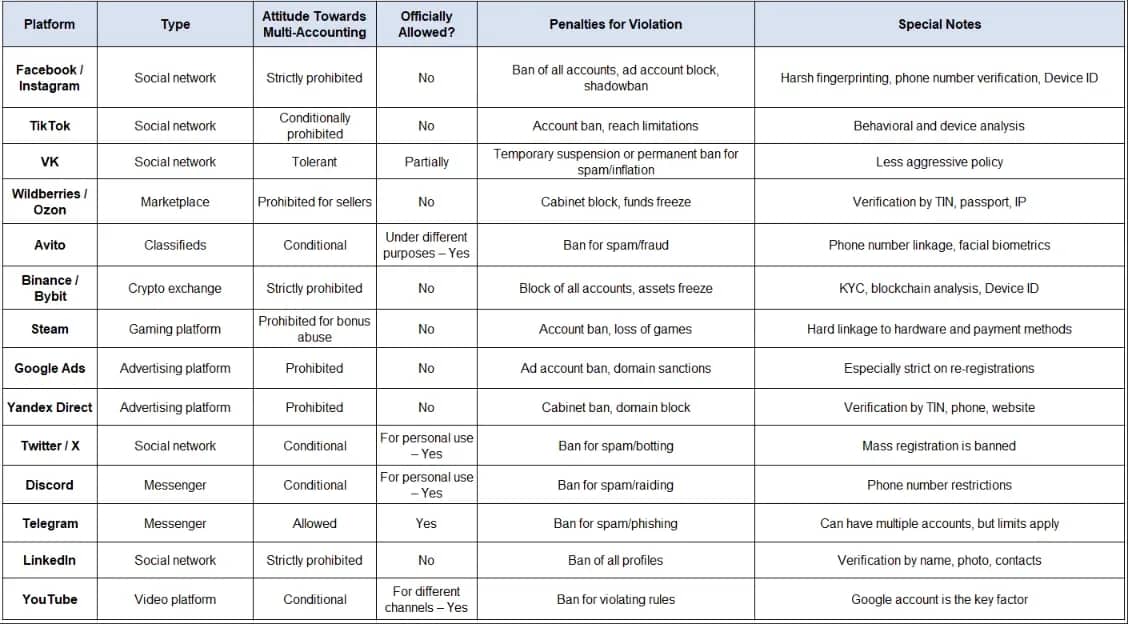
Social networks (Facebook, Instagram, TikTok, VK, Twitter/X, LinkedIn)
Social media build strict security boundaries because their capitalization depends on advertisers' trust in the quality of the audience.
Fake pages are used to manipulate public opinion, spam, inflate activities, and commit fraud. At the same time, social networks are tolerant of situations where you have one personal and one business profile on the same phone. But if the system detects the simultaneous authorization of dozens of pages with identical digital fingerprints, a block is inevitable.
As an intermediate measure, platforms, especially Instagram and TikTok, cut the reach of posts from suspicious profiles to zero. You can publish content, but no one will see it.
Marketplaces and classifieds (Wildberries, Ozon, Avito, Amazon, eBay)
In the e-commerce sector, rules are divided into buyer and commercial ones.
An ordinary buyer can create several profiles, although they might be blocked for abusing welcome discounts. For sellers, creating duplicate shops is strictly prohibited to avoid monopolization of niches and inflation of fake reviews. Marketplaces block seller accounts, freeze funds on the seller's balance until circumstances are clarified, and can terminate the contract unilaterally with major fines.
Cryptocurrency exchanges (Binance, Bybit, OKX, KuCoin, Huobi)
The DeFi sector and crypto exchanges are controlled by international financial regulators, which obliges them to implement KYC procedures. The "one passport — one account" rule makes multi-accounting on exchanges impossible under the law.
Creating multi-accounts to participate in token giveaways is countered by analyzing blockchain transactions. If different wallets are funded from a single source, they are blacklisted as Sybil accounts, which threatens the violator with a complete loss of funds without the right to appeal the block.
Ad platforms (Google Ads, Facebook Ads, Yandex Direct, TikTok Ads)
Here, a strict rule officially applies: "One advertiser — one account."
If your previous account was blocked for an incorrect ad creative or advertising prohibited goods, an attempt to create a new account with the same payment details, domains, or IP addresses will lead to an instant chain ban.
Gaming platforms (Steam, Epic Games, Battle.net, Riot Games)
The gaming industry fights against in-game inventory farmers, rank boosters, and cheaters to make the gameplay fairer and protect the internal economy. If violations are detected, you may lose access to the library of games for which real money was spent.
Messengers (Telegram, WhatsApp, Discord, Signal)
Messengers are the most loyal to multi-accounting, as long as you do not cross the line. The key limitation is the requirement of a unique mobile number for each profile. Multiple accounts are banned only for spam, aggressive mailings, inviting users to channels without their consent, and distributing malicious content.
How platforms phrase the ban in their rules
When registering on any service, the user signs a user agreement. Most, of course, do not read it, which is a mistake — there is a lot of interesting information there.
A typical phrasing in the rules of Meta or Steam looks like this:
"You agree not to create more than one personal account. Creating additional accounts without our prior written consent may result in the immediate suspension of all your accounts."
Attempts to make excuses to support with the phrase "I didn't know the rules" never work. From a legal standpoint, the fact of registration confirms your full familiarity with the website's rules.
Sanctions from platforms can be divided by severity:
- soft — temporary restrictions on sending messages, shadowbans, regular requests to pass a captcha or verify identity via SMS;
- medium — freezing the profile for up to 30 days, debiting the balance of bonuses or loyalty points, blocking access to advertising tools;
- harsh — permanent lifetime ban without the possibility of recovery, freezing commercial accounts with real money, blocking linked website domains, blacklisting TINs or passport details.
However, if you read the very same user agreement, you can find out that in some cases multi-accounts are actually allowed. Legal scenarios of working with multiple profiles — take note:
- Profile diversification — separating personal life and professional activity, for example, a personal page on Instagram and managing a work group or a business profile.
- Official functionality — using Meta Business Manager tools, integrating multiple accounts within the official Telegram client, setting up family sharing on Steam.
- Agency model — certified advertising agencies have the right to legally manage hundreds of clients' ad accounts through a single master account.
How to safely work with multiple accounts
If your professional activity requires managing several profiles, follow these safe working recommendations:
- only use official apps and sharing tools provided by the platform developers;
- separate payment details — do not link the same bank card to different ad accounts or seller profiles;
- never use identical passwords and similar logins for your profiles;
- when undergoing mandatory KYC verification, always provide only accurate passport details — document forgery leads to criminal liability;
- use reliable, clean individual proxy servers to avoid overlapping IP addresses.
Important warning: this material is for informational purposes only. We do not encourage violating platform rules, but only describe the technical aspects of how internet services operate.
For specialists whose work is directly related to managing a large number of accounts, standard browsers are not suitable. They use professional software — anti-detect browsers.
An anti-detect browser (such as Linken Sphere) is special software based on Chromium or Firefox that allows you to create isolated profiles. Each such profile emulates a unique device with its own set of hardware characteristics, operating system, time zone, and network settings.
An anti-detect browser does not just hide your data, it generates a realistic digital fingerprint from Canvas to fonts, replacing your PC's real parameters with generated ones. For the site's security system, each profile looks like a login from a new physical computer located in another part of the world.
At the same time, it is important to understand that an anti-detect browser does not guarantee absolute safety. Even if you use the most advanced anti-detect browser, but log in to different accounts with the same credit card or perform identical actions, the platform's security algorithms will easily calculate the connection between your profiles.
Conclusion
Using multi-accounts is a practice associated with high risks. There is no universal safety rule: platform rules are constantly tightening, and identification methods are being improved by machine learning algorithms. Before starting work on any platform, always carefully study the terms of use to avoid losing resources, time, and money. And of course, use an anti-detect browser to minimize the risks of detection. You can start working even without binding a card — Linken Sphere has a plan for 5 free profiles.
Frequently asked questions
- On most major commercial, financial, and advertising platforms, having more than one account per user is officially strictly prohibited. Multi-accounting is allowed in some messengers and personal social networks, but with strict limitations on activity.
- Platforms protect their ecosystem from inflation, spam, bots, fraud, and losses from the uncontrolled collection of bonuses and discounts.
- Officially, Instagram is loyal to managing a personal and a business profile from one mobile device. However, the simultaneous creation and administration of dozens of pages for the purpose of inflation will result in a permanent ban of the entire network.
- Through a comprehensive analysis of network addresses, digital fingerprints of the browser and operating system, payment details, phone numbers, metadata, and behavioral patterns.
- For buyers, funds for paid goods can usually be refunded through support or a bank chargeback. For sellers, the situation is much more complicated: marketplaces have the right to freeze payouts for a long period to compensate for potential losses due to violation of the offer.
- Yes, the official Telegram app natively supports adding up to three to four accounts on different phone numbers for quick switching between them.
Why Google Blocks Accounts and What Your Antidetect Has to Do With It
Google has once again complicated the mechanisms of digital identification by deploying a new, more sophisticated layer of protection based on proprietary HTTP headers. This quiet change caught most of the market off guard, triggering a wave of rushed updates. While others hastily released superficial 'fixes', we realized that we were dealing not with a minor issue but with a fundamental shift that required deep and comprehensive analysis.

SOCKS vs HTTP Proxy: What’s the Real Difference and Which One to Choose?
There are times when you don’t want a website to link the request back to your device. That’s where a proxy comes in, it acts like a middle layer and sends the request for you. The site sees the proxy’s info instead of yours. It’s a go-to trick when you’re trying to see a page that’s not available in your region, pull content that’s restricted by location, or avoid hitting a wall when sending lots of requests.

The Best Alternative to OBS Studio
Working with a webcam on many online platforms can turn into a real challenge. A strict oval or rectangular frame appears on the screen, but your image doesn’t align perfectly with it. As a result, the system blocks further progress, demanding perfect alignment, and your workflow is disrupted before it even begins.