
Essential SEO Services: 26 Relevant Website Promotion Tools
In recent years, SEO has changed significantly. If earlier promotion often came down to keyword research, writing texts for these queries, and building a link profile, now this is not enough. Search engines evaluate not only the presence of keywords, but also the quality of content, user behavior, the technical condition of the site, page structure, internal linking, mobile adaptation, and even brand reputation.
Furthermore, the market is influenced by the development of AI search. Users are increasingly getting answers not only in standard Google search results, but also in AI Overviews, ChatGPT, Gemini, and other systems. This changes the approach: now it is important to create content that not only matches the query, but genuinely answers the user's question, has a clear structure, is supported by facts, and is easy to read.
You cannot do without specialized tools here. How and with which services to cover SEO tasks — we explained in the article.
What SEO tasks services help solve
SEO optimization is a systematic work with a website. To promote steadily, you need to regularly analyze data, fix errors, update content, monitor competitors, and measure the result.
Technical website audit
Even high-quality content will rank poorly if pages are closed from indexing, the site loads slowly, there are broken links, duplicates, incorrect redirects, and other technical problems.
Services help find errors that are difficult to notice manually: 404 pages, redirect chains, duplicates, missing headings, meta tag problems, incorrect sitemaps, errors in URL structure, thin pages, and technical issues affecting crawling.
Semantics
A semantic core is a list of search queries that generate traffic. It is used to create platform structure, form a content plan, improve existing sections, and find new ideas.
SEO services allow you to find keywords, evaluate search volume, search difficulty, query intent, seasonality, and competitiveness. More advanced tools help to cluster queries — group them so that separate pages or articles can be created for them.
Competitor analysis
In SEO, it is important to understand how competitors get organic traffic. Which pages are their strongest? For what keywords do they rank? Where do they get links from? What content formats do they use?
Competitive analysis tools help find missed keywords, evaluate the link profile, and understand what pages should be created or strengthened on your site.
Content optimization
Content remains one of the core parts of SEO. But today it is not enough to just write a text "for keywords". You need to consider search intent, the comprehensiveness of topic coverage, structure, headings, internal linking, media, micro-markup, and readability.
Services for content optimization help analyze competitors' pages, find missing topics, check keyword density, build article structure, and improve already published materials.
On-page SEO
On-page SEO is the optimization of a specific page. This includes title, description, H1-H3, URL structure, image alt tags, internal linking, micro-markup, keyword density, intent match, and page usability for the user.
On-page analysis tools show what needs to be improved on the page so that it better matches the search query and search engine requirements.
Link profile
Links remain an important ranking factor, but it is not the quantity that matters, but the quality: relevance of donors, domain authority, naturalness of anchors, and growth dynamics.
SEO services help analyze backlinks, compare the link profile with competitors, look for donors, and track lost links.
Rank tracking
For optimization, it is important to understand how website positions change for key queries. Manual checking is inconvenient and inaccurate because search results depend on geo, device, language, personalization, and other factors.
Specialized services allow tracking positions by regions, devices, and search engines, seeing dynamics, comparing yourself with competitors, and evaluating the impact of SEO efforts.
Analytics
SEO cannot be evaluated by positions alone. It is important to understand how much organic traffic comes to the site, which pages yield conversions, where users leave, which queries bring the target audience, and how SEO affects business metrics.
For this, Google Analytics 4, Google Search Console, Looker Studio, and other analytical tools are used. Google Analytics 4, for example, collects data on websites and applications, which is convenient for analyzing the full user journey.
Local SEO
For businesses tied to a specific GEO, local SEO is important — promotion in Google Maps, local search results, directories, reviews, and geo-dependent queries.
Local SEO tools help manage company profiles, track local positions, work with reviews, check citations, and analyze business visibility in a specific location.
Reporting
SEO is a long process, so it is important to regularly track results: traffic growth, rank dynamics, visibility changes, technical improvements, new pages, conversions, and ROI.
Reporting services allow combining data from Google Search Console, Google Analytics, Semrush, Ahrefs, SE Ranking, and other platforms into clear dashboards.
The selection of up-to-date services for SEO optimization
Below is a selection of tools divided by tasks. It is not necessary to use all of them at once. The optimal stack depends on the size of the site, budget, niche, and team level.
Basic free Google tools
Google Search Console
Google Search Console is a mandatory basic service for any project. It displays indexed pages, effective keyword phrases, and identifies broken URLs, issues with the mobile version, and security problems.
The Performance section contains detailed statistics on clicks, impressions, CTR, and average position. This allows tracking the dynamics of search traffic and identifying queries that attract the audience. The indexing report is particularly useful: it shows the current status of all links known to the search engine and explains the reasons why specific pages did not appear in the search results.
Although GSC is not designed to replace paid powerhouses like Ahrefs, Semrush, or Screaming Frog, it is the one you should start with to assess the actual position of the site in search.
Google Analytics 4
Google Analytics 4 analyzes user behavior on the site. If Search Console shows how the site looks in search, GA4 helps to understand what happens inside: which pages users visit, what actions they take, and where they get lost.
For SEO, this is important because traffic should be assessed not only by the number of visits, but also by quality: scroll depth, engagement, and return rate.
For content projects, GA4 helps to understand which articles deliver not just views, but real actions. For SaaS and e-commerce — which pages bring users who then register, pay for the product, or return again.
PageSpeed Insights
PageSpeed Insights is a tool for evaluating site speed and performance. It measures load times on different devices and provides a list of technical elements that need to be improved.
For SEO, speed is important not only as a technical factor, but also as a part of the user experience. If a page takes a long time to open, the user may leave before the content loads. This is especially critical for mobile traffic, landing pages, online stores, and websites with a lot of media.
Google Trends and Google Keyword Planner
Google Trends helps analyze interest in topics. It is convenient to use for seasonal niches, news topics, e-commerce, traffic arbitrage, cryptocurrencies, AI products, and other areas where demand changes rapidly.
Google Keyword Planner is most often used in contextual advertising, but it is also useful for SEO: it helps evaluate search demand, find new keywords, and understand approximate competition.
For a comprehensive SEO analysis, these tools are usually not enough, but as a free starting point, they remain relevant.
Universal SEO platforms
Ahrefs
Ahrefs is a powerful all-in-one SEO tool for analyzing the competitive environment, semantics, and link profile. Its Keywords Explorer tool helps collect, group, and evaluate keywords, while Site Explorer parses competitors' organic and paid traffic in detail, along with their backlinks and AI visibility.
The service is a leader in competitive intelligence and link auditing: it highlights the competitors' most traffic-generating pages, their winning queries, and donor sites, opening up new opportunities for your project.
For content strategy, Ahrefs is convenient due to its comprehensive approach: in addition to search volume, it assesses ranking difficulty, actual clicks, and competitors' parameters in search results. Thanks to this, you create only those materials that are actually worth publishing.
Semrush
Semrush is a versatile platform that covers tasks related to keyword research, competitor analysis, site auditing, rank tracking, link analysis, and reporting.
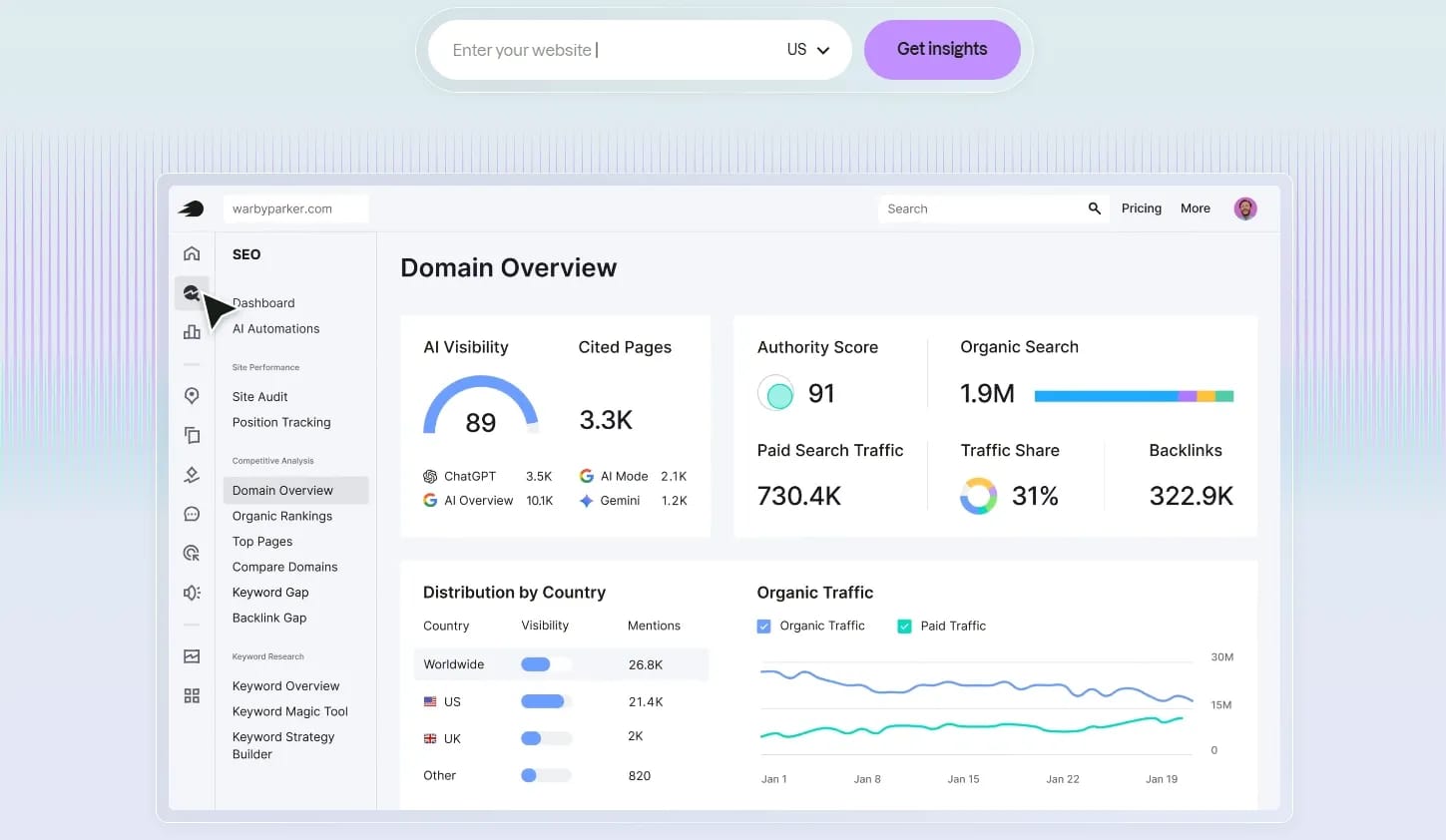
The advantage of Semrush is a strong reporting ecosystem. The tool is suitable not only for SEO specialists but also for marketing teams that need to see the big picture: organic, PPC, content, competitors, brand mentions, and visibility across different channels.
SE Ranking
SE Ranking is an SEO platform that covers main tasks: rank tracking, site auditing, backlink analysis, on-page checking, work with competitors, and reporting. The platform allows tracking positions by GEO, search engines, and devices, as well as analyzing competitors in search results.
SE Ranking is often chosen as a more flexible alternative to expensive all-in-one platforms. It is well-suited for regular project monitoring, working with multiple sites, preparing reports, and controlling technical health.
Serpstat
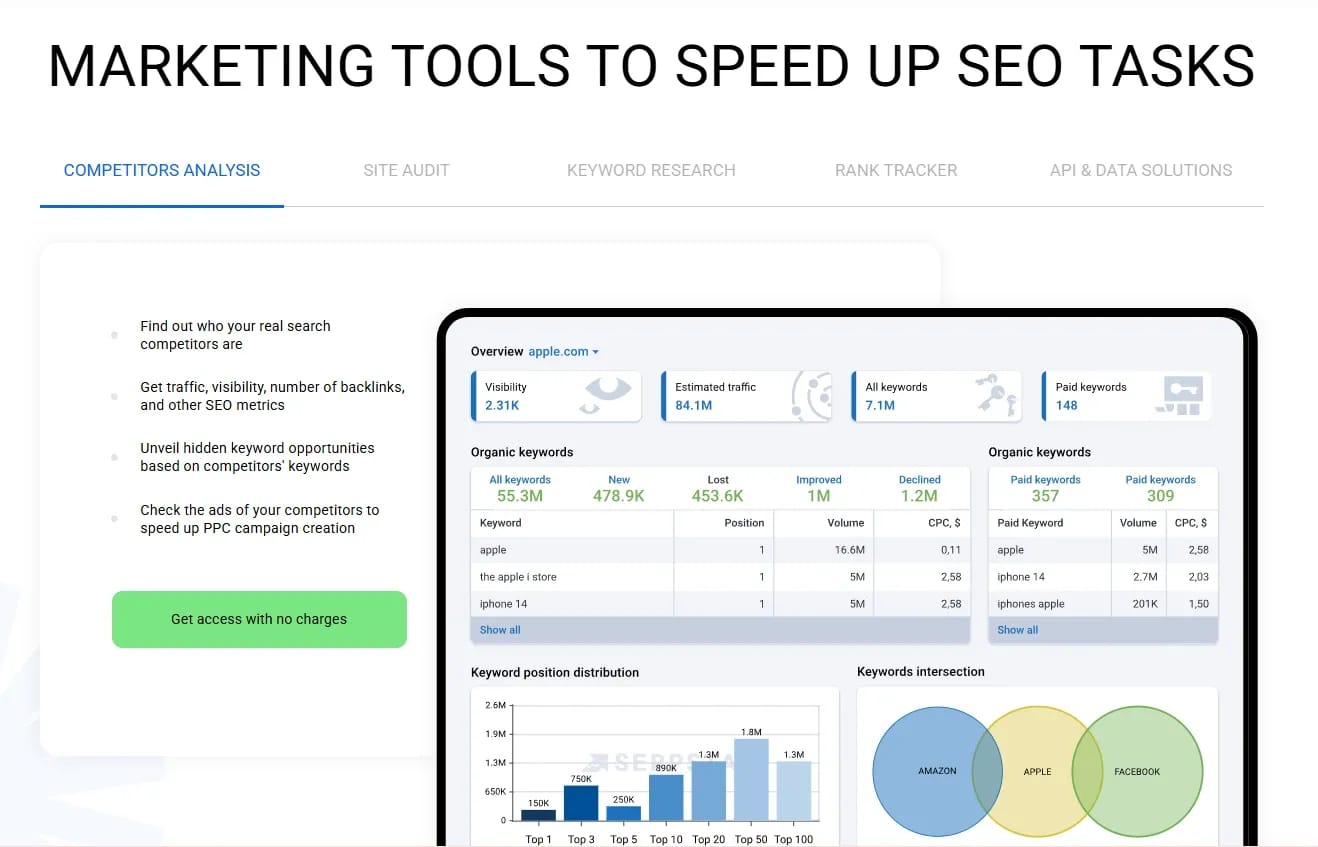
Serpstat is a comprehensive SEO service for working with keywords, links, positions, and the technical condition of a site. It helps collect semantics, analyze project visibility, and find competitors' high-traffic pages. This platform is often selected as a base tool for small and medium sites or used in conjunction with Ahrefs, Semrush, or GSC to expand the data pool.
Tools for technical SEO audit
Screaming Frog SEO Spider
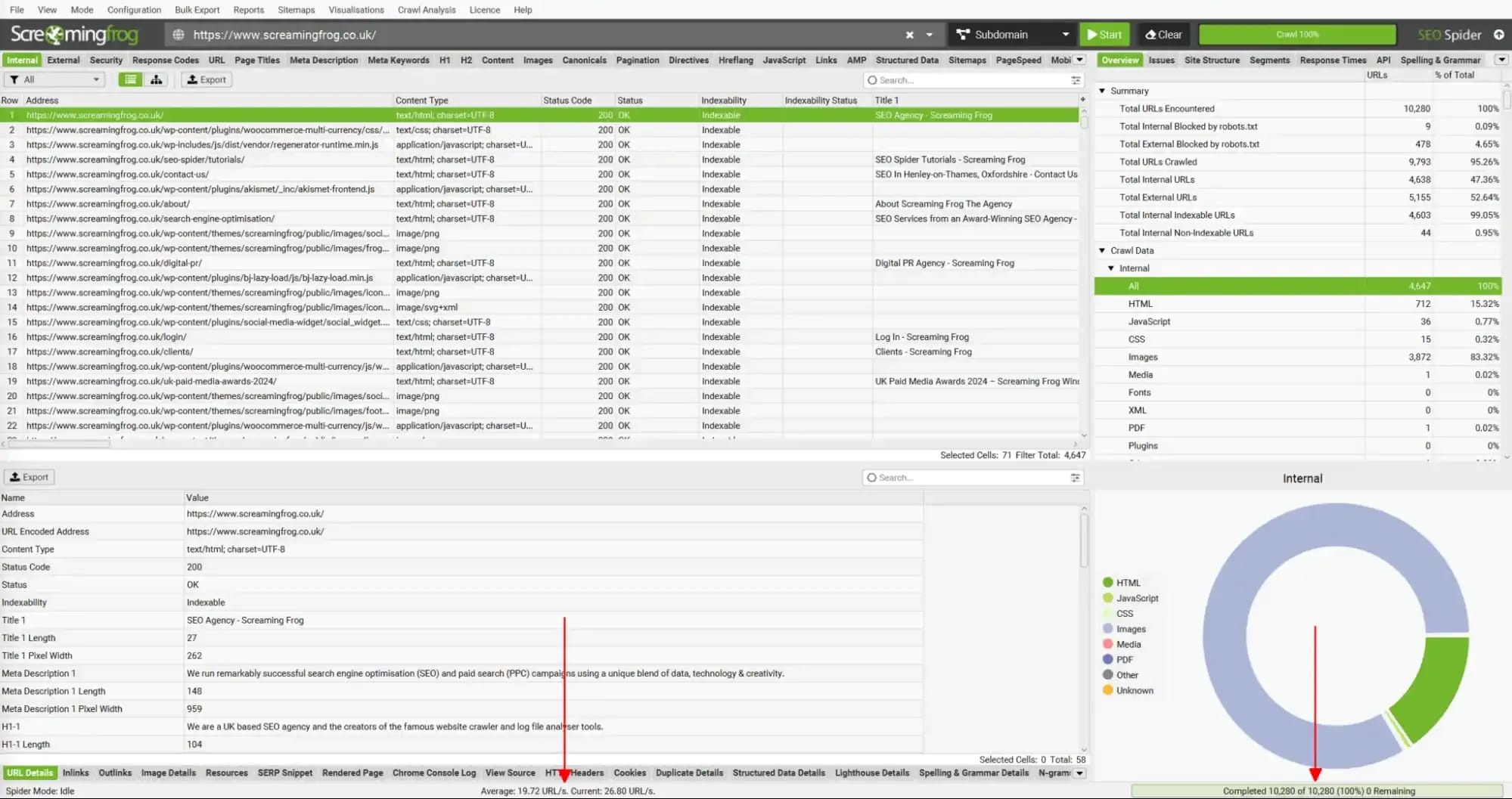
One of the leading desktop crawlers for deep technical auditing. The program simulates the behavior of search robots, scanning the resource and identifying flaws at the level of individual URLs.
The SEO Spider functionality allows diagnosing over 300 issues affecting promotion, site health, and UX: from broken links and 404 errors to redirect chains and server failures. The program is indispensable for large-scale projects, as it instantly finds duplicate meta tags, missing H1s, pages hidden from indexing, sitemap failures, and problems with internal linking or crawl depth.
Despite the high entry threshold due to a complex interface, it is a powerful tool for pros. Site migrations, redesigns, scheduled audits, and investigations into causes of traffic drops rarely happen without it.
Sitebulb
A technical scanner with an emphasis on clarity. Like Screaming Frog, it collects technical data from a resource, but its main feature is deep analytics visualization.
Sitebulb does not simply produce massive tables with URLs; it builds graphs of the site structure, visually highlights vulnerable areas, prioritizes errors, and gives clear instructions on how to fix them.
Netpeak Spider
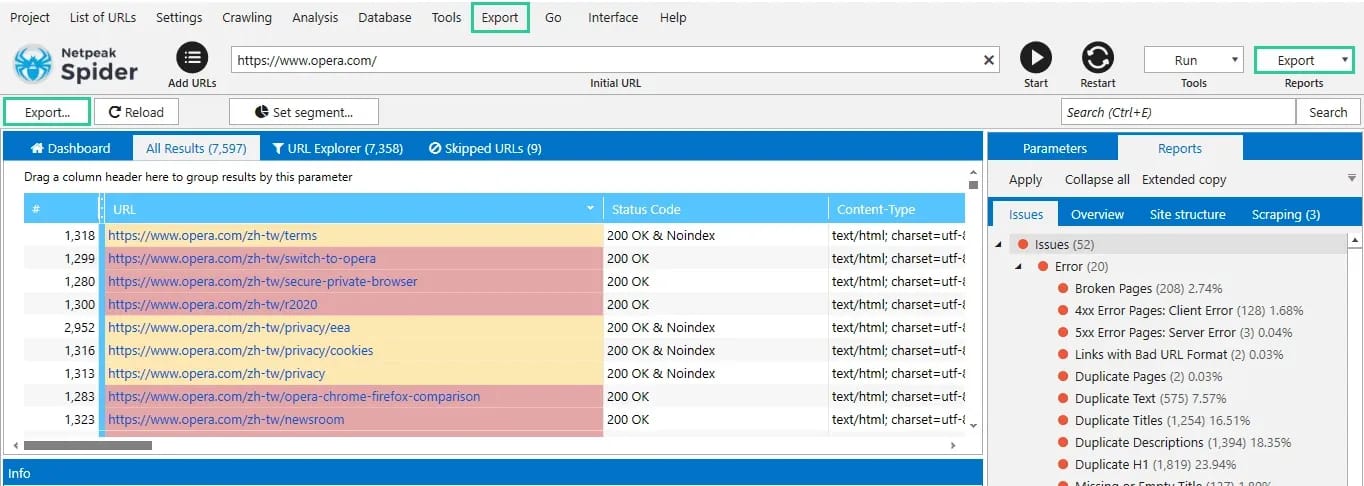
A crawler for comprehensive technical website checking, particularly popular in the CIS and Eastern Europe. It efficiently crawls a resource for SEO errors, analyzes architecture, checks response codes, duplicates, meta tags, and indexing quality. It is often used as an alternative to Screaming Frog or as a second opinion in technical audits.
Tools for keyword research and semantic analysis
Ahrefs Keywords Explorer
A powerful module for detailed keyword breakdown. It provides exhaustive analytics for a query: search volume, difficulty level, projected clicks, LSI phrases, and SERP analysis.
Its main advantage is the tight integration of keyword research with competitive intelligence. You can not just collect semantics from scratch, but also parse queries for which your main competitors are already getting traffic. This saves a lot of time and allows you to work only with proven, effective topics.
Semrush Keyword Overview and Keyword Magic Tool
Semrush offers several tools for working with keywords. Keyword Overview displays data for a specific query: volume, intent, difficulty, CPC, and other metrics.
Keyword Magic Tool is useful for expanding semantics. It helps find related queries, group them by topics, and gather ideas for new pages. This is useful for blogs, affiliate sites, online stores, and SaaS projects where you need to regularly create content for different stages of the funnel.
SE Ranking Keyword Research
SE Ranking is also suitable for keyword research and competitor analysis. It is convenient to use it in conjunction with rank tracking: first, collect semantics, then add target queries to monitoring and observe the dynamics.
SE Ranking can be a more convenient solution than using several separate tools. It covers basic SEO specialist tasks: finding keywords, analyzing positions, site auditing, and reporting.
AlsoAsked and AnswerThePublic
AlsoAsked and AnswerThePublic help find user questions. This is beneficial for informational articles, FAQ blocks, content plans, and pages where it is important to cover a maximum of related intents.
Such tools are especially well suited for blogs. For example, if you are writing an article about anti-detect browsers, proxies, multi-accounting, or SEO services, question-based queries help you understand exactly what the user cares about: "how to choose", "what is the difference", "why is it needed", "how to set up", "what are the mistakes".
Tools for content optimization
Surfer
Surfer is a platform for optimizing content for Google and AI environments. The service analyzes competing pages, helps find content gaps, add missing context, and optimize materials.
Surfer is useful when creating SEO articles, commercial pages, guides, and reviews. It helps understand which topics to cover, which terms to use, how well the text matches competitors, and what needs to be added to increase relevance.
It is important to use such tools carefully. Surfer should not turn a text into a set of keywords. Its task is to help the author not miss important topics. The final result still depends on expertise, structure, and usefulness for the reader.
Clearscope
Clearscope is a content optimization tool that helps improve the relevance of materials to search queries. It analyzes search results, suggests related terms, and helps understand how comprehensively the text covers a topic.
Clearscope is often used by content teams that work with a large volume of content and want to standardize quality. It is useful for editors, authors, and SEO specialists who need to quickly evaluate finished texts and provide clear recommendations.
MarketMuse
MarketMuse is a strategic tool for content planning and optimization. It helps analyze topical clusters, find content gaps, and evaluate page potential.
MarketMuse is suitable for large content projects where it is important not just to write a single article, but to build a full pool of topics. For example, if a site is promoted in the internet marketing niche, you can build clusters around SEO, PPC, traffic arbitrage, proxies, anti-detect browsers, analytics, AI tools, and other areas.
NeuronWriter
NeuronWriter is an SEO content tool that helps analyze competitors, build text structure, select terms, and optimize articles. It can be used as a more affordable alternative to Surfer or Clearscope.
Such a service will suit authors and SEO specialists who want to speed up content creation but are not ready to use expensive tools.
Tools for link analysis
Ahrefs Backlink Checker and Site Explorer
Ahrefs remains one of the strongest tools for link analysis. Through Site Explorer, you can see which domains link to the site, which pages get more links, which anchors are used, and which links have been lost.
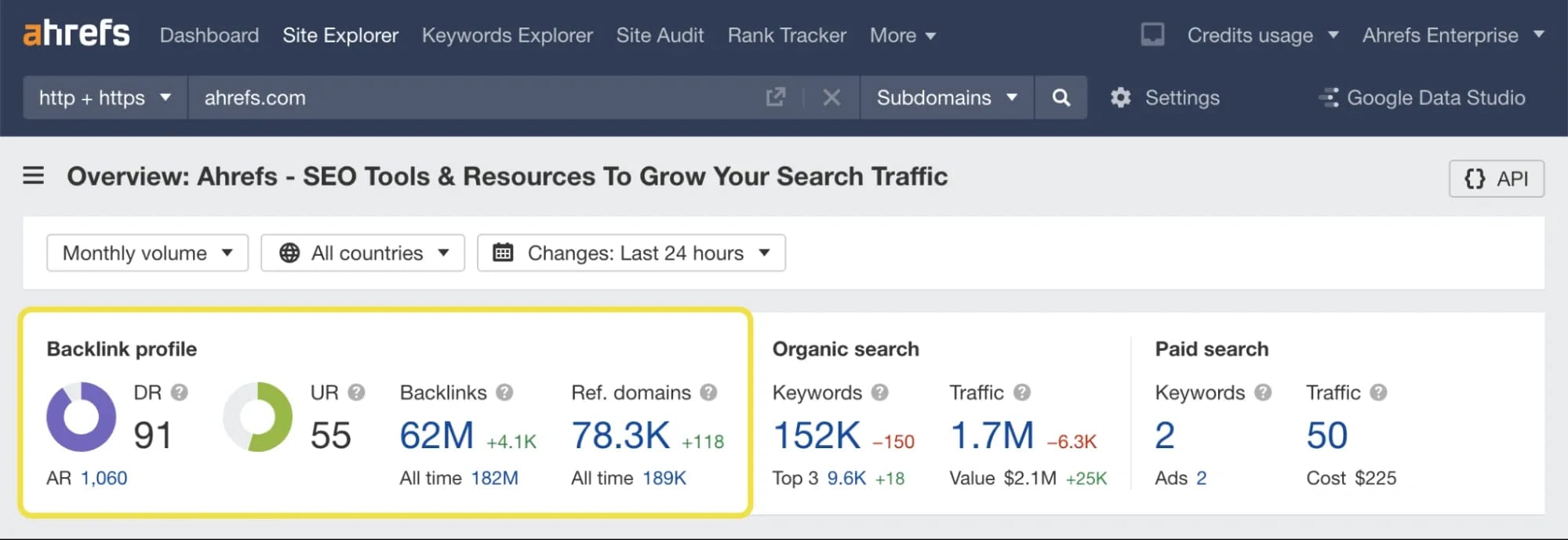
This is useful for analyzing competitors and building your own link strategy. For example, you can find competitor pages that actively accumulate links, figure out the type of donors, and use this as a foundation for manual prospect gathering, guest posting, and partnership placements.
Semrush Backlink Analytics
Semrush also offers tools for backlink profile analysis. They are convenient to use if you are already working inside Semrush and want to connect link analysis with other data: rankings, organic keywords, competitors, and technical audit.
Backlink Analytics helps track donor domains, anchors, link dynamics, and compare link profiles with competitors. This is especially important in niches where organic visibility heavily depends on domain authority.
Majestic
Majestic is a specialized tool for link analysis. It is frequently used for evaluating domain quality, analyzing link mass, and checking donors prior to placement.
Majestic can be handy for link builders, SEO agencies, and specialists who actively work with external links. Coupled with Ahrefs or Semrush, it helps gain a more complete picture of the link profile.
Tools for rank tracking
AccuRanker
AccuRanker is a specialized service for tracking rankings. Its main advantage is accuracy and ease of reporting. If a project is promoted in several countries or cities, manual position checking becomes impossible. AccuRanker helps automate this process.
SE Ranking Rank Tracker
SE Ranking allows you to track positions, analyze competitors, perform site audits, and prepare reports in a single interface.
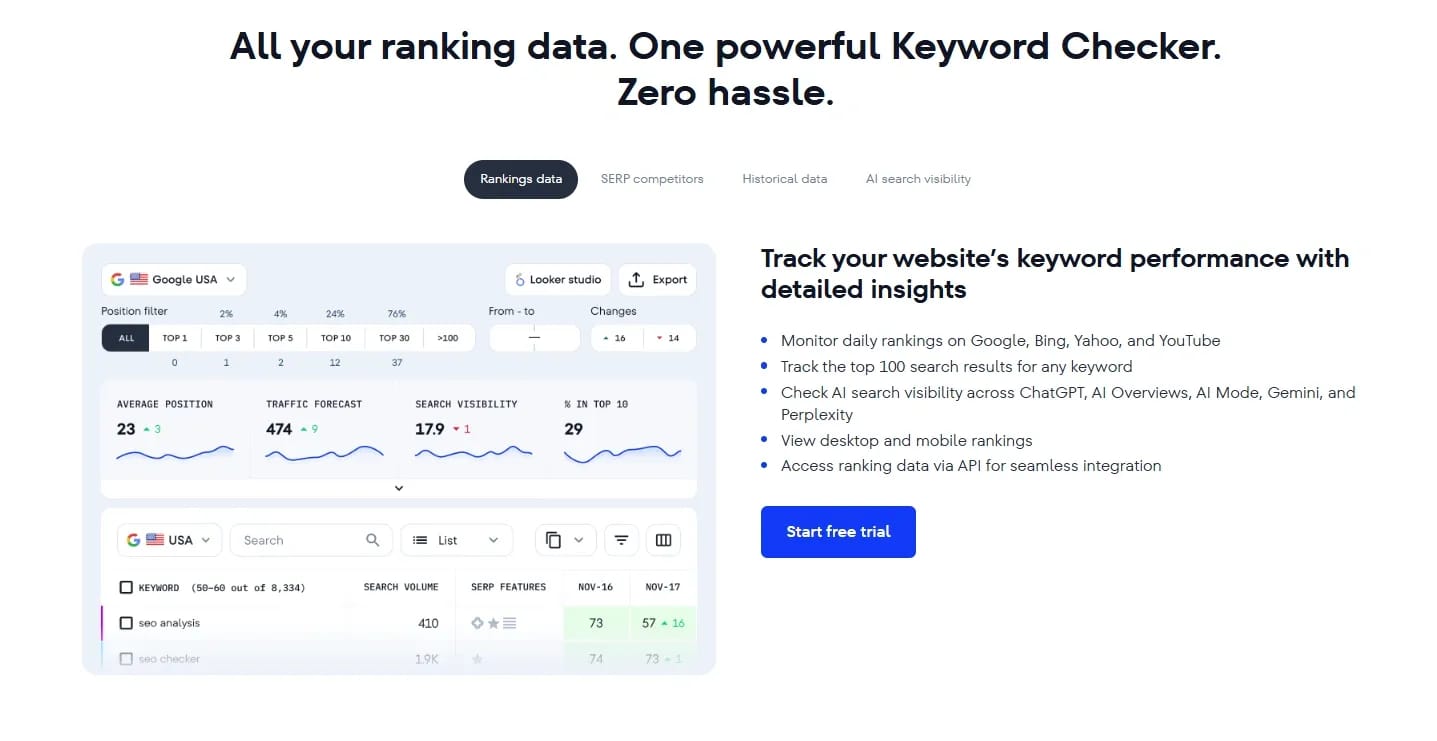
For small and medium projects, this is often more practical than using a separate tool solely for rankings. Especially if you need to manage multiple sites, clients, or language versions.
Semrush Position Tracking
Semrush Position Tracking suits those who already use Semrush for semantics and competitive analysis. The tool helps track keyword positions, view visibility dynamics, compare yourself against competitors, and analyze changes in the SERP.
It is particularly helpful for projects where SEO works alongside content and paid advertising: all data can be kept in one system.
Tools for WordPress
Rank Math
Rank Math is a popular SEO plugin for WordPress. It helps set up SEO parameters for pages, manage indexing, add structured data, and optimize content using built-in recommendations.
Rank Math is appropriate for blogs, media, affiliate websites, WooCommerce stores, and corporate websites. It is convenient because many basic SEO settings can be configured without a developer: title, description, schema, sitemap, robots, breadcrumbs, redirects, and other elements.
Yoast SEO
Yoast SEO is one of the most famous SEO plugins for WordPress. It aids in optimizing pages, working with meta tags, sitemaps, schema, and basic content recommendations.
Yoast automatically generates an XML sitemap and updates it when content is added or removed, helping search engines discover and crawl important site pages. The plugin ensures you do not forget basic SEO elements before publishing: title, description, readability, keywords, internal links, and indexing.
Tools for local SEO
Google Business Profile
Google Business Profile is necessary for companies promoting in local search and Google Maps. These are restaurants, clinics, stores, service companies, local agencies, studios, salons, and any businesses tied to a specific GEO.
Using the profile, you can manage company information, operating hours, reviews, and photos. For local SEO, this is one of the basic tools because a business profile often appears above classic organic results.
BrightLocal
BrightLocal is a platform for local SEO. It helps work with local visibility, reviews, citations, and reporting. A separate Reputation Manager module helps aggregate reviews in one place, receive notifications about new ones, respond to Google and Facebook reviews, track trends, and prepare reports.
BrightLocal allows for systematically managing local presence rather than checking everything manually.
Reporting tools
Looker Studio
Looker Studio is a tool for data visualization and SEO report creation. It allows you to gather data from various sources and turn them into interactive dashboards. For SEO, Looker Studio is convenient because you can consolidate data from Google Search Console, Google Analytics 4, Google Ads, spreadsheets, CRMs, and third-party SEO services. As a result, you do not just see a set of metrics, but a clear picture: traffic, rankings, conversions, and dynamics by countries and devices.
Looker Studio is especially beneficial for monthly reporting. Instead of manually preparing presentations, you can build a template once and have the data update automatically on a regular basis.
Google Sheets
Google Sheets remains an important working tool for an SEO specialist. It is utilized for semantic cores, content plans, URL lists, optimization tasks, Screaming Frog export analysis, clustering, and reports.
Despite the availability of complex platforms, spreadsheets remain a universal place where it is convenient to merge data from different sources and work with it quickly by hand.
How to choose SEO services for your tasks
There is no single ideal tool that perfectly covers all tasks.
For a small site, you can start with a basic toolkit: Google Search Console, Google Analytics 4, PageSpeed Insights, Rank Math or Yoast SEO, as well as one all-in-one suite like SE Ranking, Ahrefs, or Semrush.
For a content project, Surfer, Clearscope, NeuronWriter, or a similar article optimization tool will additionally be useful. If a site regularly publishes materials, it is important not only to write new texts but also to update old ones: improve structure, add current data, expand sections, and enhance internal linking.
For a large website, a technical crawler is mandatory: Screaming Frog, Sitebulb, or Netpeak Spider. The more pages there are, the higher the risk of technical errors, duplicates, broken links, and indexing issues.
For competitive niches, solid backlink analysis should be added: Ahrefs, Semrush, or Majestic. If competitors actively utilize external links, without analyzing donors and link dynamics, it will be difficult to comprehend why they hold their positions.
For local businesses, Google Business Profile and BrightLocal are crucial. Here, SEO depends not only on the site itself but also on reviews, maps, mentions, and the accuracy of company data.
SEO optimization in 2026 is a continuous process, not a one-time website adjustment. Search engines are becoming more complex, competition is growing, and AI search is developing alongside classic results. Therefore, it is essential to systematically work on the visibility of the website and the brand.
SEO services help accelerate this work and make data-driven decisions. The best approach is to choose tools based on tasks, not popularity. If a site has indexing problems, a technical audit is needed first. If traffic is lacking — semantics and competitor analysis. If articles are getting impressions but not improving in rankings — content optimization. If there is traffic but no leads — analyzing user behavior and conversions.
Properly selected tools assist in seeing a website's weak spots, discovering new growth points, and building promotion strategies based on understandable data rather than guesswork.

Why Google Blocks Accounts and What Your Antidetect Has to Do With It
Google has once again complicated the mechanisms of digital identification by deploying a new, more sophisticated layer of protection based on proprietary HTTP headers. This quiet change caught most of the market off guard, triggering a wave of rushed updates. While others hastily released superficial 'fixes', we realized that we were dealing not with a minor issue but with a fundamental shift that required deep and comprehensive analysis.

SOCKS vs HTTP Proxy: What’s the Real Difference and Which One to Choose?
There are times when you don’t want a website to link the request back to your device. That’s where a proxy comes in, it acts like a middle layer and sends the request for you. The site sees the proxy’s info instead of yours. It’s a go-to trick when you’re trying to see a page that’s not available in your region, pull content that’s restricted by location, or avoid hitting a wall when sending lots of requests.

The Best Alternative to OBS Studio
Working with a webcam on many online platforms can turn into a real challenge. A strict oval or rectangular frame appears on the screen, but your image doesn’t align perfectly with it. As a result, the system blocks further progress, demanding perfect alignment, and your workflow is disrupted before it even begins.