
TLS Proxies: Pros and Cons of Software-Based Solutions
Internet data transmission security today relies almost entirely on end-to-end encryption. The TLS — Transport Layer Security — protocol has become the standard, protecting traffic from interception and tampering. However, ubiquitous encryption creates a serious problem for corporate security systems, developers, and network engineers: it is impossible to protect a network from viruses, data leaks, or malware if all incoming and outgoing traffic is an impenetrable, encrypted stream.
To solve this problem, TLS proxies are used — a specialized intermediate server that can encrypt, decrypt, and analyze TLS traffic passing between the user and the destination web resource. In essence, it acts as a middleman, splitting a single secure connection into two controlled segments.
Today, TLS proxies are applied in fields ranging from corporate data loss prevention systems and deep packet inspection to load balancers in cloud infrastructures, mobile application debugging, and internet censorship circumvention systems. There are two principal approaches to their implementation: software-based and hardware-based. In this article, we will examine the features of software solutions in detail, exploring their strengths and weaknesses, and comparing popular tools current as of July 2026.
What is a TLS Proxy and How It Works
To understand the specifics of a TLS proxy, it is important first to distinguish it from classic proxy servers.
A standard HTTP proxy operates at the application data level without encryption — it simply forwards requests and sees their content in plain text. A standard HTTPS proxy operates as a blind tunnel: the client sends a request to establish a connection, and the proxy server forwards the encrypted data to the recipient without knowing what is inside the packets. It only sees the destination IP address and domain.
In contrast, a TLS proxy can decrypt traffic. It completely terminates the TLS connection on itself, decrypts the data to analyze or modify it, and then encrypts it again before sending it to the recipient.
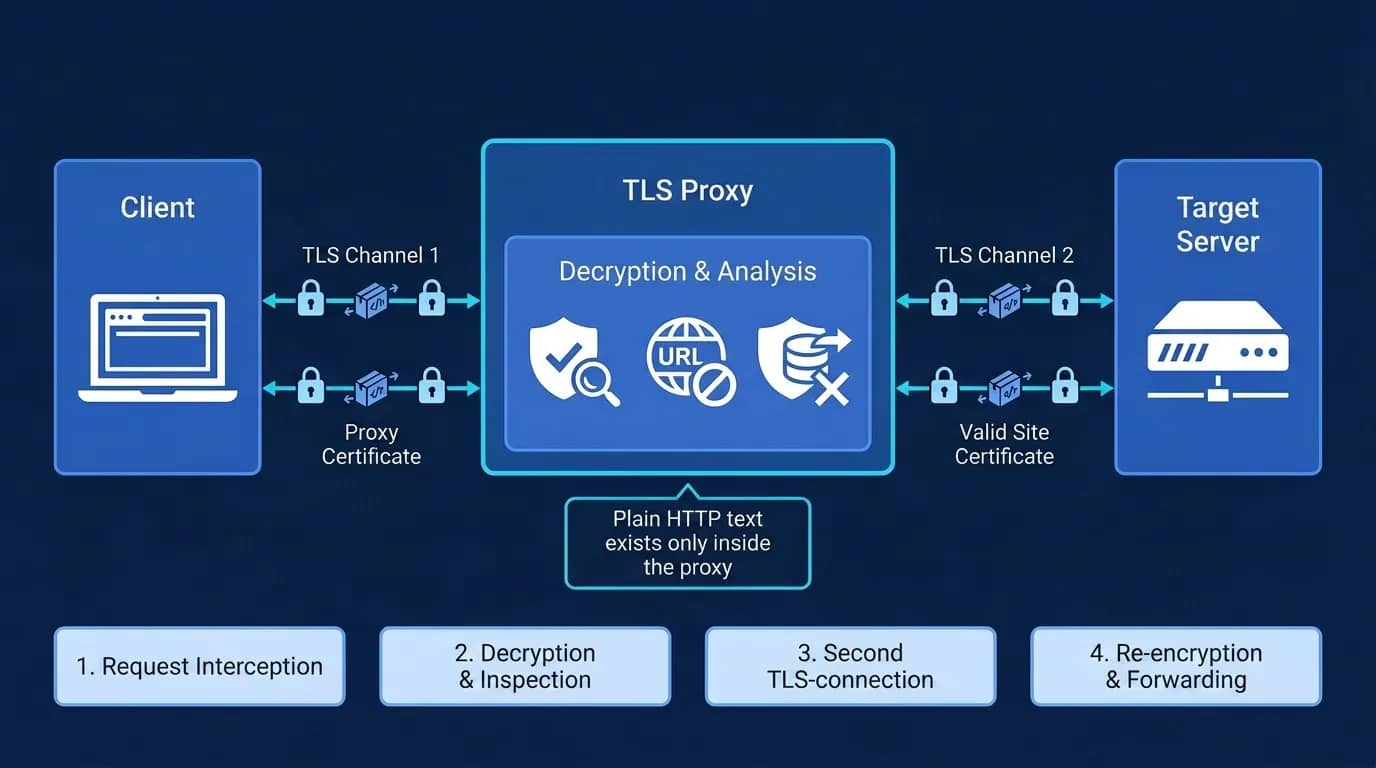
TLS Proxy Workflow
Here is what the traffic processing workflow looks like, using an outgoing request with inspection as an example:
- Client — Proxy. The client attempts to establish a secure connection with a website, and the TLS proxy intercepts this request. Instead of the website's original certificate, the proxy generates its own spoofed TLS certificate, signed by a trusted local root certificate that is pre-installed on the client's device. A standard handshake occurs, and an encrypted TLS channel is established between the client and the proxy.
- Decryption and Analysis. The proxy receives the encrypted data from the client, decrypts it using the private key of the generated certificate, and analyzes the plaintext HTTP: it scans for viruses, filters unwanted URLs, and checks for leaks of confidential information.
- Proxy — Target Server. Simultaneously, the proxy server initiates a second, independent TLS connection with the real website server. They perform a classic handshake using the valid global certificate of the target website.
- Re-encryption and Sending. The cleaned and verified traffic from the client is re-encrypted using the keys of the second TLS channel and transmitted to the target server.
Types of TLS Proxies
Based on the direction of traffic flow and integration method, three main types are distinguished:
- forward proxy — controls outgoing traffic from the internal network to the external internet. It is used in companies to block undesirable websites, scan downloaded files with an antivirus, and monitor employee activity;
- reverse proxy — protects incoming traffic moving from the internet to a company's internal servers. It accepts external TLS requests, terminates them (relieving backend servers of the encryption load), and forwards clean traffic to the secure internal network. It often combines load balancing and firewall features;
- transparent proxy — intercepts traffic at the routing level without explicit configuration on the client side. The user is completely unaware that their data is passing through a proxy server.
In addition to security, TLS proxies are indispensable in content delivery networks for caching static content from secured websites, as well as in developer tools for API debugging and analyzing the structure of application requests to the backend.
Software TLS Proxies vs. Hardware Solutions
TLS termination and inspection functions can be implemented either by installing specialized software on standard servers or by purchasing turnkey hardware systems.
Software solutions represent software deployed on standard server architectures, virtual machines, or containers. These include open-source products like Nginx, HAProxy, Squid, Envoy, Traefik, mitmproxy, as well as comprehensive commercial virtual security platforms.
Hardware solutions are high-density physical network gateways equipped with specialized chips for integrated cryptographic hardware acceleration and HSM (Hardware Security Module) blocks for isolated storage of private encryption keys.
Pros of Software TLS Proxies
The popularity of software TLS proxies stems from the evolution of cloud environments, microservices architectures, and business requirements to reduce overhead costs. Pros of software solutions include:
- Cost-effectiveness — the ability to deploy a fully functional fault-tolerant gateway using free software.
- Integration flexibility and DevOps compatibility.
- Rapid deployment of new standards — software developers instantly react to updates in network standards.
- End-to-end analytics and advanced logging — software solutions offer flexible log formatting and instant transfer of detailed transaction data to modern monitoring systems.
- Integration with security ecosystems — most modern software inspection platforms support the ICAP protocol, making it easy to forward decrypted traffic to external antivirus servers, threat sandboxes, and DLP data leak prevention systems.
Cons of Software TLS Proxies
Despite obvious advantages, integrating a software proxy server comes with technical tradeoffs and risks that must be taken into account:
- Since the proxy decrypts all passing traffic, an attacker who gains access to the proxy server's file system or RAM gets access to confidential client data in plaintext (passwords, private messages, billing details).
- The TLS inspection process is highly resource-intensive. Performing decryption and subsequent re-encryption of every packet using a general-purpose CPU sharply increases network latency and CPU load. Under high traffic volumes, this can lead to denial of service.
- To ensure the uninterrupted operation of forward proxies, administrators must tightly control the generation and timely installation of internal SSL certificates across thousands of end-user devices. Any expiration or failure within the internal certificate authority will paralyze the operations of the entire organization.
- Enforcing employee traffic decryption in workspaces may violate communications privacy and personal data protection laws (e.g., GDPR). The proxy must be finely tuned to exclude sensitive traffic categories from inspection — such as online banking, medical portals, and public state services.
- Many modern web resources and mobile applications fight against silent traffic decryption. The use of hardcoded trusted certificate pinning (SSL pinning) in application code causes the app to recognize the proxy's spoofed certificate and flatly refuse to connect. Furthermore, new security standards are gradually stripping proxies of the ability to analyze even request metadata.
Comparing Popular Software TLS Proxies
There are many software solutions available on the market, each optimized for specific use cases. We have compiled the most popular tools in the table below:
| Product | Usage Type | TLS 1.3 Support | Configuration Complexity | Primary Purpose | License Type |
| Nginx | Reverse Proxy | Full | Medium | High-efficiency delivery, load balancing, and basic TLS termination | Open Source (BSD-like) / Commercial (Plus) |
| HAProxy | Reverse Proxy | Full | Medium | Professional load balancing of high-load L4-L7 traffic, high-throughput SSL termination | Open Source (GPL v2) |
| Traefik | Reverse Proxy | Full | Low | Dynamic traffic routing in cloud and container environments, automatic Let's Encrypt SSL certificate acquisition | Open Source (MIT) / Commercial (Enterprise) |
| Envoy | Reverse/Forward Proxy | Full | High | High-performance proxy for complex distributed cloud platforms | Open Source (Apache 2.0) |
| Squid | Forward Proxy | Limited | High | Classic filtering of corporate client internet access, content caching, and URL blocking | Open Source (GPL v2) |
| mitmproxy | Forward Proxy | Full | Low | Tool for developers and security researchers to interactively intercept, analyze, and modify HTTPS requests manually | Open Source (MIT) |
When to Choose Software TLS Proxies
The decision on proxing architecture should be based on your business specifics, technology stack, and budget.
Software TLS proxies are ideal if:
- your company's overall traffic volume does not exceed several gigabits per second;
- physical installation of a hardware gateway in a provider's data center is technically impossible;
- you are conducting load testing of secured backends and debugging mobile applications;
- filtering of outgoing employee traffic is required.
You should opt out of software solutions in favor of hardware ones for:
- large fintech and the banking sector — financial transactions require the strictest level of data security standards compliance, and using hardware security modules to isolate keys is a mandatory regulatory requirement;
- telecom operators and backbone networks — under loads of tens or hundreds of Gbps, the overhead costs of re-encryption lead to network performance degradation;
- infrastructures with ultra-strict privacy levels — where the risks of potential compromise and the subsequent theft of proxy private keys entail irreparable damage to the business.
Conclusion
Software TLS proxies have become an indispensable element of modern IT architecture. They offer configuration flexibility, simple integration into cloud environments, support for the latest communications protocols, and a low entrance fee for deploying infrastructure.
Nevertheless, launching a software TLS proxy is always a compromise between network visibility and endpoint security. To minimize the risks of performance degradation and data compromise, it is necessary to start with precise architectural design, ensure strict access control to the proxy server, and apply timely rotation and centralized certificate management.
Frequently asked questions
- Within private networks or corporate infrastructures where employee devices belong to the company and users have signed an internal agreement regarding resource search guidelines and working hours monitoring, this is absolutely legal and is a standard information security practice. However, covertly intercepting the traffic of third parties on public Wi-Fi hotspots is classified as unauthorized access to computer information and is prosecuted by law.
- This happens because the browser sees the spoofed SSL certificate that the TLS proxy generated for the destination website. Since this certificate is signed by your proxy's internal Certificate Authority, and not a universally recognized global CA like DigiCert or Let's Encrypt, the browser does not trust it by default. To resolve this warning, you must export your proxy server's root certificate and manually add it to the trusted root certificate store on each client computer or smartphone.
- Yes, this is one of the popular use cases. Specific proxy servers (e.g., Shadowsocks with v2ray plug-ins, Xray, or specialized variants based on Envoy) do not just decrypt traffic, but mask it as ordinary allowed HTTPS sessions. This makes it possible to bypass deep packet inspection systems used by internet service providers.

Why Google Blocks Accounts and What Your Antidetect Has to Do With It
Google has once again complicated the mechanisms of digital identification by deploying a new, more sophisticated layer of protection based on proprietary HTTP headers. This quiet change caught most of the market off guard, triggering a wave of rushed updates. While others hastily released superficial 'fixes', we realized that we were dealing not with a minor issue but with a fundamental shift that required deep and comprehensive analysis.

SOCKS vs HTTP Proxy: What’s the Real Difference and Which One to Choose?
There are times when you don’t want a website to link the request back to your device. That’s where a proxy comes in, it acts like a middle layer and sends the request for you. The site sees the proxy’s info instead of yours. It’s a go-to trick when you’re trying to see a page that’s not available in your region, pull content that’s restricted by location, or avoid hitting a wall when sending lots of requests.

The Best Alternative to OBS Studio
Working with a webcam on many online platforms can turn into a real challenge. A strict oval or rectangular frame appears on the screen, but your image doesn’t align perfectly with it. As a result, the system blocks further progress, demanding perfect alignment, and your workflow is disrupted before it even begins.