
Which proxies to buy for work: 10 best proxy services
Stable and scalable earnings on the Internet necessarily include working with proxies. Their quality, as well as the correctness of replacing the digital fingerprints of your anti-detection browser, determines the probability of passing the anti-bot systems of sites and the further possibility of multi-accounting without blocking.
We explain in simple terms what a proxy is, what types of tasks each type is used for, as well as who the current market leaders are and at what prices they offer their services.
What is a proxy in simple terms
A proxy server is an intermediary for secure Internet access. If you are a beginner, the simplest description is that a proxy is a kind of VPN that allows you to change your IP address to bypass various restrictions and protect your Internet connection.
When interacting with an external server (when visiting any website, using applications, or communicating in messengers), each device sends a request using the device's current Internet connection data—it sends your real IP address, which is provided by your Internet service provider or mobile operator, to the server. Interaction format: you – server. Data exchange occurs directly.
When using a proxy, your request first goes to the proxy server, an intermediate server through which all your traffic passes, sending data to the target resource server (to the website) on its own behalf. That is, if your Internet connection uses a proxy server, the end resource receives its data, not the actual connection data of your device.
For example, if you use a German proxy IP address, the website will identify you as a user from Germany, regardless of where you are actually located.
Why are proxies necessary?
One of the main functions of proxies is to ensure security by replacing the real IP address and location. When using an anti-detection browser such as Linken Sphere and a proxy connection, the user becomes anonymous on the network, a new device with unique digital fingerprints and an IP address that are in no way connected to the real device.
In terms of practical application, proxies help bypass various platform restrictions, allowing you to scale your work processes in a variety of ways to earn money online.
Each online platform sets its own rules for interaction, which prevent you from maximizing the potential of your processes. A trivial example: it allows the user to have only one personal account, and when creating new ones, it blocks or “marks” them. Even if you unknowingly violated the platform's rules and got blocked, it can ruin all your plans.
Specialists in completely different fields face similar situations: advertising agencies, marketers and media buyers, sellers on e-commerce platforms, specialists who are engaged in data collection (parsing), bonus hunting, and other areas that require multiple active accounts or process automation to work.
How does it work?
Anti-bot systems have data on the average user and their activity, which allows them to identify unwanted “anomalies” and combat them.
For example, you collect data from websites—you automatically track prices in online stores in real time to find the lowest ones and enter them into your spreadsheet for further purchase for resale—you send hundreds of requests in a short period of time, which creates a load on the server from a single IP address and forces the system to respond. In the best case scenario, you will receive a captcha in response, which you must pass in order to continue the process.
If you distribute the process across several proxy servers, the system will receive the same amount of load, but not from one IP address, but from, say, 20-30 unrelated IP addresses, which will not look so provocative and will not require sanctions against you (this is an abstract situation, the number of requests is far from real).
When it comes to social networks, spam or registering dozens of accounts in a short period of time can be considered an “anomaly.” If such activity is detected, the anti-bot system will take action—for example, it will block you. And in case of further violations, it will be able to blacklist your IP address and device fingerprints, sending you to a preventive ban upon detection, even before you violate the platform's rules.
By the same logic, you can bypass such restrictions by using a proxy and an anti-detection browser, where each new profile will be a completely independent device with its own “history.”
It is worth noting that the presence of any proxy server does not guarantee a solution to the problem; you still need to choose the right one for the task.
Types of proxy servers
Given that virtually any device with Internet access can act as a proxy server, there are several types of proxies based on their origin: server-based, resident, and mobile.
Server proxies are proxy servers running on the capacities of data centers, large cloud providers, or physical equipment. They are relatively inexpensive and have high speeds, but their IP addresses are “recognizable” (often identified by anti-bot systems as proxies) because they belong to large hosting providers such as Amazon, Digital Ocean, Hetzner, and others.
They are often used for technical tasks that do not require anonymity, where the consequences of identification are insignificant: parsing information, automating API processes, implementing various scripts. They are not suitable for working with social media accounts, advertising, or platforms that monitor the uniqueness and “realism” of users.
Resident proxies are IP addresses of real devices that they receive from their Internet service provider and, with the help of special software, act as a proxy server. Security systems identify such IP addresses as user addresses, not server addresses, which guarantees a high level of trust in the user.
Their main area of application is multi-accounting. They are used when working with multiple accounts in advertising networks such as Meta Ads, Google Ads, TikTok Ads, parsing data from marketplaces and platforms with a high level of protection. They are the main tool for anonymous connection and allow you to bypass restrictions that server proxies or VPNs may not be able to solve.
It is worth noting their higher price compared to server proxies, good speed, and high level of anonymity.
Mobile proxies are proxy servers that use the IP addresses of mobile operators. They are considered the most reliable option for tasks of any complexity. The specificity of mobile proxies is that they belong to mobile operators, whose end users are mobile Internet users, essentially everyone. And if a service blocks the entire subnet of a mobile operator's IP addresses, it can block thousands of real users.
Based on this, mobile proxies are often used for tasks that require the most “real” device possible — working with social and advertising accounts, multi-accounting in marketplaces, and dropshipping.
Considering that mobile proxies require a real SIM card from a mobile operator to work, they are more expensive and have above-average speeds, depending on the mobile coverage of the mobile operator in a particular country.
What do IPv4 and IPv6 mean in proxies?
When choosing a proxy, in addition to different types, you may also encounter two versions of protocols: IPv4 and IPv6. Without going into technical details, it is enough to understand that not all sites and platforms allow IPv6 proxies to work correctly, so if the task is related to bypassing anti-bot systems and requires a high level of your profile, it is better to use IPv4.
What is the difference? IPv6 is a new, more modern type of protocol that solves one of the main problems of the IPv4 protocol – the finiteness of IP addresses. At the stage of creating the technology, such Internet coverage in the world was not envisaged, so the issue of scaling was not so acute. There are a total of about 4.3 billion IPv4 IP addresses, and almost all of them have already been used up. But since this technology was universal, and most web resources were originally built to work with it, there is more trust in this type of protocol. Accordingly, the price of IPv4 is higher than that of IPv6.
It can be said that the transition to the new protocol type, IPv6, is currently underway, which means that its penetration into the market is only a matter of time. IPv6 is often used for automation, development, and parsing.
If you need to work with accounts on social and advertising networks and marketplaces, we recommend choosing IPv4.
How to choose a proxy server?
When choosing a proxy, the main parameter is the tasks you will be solving with their help. We have already described the features of each type of proxy, so in a nutshell and in simple language:
- Server proxies are a cheap solution for automation, parsing, and testing.
- Resident proxies are a universal solution for any task and are used for multi-accounting on any platform.
- Mobile proxies are universal but more expensive IP addresses from mobile operators.
The price difference between each type of proxy is significant, so it makes no sense to solve parsing tasks using resident proxies, or to try to save money and work with multi-accounting in Meta or Google with data center proxies.
The next parameter to pay attention to when choosing a proxy server is the speed and stability of the connection. For the same price, different providers can offer proxies of completely different quality. The good news is that most proxy providers are happy to offer a trial of their service, which allows you to test their proxies. While any speed test service can help you determine the speed, it is better to check the stability of the connection directly while working so that the connection does not drop in the middle of the work process and you do not have to change the port or wait for a solution from the service support.
Another parameter that plays an important role is the “cleanliness” of the IP address. It is important to understand that a proxy provider's total pool includes tens, and sometimes hundreds, of millions of IP addresses. Naturally, most of them have already been used and are most likely blacklisted by services. In turn, databases of “undesirable” IP addresses, like databases of bots, are often exchanged in order to jointly filter out such traffic.
This means that even if you have taken a completely new IP address, it may already be blacklisted due to the background of the rest of the pool. All you need to understand here is that proxies need to be tested for a specific task, the high price of proxies can be justified by their “cleanliness,” and they can pay off on tasks that require a high level of trust in the anti-bot system and where there is high marginality.
Of course, price is also a key parameter when choosing. The user's task when choosing a proxy is to find the optimal solution in terms of “cleanliness,” speed, and stability at the best price on the market. In the long run, this will save you a significant portion of your budget.
How to check proxy performance?
Before working with target resources, you need to check the proxy connection and its compliance with the stated characteristics. To do this, you can use anonymity checking services such as Fake Vision, which checks the anonymity of your browser profile, the correctness of the substitution, and your IP connection. Additionally, the service also shows the “quality” of the proxy – whether it identifies it as a VPN or proxy, or as a standard connection.
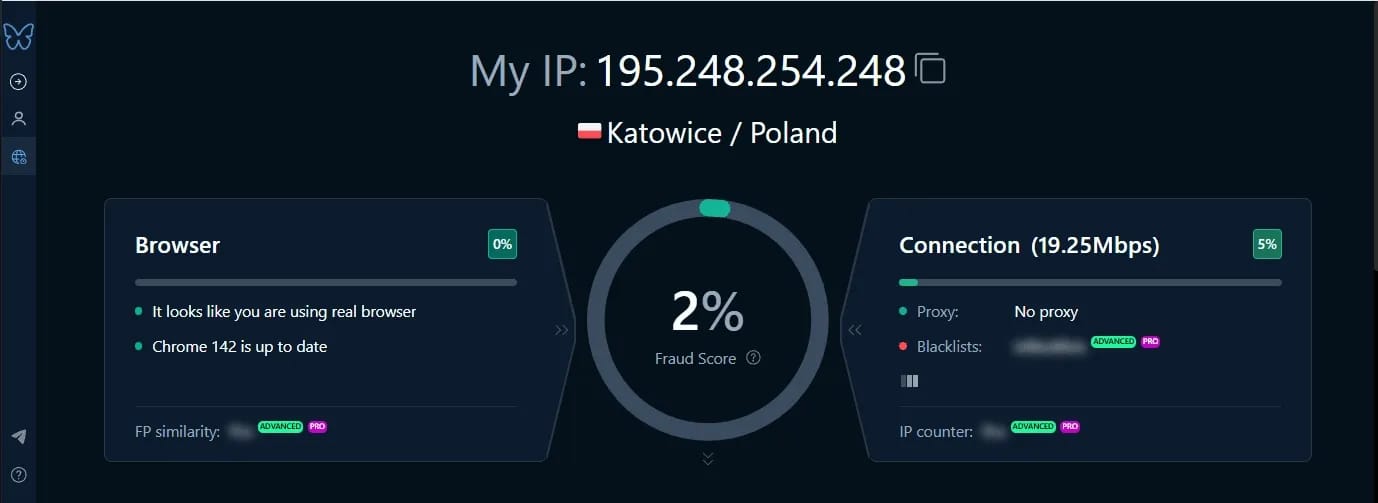
You can also use analogues – for example, pixelscan. But even if the proxy is on some blacklists, this does not mean that you cannot work with it. It all depends on the tasks, the level of the anti-bot system, and other factors (behavioral, trust in the session – account, cookies). Such services help to avoid serious mistakes, and then there are details that may vary from task to task.
Top 10 proxy servers for multi-accounting
Oxylabs
One of the largest proxy services specializing in parsing. It has been on the market since 2015 and has more than 177 million IP addresses covering approximately 195 countries worldwide.
The service offers customers all types of proxies with flexible payment options:
- resident proxies with traffic billing at $8/GB, package formats with an average cost of $3.75 per GB
- server proxies at up to $1.6/month per IP
- mobile proxies at $5.4/GB with pay-per-traffic, as well as package formats with an average cost of $4.75 per GB
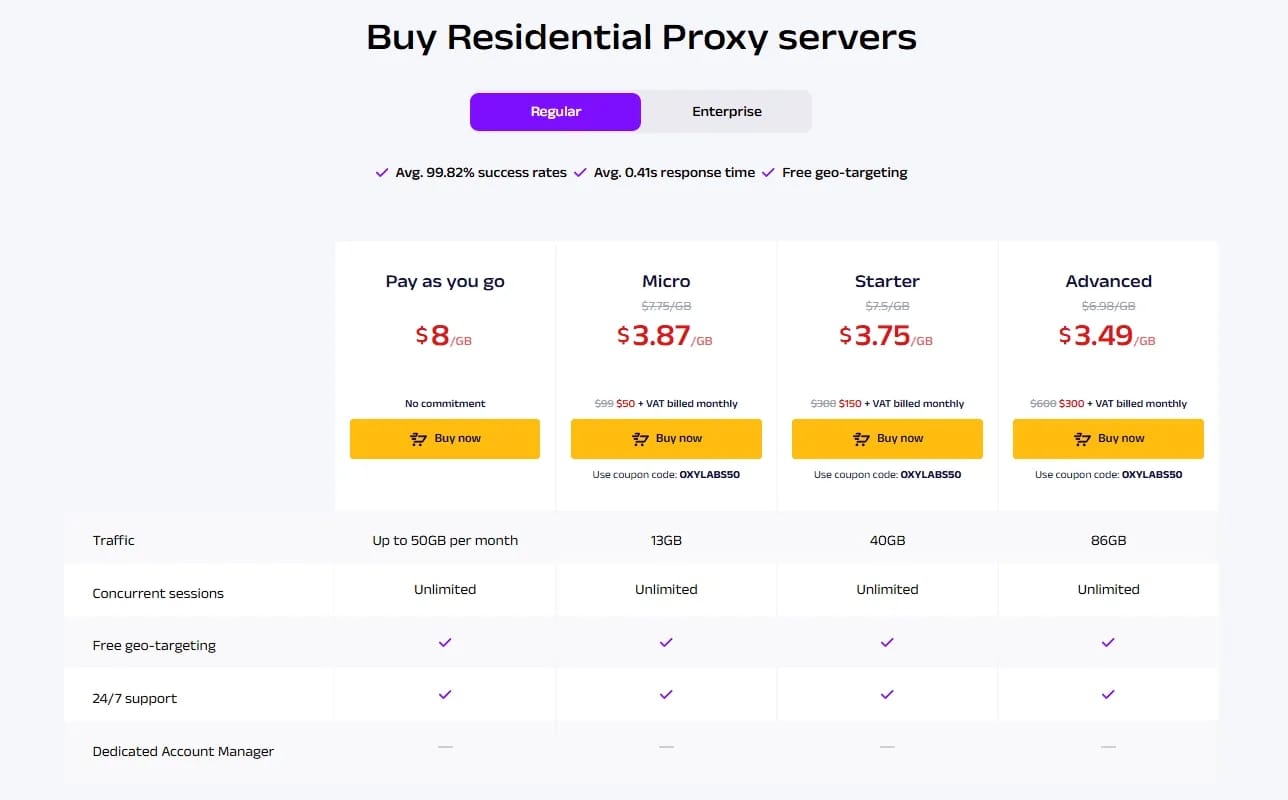
For companies and large customers, there is a special offer with prices 30-50% cheaper depending on the tariff and type of proxy.
Oxylabs also offers a wide range of AI tools for web scraping and guarantees 24/7 support for all customers.
New users can take advantage of a 3-day trial and bonus promo codes. Payment is accepted via bank cards and transfers, PayPal, and other payment systems.
IPRoyal
A provider of global proxy solutions with flexible pricing plans. The service offers a range of proxy servers of all types with both pay-as-you-go and subscription-based payment options. The total pool of residential proxies includes more than 32 million IP addresses.
Prices vary depending on the type of proxy, traffic volume, and payment model:
- Resident proxies – $2.57-3.68/GB
- Mobile proxies – $130/month
- ISP proxies – from $2.7 per month for 1 IP
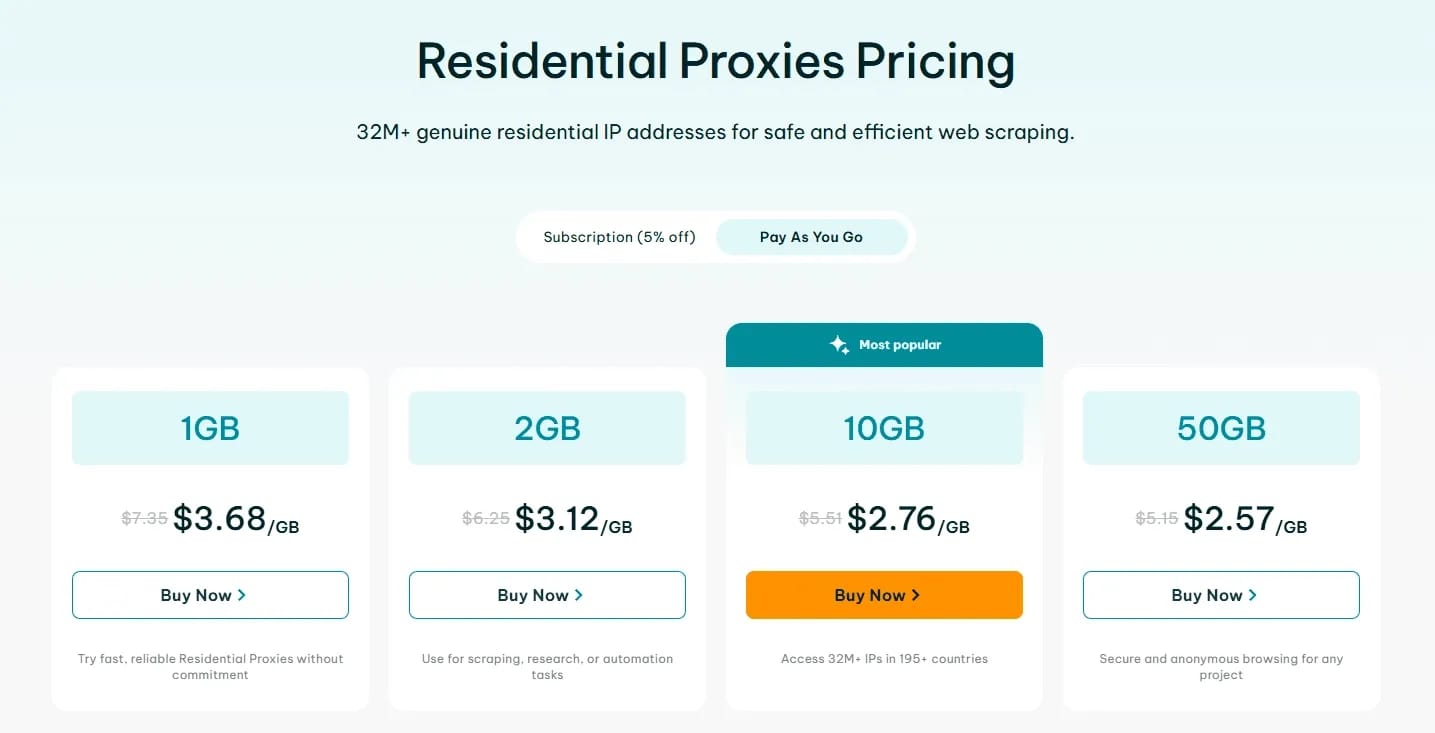
Discount promo codes are also available for new customers. The service does not offer a free trial. Payment is made by bank card, cryptocurrency, and PayPal.
Additional features worth noting include Web Unlocker and Video Scraper API, which allow you to automate the process of collecting information from websites and YouTube.
Dataimpulse
A proxy service specializing in providing unique solutions for businesses. The company provides server and mobile proxies, as well as standard and premium residential proxies. The total pool of IP addresses is over 90 million, covering 190+ countries. Traffic is unlimited in time—you can use as much of the resource as you need.
Cost of services:
- Resident proxies—standard resident proxies start at $1 per GB, and premium proxies start at $5 per GB;
- Server proxies—start at $0.5 per GB;
- Mobile proxies—start at $2 per GB
When working with large amounts of traffic, prices are reduced by approximately 20%.
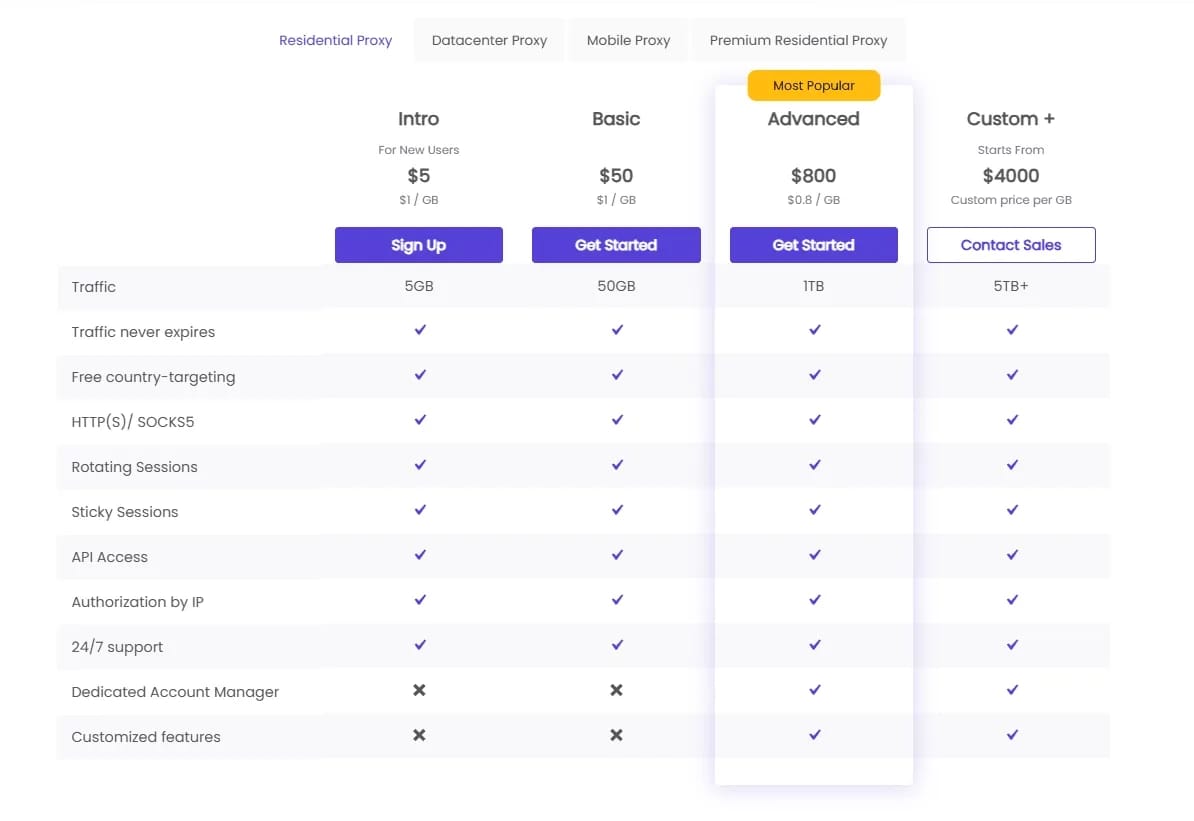
The service does not offer a free trial, but the starting rates are $5 – anyone can try it. Payment is exclusively for traffic. The service accepts payment by bank cards, transfers, cryptocurrencies, as well as Apple Pay and Google Pay.
Dataimpulse support is available 24/7, and a competent employee will respond to you at any time of the day.
Infatica
Proxy solutions for tasks of various levels. The company offers more than 20 million IP addresses, most of which are residential proxies, including both classic and premium IPs. In addition to residential proxies, there are static ISPs, dedicated and shared data center IPs, as well as mobile proxies.
The service offers a payment model based on actual traffic used, as well as payment for a specific volume. The price varies accordingly.
For example, residential proxies on the Pay As You Go model cost $4/GB, while package formats offer residential proxies for $3.84-3.6/GB for up to 100 GB, and $2.6-2.7 for larger volumes.
The service provides a 7-day trial access for a few dollars, with prices ranging from $4 to $8 depending on the type of proxy.
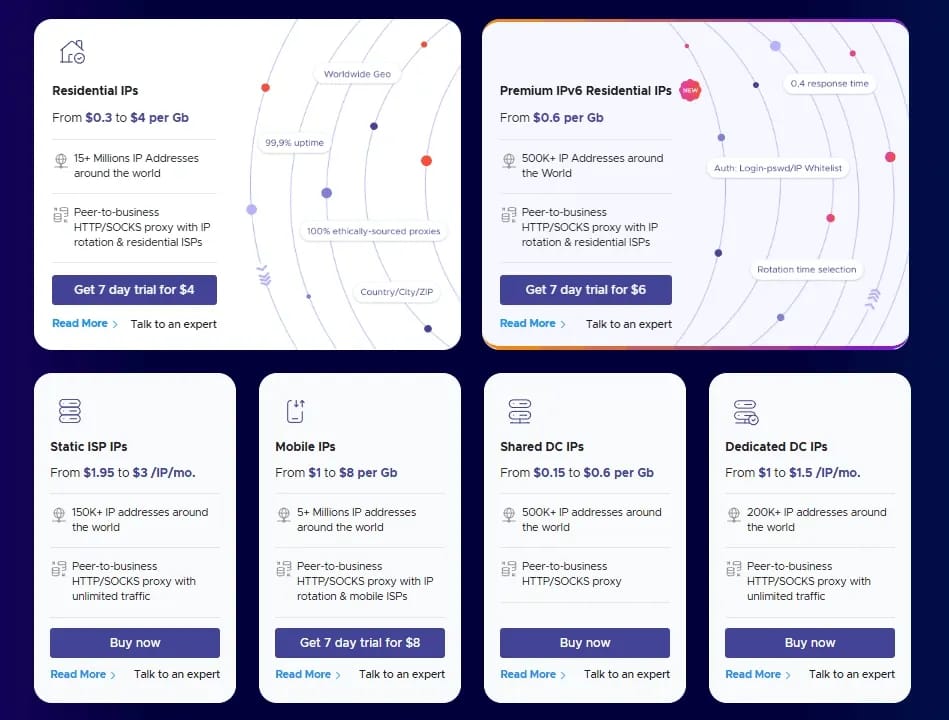
In addition to the proxies themselves, Infatica also offers a wide range of data scraping services for different platforms.
Payment for services is available via bank cards, PayPal, and other payment systems.
Brightdata
The largest proxy provider for tasks of any complexity. They have a pool of more than 150+ million IP addresses covering 195 countries. In addition to their main asset in the form of residential proxies (150 million IPs), they offer their customers mobile IP addresses (7 million IPs), ISP (1.3 million IPs), and data center proxies (1.3 million IPs).
They operate on both a Pay As You Go basis and with standard fixed-price traffic packages.
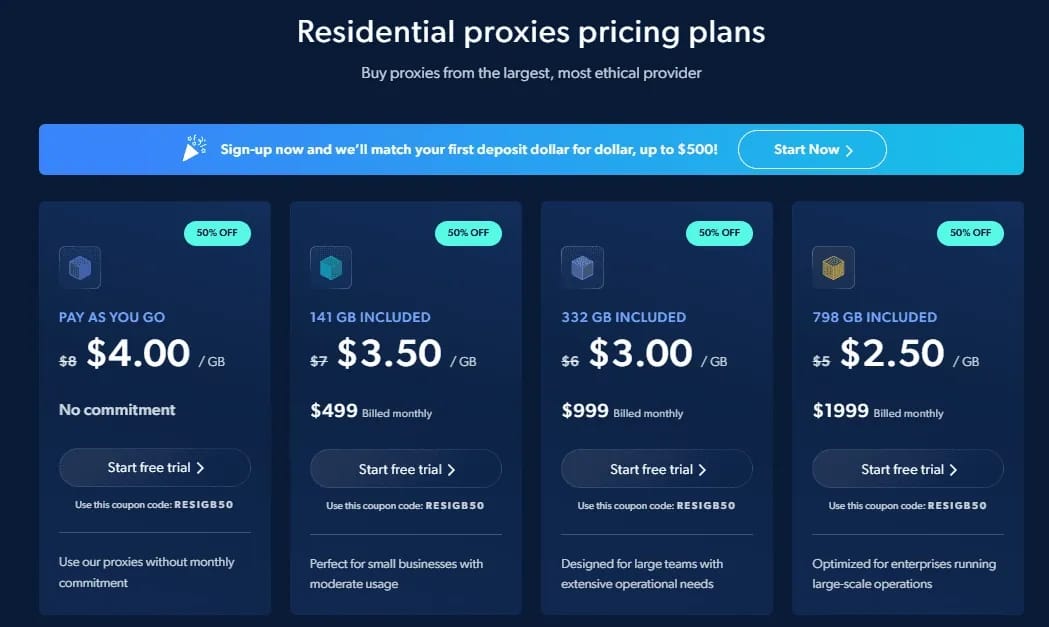
Prices for residential proxies start at $4 per GB.
New users receive welcome promo codes and a trial period. Payment is supported by bank cards, transfers, Payoneer, and other payment systems.
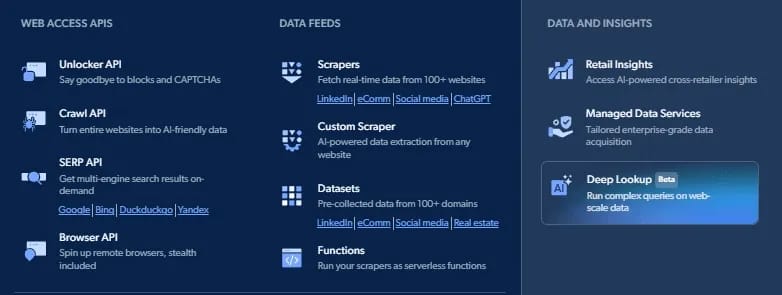
The service is actively developing in the direction of data scraping and is developing its own solutions: scrapers, collected data from various sites, parsing functions, etc.
Nodemaven
Proxy service with IP addresses for your privacy. The service has more than 30 million residential and mobile IP addresses. A convenient solution with an emphasis on multi-accounting on any platform. The service claims to automatically filter IP addresses before issuing them to clients, which allows it to maintain a high level of proxy quality and trust.
The service operates on a Pay As You Go model and offers ready-made monthly plans with different fixed traffic volumes.
Under the pay-as-you-go model, 1 GB of residential proxies with a volume of up to 200 GB will cost from $3.9 to $2.6 per GB — the higher the traffic volume, the cheaper it is.
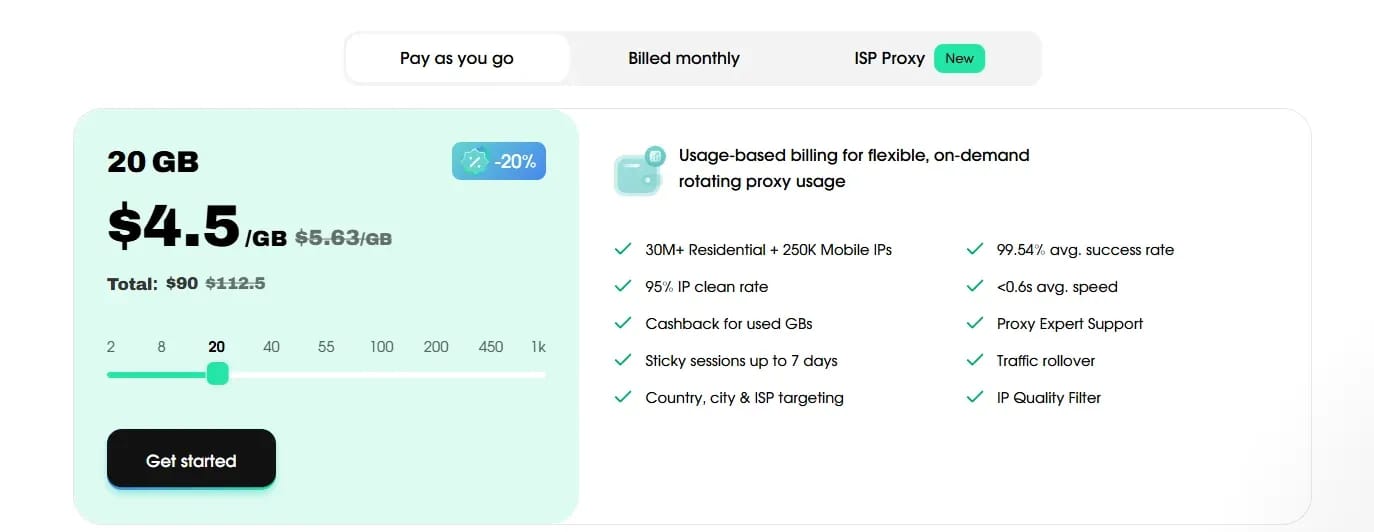
The service offers discount promo codes, as well as a 750MB trial for $3,50. Payment is available via bank cards, transfers, and cryptocurrencies.
Proxy-seller
A proxy service with flexible settings and proxies for any task. With over 20 million IP addresses, the service offers a wide variety of proxies for social networks, gaming, web scraping, marketplaces, programming, and other tasks.
The company provides residential, mobile, and ISP proxies. There is a choice of protocols – IPv4 and IPv6.
Resident proxies are paid for by traffic – you purchase a monthly plan, while server proxies are paid for by time (with no traffic limits).
The price of resident proxies starts at $3.5 per 1 GB, but with a volume of 100 GB, the price drops to $2.2 per GB. The more traffic, the lower the price, with the lowest price in the ready-made plans being $1.5 per GB.
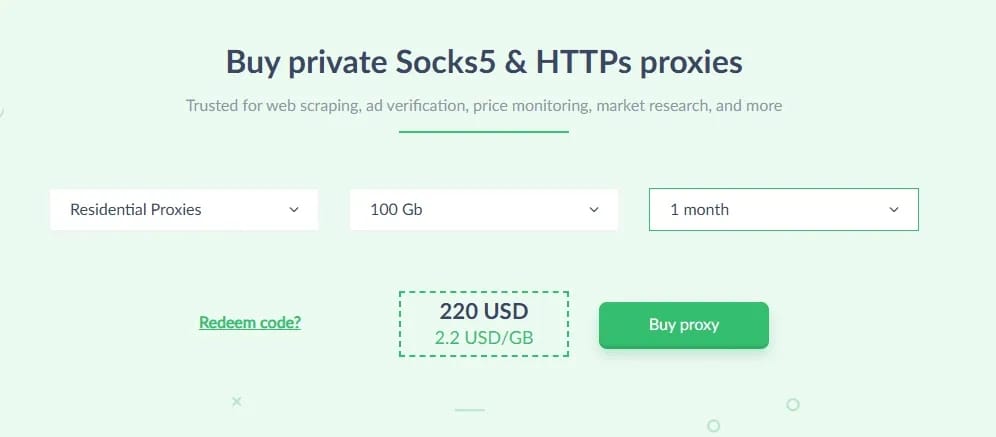
The service is convenient because it has affordable prices and formats for the average user. Simple and understandable ready-made solutions for specific tasks.
There is a 3-day trial for $1.99. You can pay with a bank card, PayPal, or cryptocurrency.
Thordata
High-quality proxies with a focus on data collection and AI tasks. More than 60 million IP addresses with high uptime and coverage in 190+ countries are available. The service provides residential, mobile, and server proxies, as well as infrastructure for web scraping—its own AI scrapers, ready-made data sets from popular sites, and various APIs.
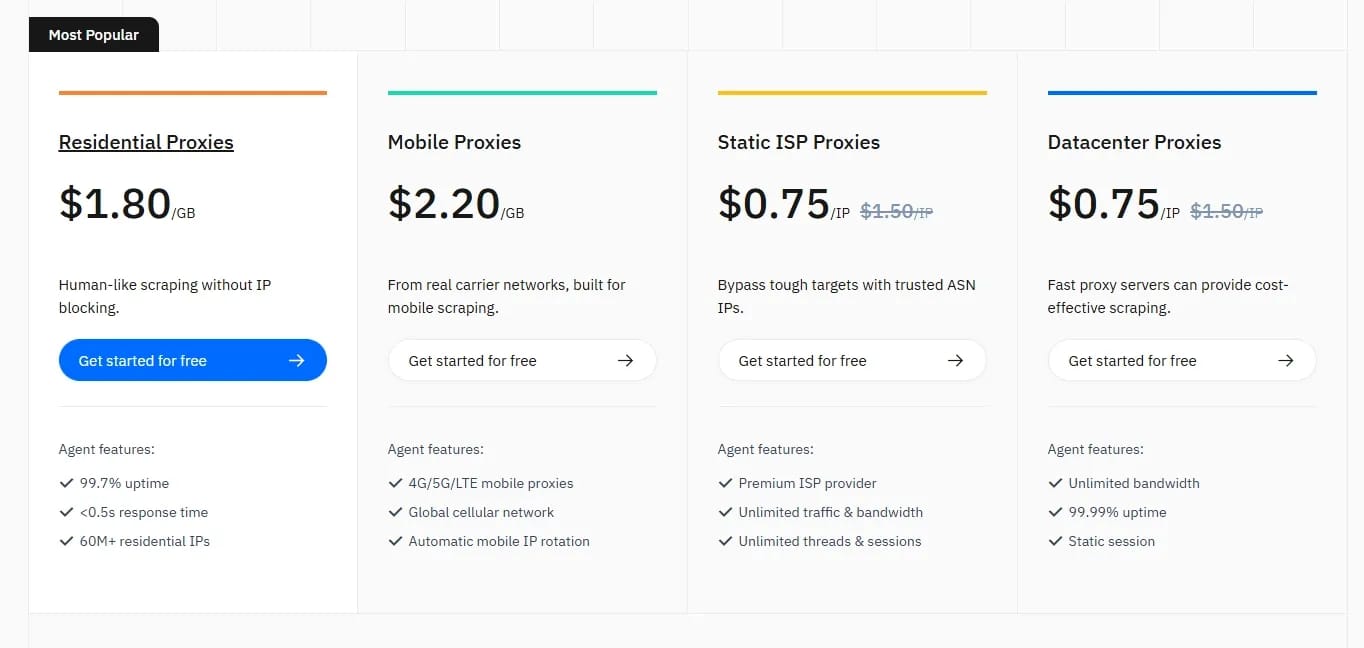
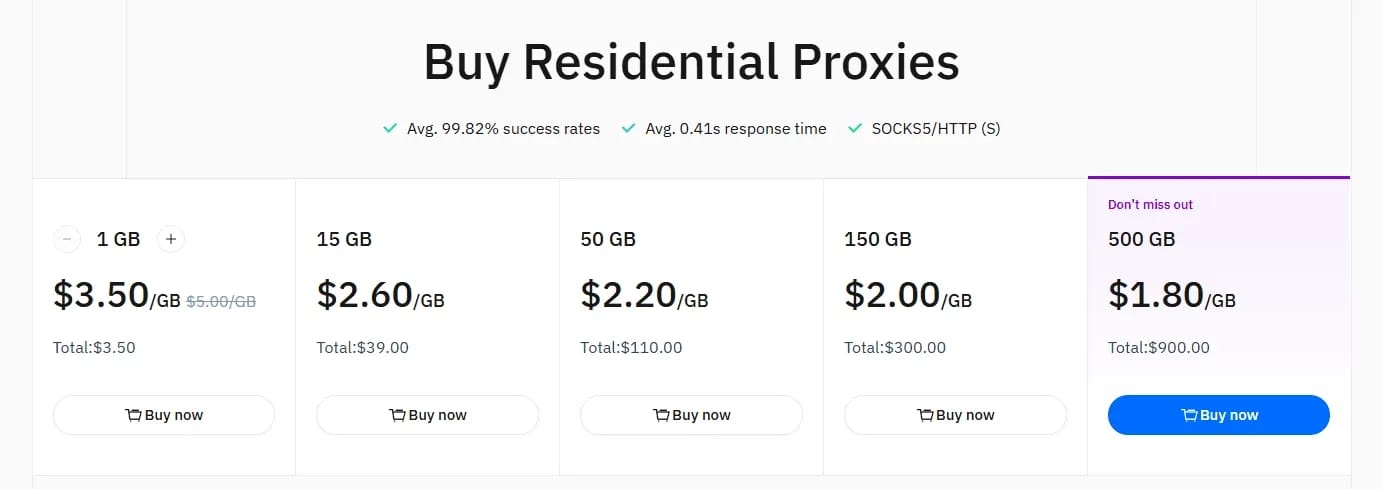
The cost of residential proxies starts at $3.5 per GB and decreases to $1.8-2 per volume. Proxies are sold on a fixed traffic volume tariff plan.
The service provides a trial for new users. Payment is available by bank card, PayPal, and cryptocurrencies.
Where to buy the best proxies for work: summarizing
High-quality proxies are the basis for effective multi-accounting and web scraping. After all, only by using a proxy connection can you fully unlock the potential of an anti-detection browser. This means that you need to choose the best solutions. Not the most expensive, not the cheapest, but the best in terms of price-quality ratio — so that your work processes are stable and you don't lose money due to important profiles being blocked.
It is impossible to single out the best provider — you need to test several, optimizing your costs with the best conditions without losing quality. In our selection, we have highlighted the main market leaders who provide a wide pool of IP addresses with extensive coverage across countries, different types of proxies, and a solid reputation in the market — you will definitely get what you pay for.
You can always find cheaper local options from small proxy sellers, but these are niche products for specific tasks. Look for selections of proxy services for specific countries in our blog. Discount offers for various services are already waiting for you in our “Partners” section.
Choose high-quality proxies, test and optimize your costs in terms of volume, and use the “AdsCrusher” feature in Linken Sphere.
SOCKS vs HTTP Proxy: What’s the Real Difference and Which One to Choose?
There are times when you don’t want a website to link the request back to your device. That’s where a proxy comes in, it acts like a middle layer and sends the request for you. The site sees the proxy’s info instead of yours. It’s a go-to trick when you’re trying to see a page that’s not available in your region, pull content that’s restricted by location, or avoid hitting a wall when sending lots of requests.

How SOCKS5 Proxies Work: Explained in Simple Terms
What is this technology and how does SOCKS5 work when transferring data between a user and a website?

What Is an Antidetect Browser? A Comprehensive Guide
Imagine entering a meeting, and everyone instantly knows your latest Amazon purchases, your preferred news sites, and even the airline you last booked. That's what happens when you browse the web with a regular browser - your digital fingerprint gives you away. Websites today don’t just track cookies. They build detailed profiles based on your device settings, browser type, screen size, fonts, time zone, and even how fast you move your mouse. This is called browser fingerprinting, and it's surprisingly accurate, often enough to identify you out of thousands of users. That’s where antidetect browsers come in. These privacy-focused browsers are designed to protect your online identity by tricking fingerprinting systems. They allow you to control what your browser reveals or doesn't reveal about you. We’ve put together a short antidetect browser tutorial.