
Where to Buy Twitter (X) Accounts in Bulk
Most guides to buying X accounts are written for someone purchasing one account. The advice changes completely at volume. A process that works fine for a single handover — negotiate, pay into escrow, wait for the seller to hand over credentials, confirm — becomes unworkable at fifty units and impossible at five hundred. This guide covers what actually differs between platforms, why bought accounts fail, and how to evaluate a supplier before committing to an order.
What you are actually buying
"Twitter account" covers products that have almost nothing in common beyond the platform. Price differences of three orders of magnitude between listings are normal, and they reflect genuinely different things.
| Type | What it is | Typical use | Price band |
| PVA (phone verified) | Freshly registered, verified by SMS, no posting history, blank profile | Volume work where history does not matter | Low single dollars |
| Aged | Registered years earlier, sometimes with light activity | Situations where account age affects treatment | Tens of dollars, rising with age |
| Verified / Premium | Active paid subscription, blue checkmark | Visibility, longer posts, reply priority | Priced individually |
| Follower-tier | Existing audience, established niche | Acquiring reach rather than an account | Hundreds to thousands |
| Developer-ready | API access already provisioned | Automation and data work | Varies widely |
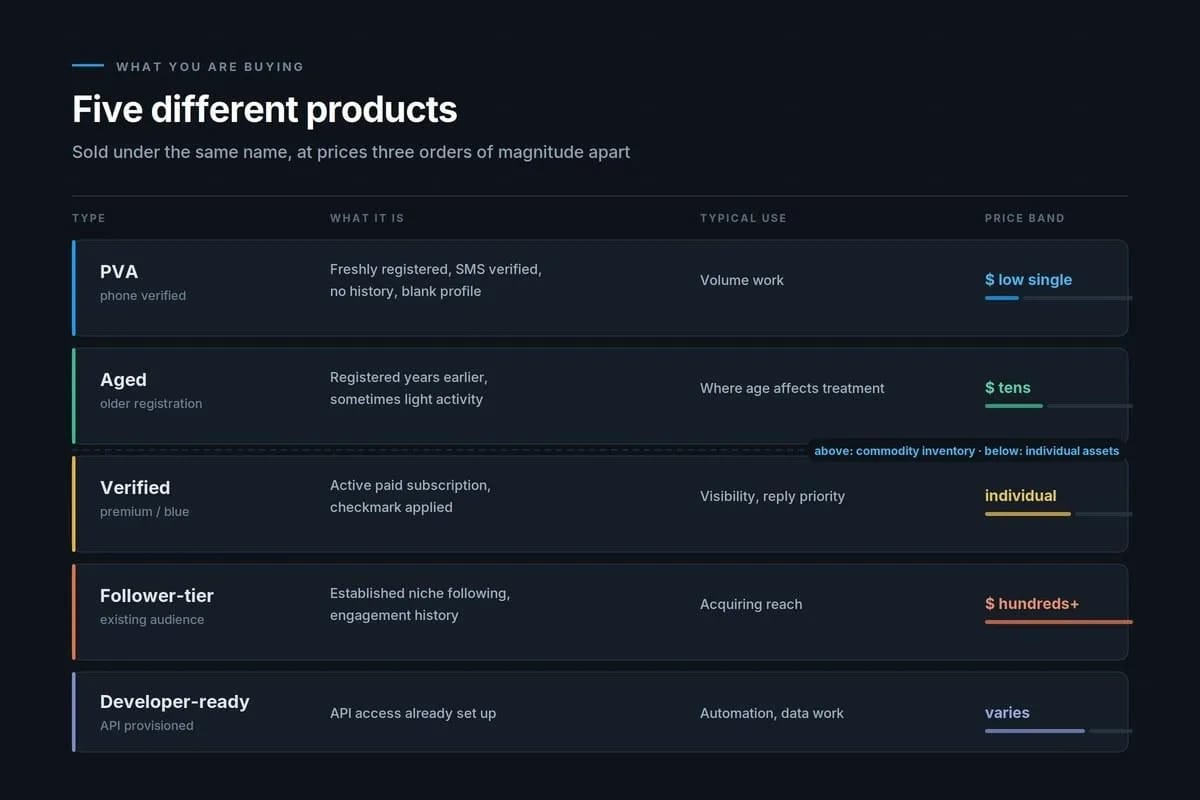
The first two rows are commodity inventory sold by specification. The rest are individual assets negotiated one at a time.
The distinction that matters for bulk buyers is between the first two rows and the rest. PVA and aged accounts are commodity inventory — interchangeable units, sold by specification. Verified and follower-tier accounts are individual assets, each negotiated separately. Those two categories are sold through completely different platform types, which is the subject of most of this guide.
Why bought accounts get banned or shadowbanned
This section matters more than the marketplace comparison further down, because a cheap account that dies in a week costs more than an expensive one that survives. Failures fall into two groups, and they have different fixes.
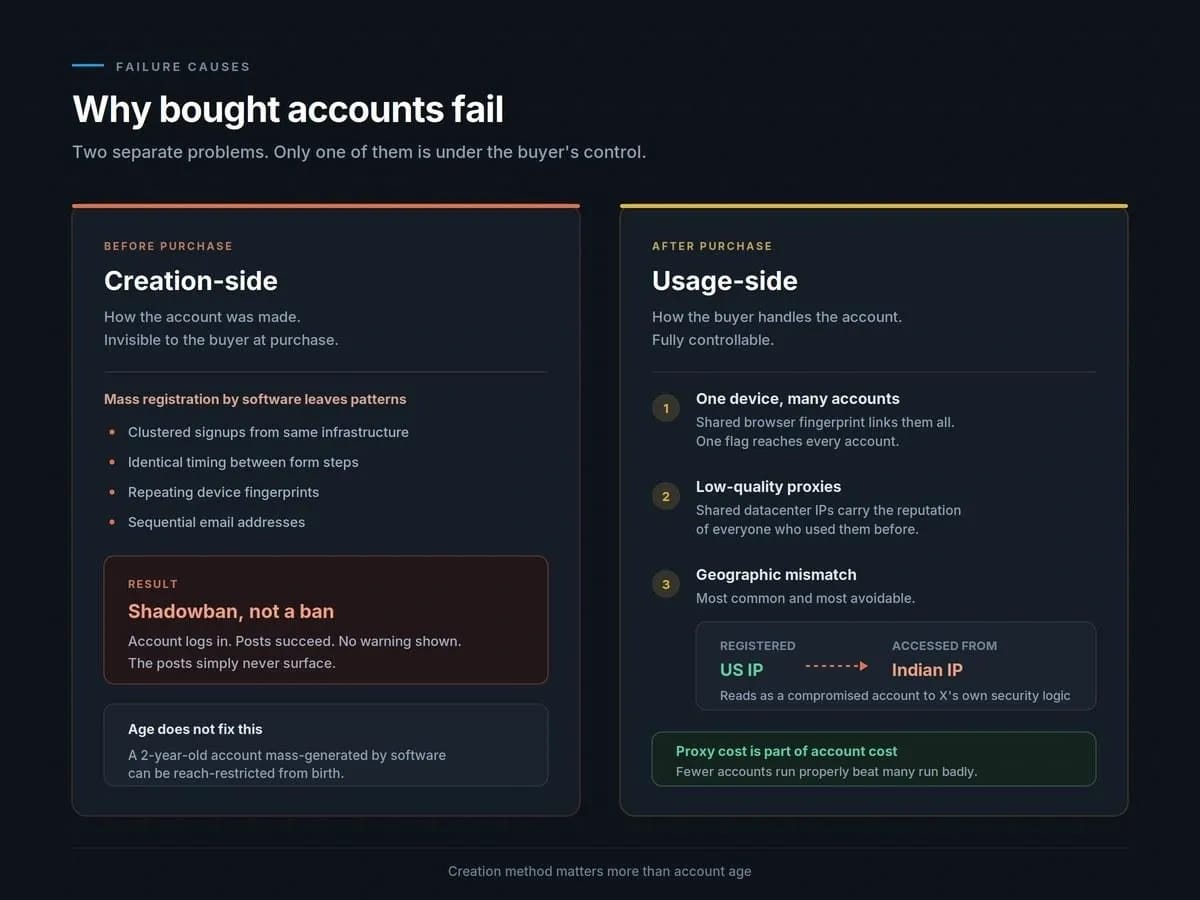
Creation-side problems are invisible at purchase. Usage-side problems are fully under the buyer's control.
Creation-side: how the account was made
The single largest factor in whether a bought account survives is something the buyer cannot see at purchase: whether it was registered by a human on a real device, or generated in bulk by software.
Automated registration leaves patterns. Registrations arriving in clusters from the same infrastructure, identical timing between form steps, device fingerprints that repeat across thousands of signups, sequential email addresses — none of these are visible in the finished account, but all of them are visible to X at the moment of creation and afterwards.
When X detects this, the usual response is not a ban. It is a reach restriction — what most people call a shadowban. The account logs in normally, posts successfully, and shows no warning. The posts simply do not surface in search or timelines. Buyers often do not discover this for weeks, by which time the replacement window at many suppliers has closed.
The creation method matters more than account age. A two-year-old account mass-generated by software can be reach-restricted from birth. A three-month-old account registered manually on a real device may perform normally. Age is easy to advertise and easy to verify; creation method is neither, which is precisely why it is worth asking about.
Suppliers that produce inventory in-house can filter for this before sale, because they control the creation process and can test output. Marketplaces that resell whatever third-party sellers upload have no visibility into it — the seller may not know either.
Usage-side: what happens after handover
Three buyer-side mistakes account for the majority of accounts lost in the first week.
- Multiple accounts logged into one device without isolation. A browser carries a fingerprint — fonts, canvas rendering, timezone, screen properties, hardware signatures. Logging six accounts into the same browser links all six. When one is flagged, the association is already recorded.
- Low-quality proxies. Cheap datacenter proxies are shared by large numbers of users, and their IP ranges are widely known. An account accessed through an IP recently used for spam inherits that reputation.
- Geographic mismatch. An account registered on a US IP, then accessed from an Indian IP the day after purchase, presents as a compromised account. The platform’s own security logic flags it — the same logic that protects real users from takeover.
A practical consequence: the proxy cost is part of the account cost. Buying a hundred accounts at a low unit price and then accessing them through shared datacenter IPs typically produces a worse outcome than buying fewer accounts and running them properly.
Two different marketplace models
Platforms selling X accounts fall into two structurally different categories. Most confusion about which platform to use comes from not recognising this, because both types appear in the same search results and describe themselves similarly.
Escrow marketplaces
Platforms such as SWAPD, PlayerUp and SocialTradia are intermediaries. They do not own the accounts listed on them. Third-party sellers post listings, buyers browse, the platform holds payment until the buyer confirms receipt, and delivery happens manually between the two parties.
This model has real strengths. For a high-value purchase — a follower-tier account costing several thousand dollars — escrow is genuinely the right structure. The money is protected during handover, and the platform provides a dispute process. PlayerUp has operated since 2007 and SWAPD since 2013, which counts for something in a sector where most operations do not last.
The limitations are structural rather than a matter of service quality:
- Listings often carry only a title. The country of registration, creation method, verification status and account format are frequently absent.
- Delivery is manual. Someone has to be awake and available on the other end. For fifty accounts, that is fifty handovers.
- Disputes depend on seller response. Reported resolution windows range from around 24 hours to several days.
- Volume is not what the model is built for. Ordering a thousand units usually means multiple sellers and inconsistent specifications.
Dedicated account stores
Platforms such as AccsZone and AccsMarket hold their own inventory. There is no third-party seller in the transaction. Listings carry full specifications because the platform produced or sourced the accounts directly, stock levels are visible, and delivery is automated — credentials are released by the system on payment confirmation rather than handed over by a person.
The trade-off runs the other way. There is no escrow holding the payment, so the buyer is relying on the platform’s own replacement and refund policy rather than a neutral third party. That makes the platform’s track record and support responsiveness the thing to evaluate, in place of the escrow mechanism.
Worth noting about search results: escrow platforms tend to rank well for account-buying queries partly because the escrow model reads as a trust signal to search engines. That signal is real for high-value single transactions. It says nothing about whether the platform can fulfil a bulk order.
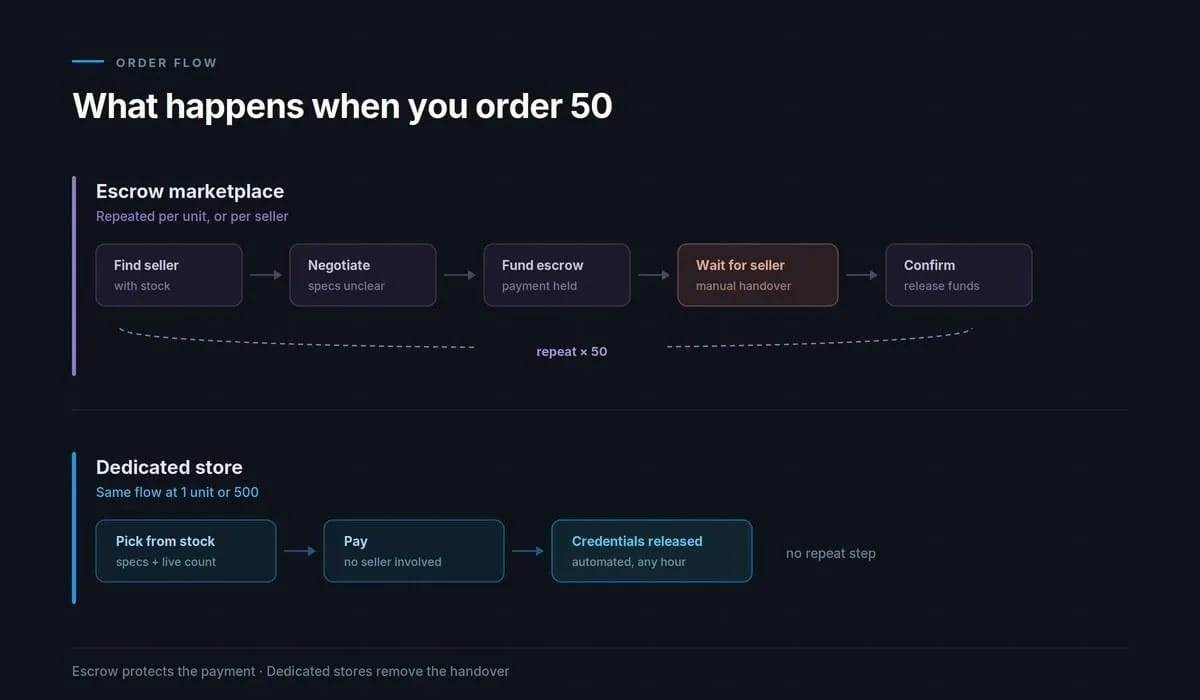
Escrow repeats the full cycle per unit or per seller. A dedicated store runs the same three steps whether the order is one account or five hundred.
Which model fits which order
| Order | Better fit | Why |
| 1 account, high value, verified or follower-tier | Escrow marketplace | Payment protection matters most; manual handover is acceptable once |
| 1–5 accounts, standard | Either | Both models handle this volume without strain |
| 10–100 accounts | Dedicated store | Manual handover becomes the bottleneck; consistent specification matters |
| 100+ accounts, recurring | Dedicated store | Requires held inventory, visible stock, and automated fulfilment |
Seven criteria for evaluating a bulk supplier
These are the questions worth asking before a first order, roughly in order of how much they affect the outcome.
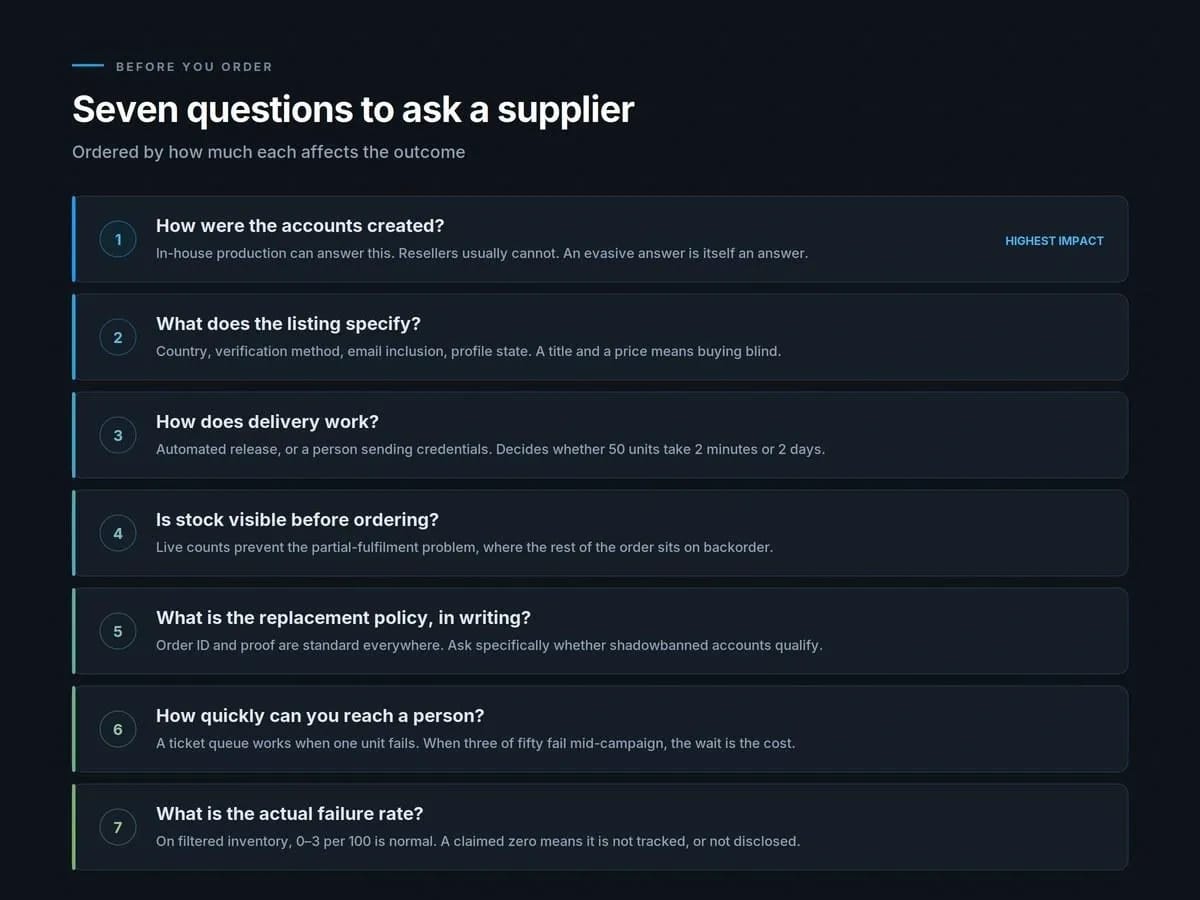
1. How were the accounts created?
The most important question on this list. A supplier that produces in-house can answer it. One that resells third-party inventory usually cannot. An evasive answer is itself an answer.
2. What does the listing actually specify?
Country of registration, verification method, email inclusion, profile state, creation period. If a listing is a title and a price, you are buying blind.
3. How does delivery work?
Automated release on payment, or a person sending credentials manually. This determines whether a fifty-unit order takes two minutes or two days.
4. Is stock visible before ordering?
Live stock counts prevent the common failure where an order is placed, partially fulfilled, and the remainder backordered indefinitely.
5. What is the replacement policy, in writing?
Every platform requires an order ID and evidence of the failure — that part is standard and not a differentiator. Ask specifically whether shadowbanned accounts qualify, since that is the failure mode most likely to be discovered late.
6. How quickly can you reach a person?
Submitting a ticket and waiting 24 to 72 hours is workable when one account fails. When three units out of fifty fail mid-campaign, the wait is the cost.
7. What is the actual failure rate?
On well-filtered inventory, a hundred-unit order commonly produces between zero and three accounts needing replacement. A supplier quoting zero across all orders is either not tracking it or not telling you.
Marketplace comparison
| Platform | Model | Since | Delivery | Support | Best suited to |
| AccsZone | Dedicated store | 2023 | Automated | Live chat, 24/7 | Bulk orders needing immediate fulfilment |
| AccsMarket | Dedicated store | 2017 | Automated | Ticket, 24–72h | Breadth of catalogue, established history |
| SWAPD | Escrow | 2013 | Manual | Ticket / dispute | High-value single accounts |
| PlayerUp | Escrow | 2007 | Manual | Ticket / dispute | Long-running middleman service |
| SocialTradia | Escrow | 2016 | Manual | Ticket / dispute | Vetted individual account sales |
| Sebuda | Marketplace | 2021 | Mixed | Ticket | Mixed digital goods |
Registration years are taken from public domain records and indicate when the domain was first registered, not necessarily when the service launched.
Platform reviews
1. AccsZone
Dedicated store · domain registered June 2023 · automated delivery · cryptocurrency payment
The clearest fit for buyers whose problem is volume and timing rather than payment protection. Inventory is produced in-house rather than resold from third-party sellers, which means listings can specify creation method, registration region, email inclusion and profile state — and means the supplier can filter reach-restricted accounts before they reach a buyer, since it controls the process that creates them.
Delivery is fully automated: credentials are released by the system on payment confirmation, with no manual seller step, so a fifty-unit order completes the same way a single-unit order does and at any hour. Stock counts are visible on listings before ordering. Support runs as a live channel around the clock, which matters less for the evidence requirements — order ID and proof of failure are standard everywhere — than for how quickly a replacement request reaches someone who can act on it.
Strengths — In-house production with quality filtering, automated fulfilment at any volume, full listing specifications, live support, replacement covering shadowbanned and suspended accounts.
Limitations — Operating since 2023, so a shorter public track record than the escrow platforms below. No third-party escrow — payment protection depends on the platform’s own policy. Cryptocurrency only, which rules it out for buyers who need card or invoice payment.
2. AccsMarket
Dedicated store · domain registered July 2017 · automated delivery
The longest-established dedicated store in this category and the reference point most buyers compare against. Catalogue breadth is its main advantage — coverage across platforms and account types is extensive, and the same inventory model applies: held stock, specified listings, automated delivery.
The practical friction is support throughput. Replacement requests go through a ticket queue with reported resolution times in the 24 to 72 hour range, and the documentation requirement tends to be thorough — screenshots and supporting evidence for each failed unit. Refunds for bad accounts are issued, but the process is slower than a live channel.
Strengths — Longest track record among dedicated stores, very broad catalogue, automated delivery, established refund process.
Limitations — Ticket-based support with 24–72 hour typical resolution, documentation-heavy replacement process.
3. SWAPD
Escrow marketplace · domain registered December 2013 · manual delivery
Where high-value account sales tend to happen, and appropriately so. The escrow structure holds payment until the buyer confirms the handover, which is the right protection when a single transaction runs into four or five figures. Listings are moderated more actively than on most escrow platforms.
For volume it does not fit, and this is a property of the model rather than a criticism of execution. Each account is a separate negotiation with a separate seller and a separate manual handover. If a purchased account fails afterwards, resolution runs through the escrow dispute process and depends on the seller engaging — a window commonly described as running from around 24 hours to several days.
Strengths — Strong payment protection, active moderation, well suited to high-value single purchases, long operating history.
Limitations — Manual delivery, unsuited to bulk, dispute resolution depends on seller response, variable listing detail.
4. PlayerUp
Escrow marketplace · domain registered May 2007 · manual delivery
The oldest operation in this comparison, originally built around gaming account transfers and extended into social accounts. The middleman service is the product: PlayerUp does not own the accounts listed, it facilitates the transaction between two parties.
The main issue for buyers is listing quality. Because sellers create the listings, detail varies enormously — many carry a title and little else, with registration country, creation method and account format left undocumented. Buyers frequently do not know what they are receiving until after handover.
Strengths — Very long operating history, broad category coverage, established middleman process.
Limitations — Inconsistent and often minimal listing detail, manual delivery, platform holds no inventory, not built for volume.
5. SocialTradia
Escrow marketplace · domain registered February 2016 · manual delivery
Focused specifically on social media accounts rather than digital goods generally, with a vetting process applied to listings before they go live. For buyers acquiring one established account with an existing audience, that focus and the escrow protection are a reasonable combination.
The constraints are those of the escrow model. Delivery is manual, inventory belongs to sellers rather than the platform, and dispute resolution runs on the same seller-dependent timeline.
Strengths — Social-specific focus, listing vetting, escrow protection.
Limitations — Manual delivery, no held inventory, not suited to bulk quantities.
6. Sebuda
Marketplace · domain registered March 2021 · mixed delivery
A broader digital goods marketplace where accounts sit alongside other categories. Appears frequently in search results for account-buying queries. The breadth is the trade-off: less specialisation in accounts specifically, and listing detail and delivery method vary by seller.
Strengths — Wide category coverage, accessible interface.
Limitations — Not account-specialised, variable listing quality and delivery method.
How to place a first order
The most expensive mistake in this sector is ordering at scale before testing at small scale. It is also the most common.
- Order five units, not five hundred. Whatever the supplier, whatever the reviews. This applies to every platform in this guide without exception.
- Set up isolation before logging in. Separate browser profile per account, residential proxy matched to the registration region. Doing this after the first login is too late.
- Check visibility, not just login success. Open the profile URL in a logged-out browser or private window. If it returns a "this page does not exist" message, the account is not publicly reachable — through suspension, deletion or restriction — and should be replaced regardless of which. Then post and check whether it surfaces in search from that same logged-out session.
- Run them for a week before scaling. Most failures appear in the first seven days. A batch that survives a week under normal use is usually sound.
- Test the replacement process deliberately. If a unit fails, submit the claim and time the response. Better to learn the real support timeline on a five-unit order than on a five-hundred-unit one.
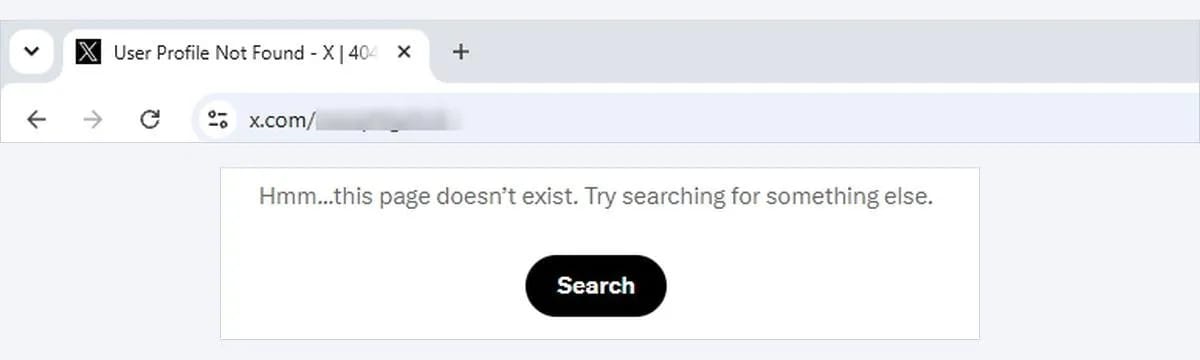
Opening the profile URL logged out is the fastest visibility check. A “this page doesn’t exist” response means the account is not publicly reachable. Username redacted.
Terms of service. Buying, selling and transferring accounts is prohibited under X’s terms, and an account can be suspended on those grounds regardless of how it was created or where it was purchased. No supplier can indemnify against this. It is a fixed condition of the activity, not a variable between platforms.
Keeping accounts alive after purchase
Account survival depends more on the first week of handling than on anything about the purchase itself.
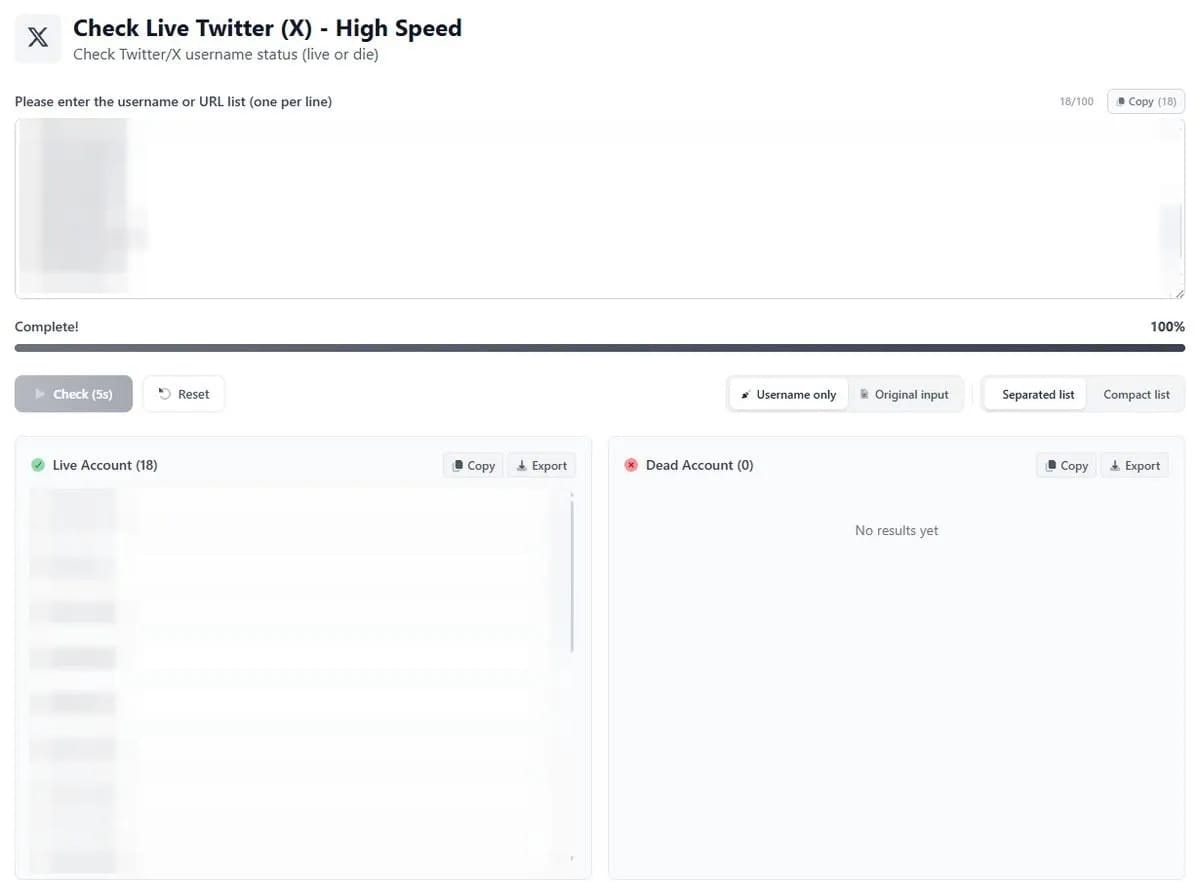
Bulk status checkers verify whether accounts are alive across a whole batch at once. Usernames redacted. This confirms accounts exist — it does not detect reach restrictions.
Isolation
One browser profile per account, consistently. Antidetect browsers exist specifically to give each profile a distinct and stable fingerprint — the stability matters as much as the distinctness, since a fingerprint that changes between sessions is itself a signal.
Proxy matching
Residential proxy, matched to registration region, and kept consistent for that account. Rotating an account across countries is a stronger flag than any single suspicious IP.
Warm-up
New accounts that immediately begin posting at volume attract attention. A few days of ordinary reading, following and occasional interaction before any campaign activity substantially reduces early losses.
Credentials and recovery
Change the password immediately, and record whether the account includes email access. Without it, recovery options are limited if the account is ever locked.
Frequently asked questions
- Bulk quantities generally come from dedicated stores holding their own inventory rather than escrow marketplaces. Escrow platforms connect individual sellers to individual buyers, which suits one high-value account but does not scale.
- Two causes. Creation-side: accounts mass-generated by software carry detectable registration patterns. Usage-side: multiple accounts on one device without isolation, low-quality shared proxies, or accessing an account from a country that does not match its registration region.
- Usually the creation method. Software-generated accounts leave patterns X can detect, and the response is often a reach restriction rather than a visible ban. The account works normally from the owner’s side but its posts do not surface.
- Bulk PVA accounts sit in the low single-dollar range per unit. Aged accounts cost more depending on registration year. Verified and follower-tier accounts are priced individually and can reach thousands.
- It depends far more on niche and engagement than on follower count. Escrow platforms are where these are typically traded, and browsing completed sales in a comparable niche gives a better estimate than any general rule.
- Account transfer breaches X’s terms, and suspension on those grounds is possible regardless of supplier. The commercial risks are more controllable: choose platforms that disclose creation methods, publish a replacement policy, and can be reached quickly.
- An escrow marketplace does not own what it lists — sellers post, the platform holds payment, delivery is manual. A dedicated store holds inventory, publishes specifications and delivers automatically.
- On well-filtered inventory, a hundred-unit order commonly produces zero to three needing replacement. Treat a claimed zero percent rate with caution. The more useful question is how quickly replacements are issued.
- Technically yes, and it is a common way to lose a batch. Accounts sharing an IP are associable, so a flag on one propagates. For anything beyond a couple of accounts, one residential IP per account is the practical minimum.
- Only if the age is genuine and the creation was clean. An aged account that was mass-generated can be reach-restricted from the start. Age is a useful signal alongside the creation method, not a substitute for it.
Why Google Blocks Accounts and What Your Antidetect Has to Do With It
Google has once again complicated the mechanisms of digital identification by deploying a new, more sophisticated layer of protection based on proprietary HTTP headers. This quiet change caught most of the market off guard, triggering a wave of rushed updates. While others hastily released superficial 'fixes', we realized that we were dealing not with a minor issue but with a fundamental shift that required deep and comprehensive analysis.
SOCKS vs HTTP Proxy: What’s the Real Difference and Which One to Choose?
There are times when you don’t want a website to link the request back to your device. That’s where a proxy comes in, it acts like a middle layer and sends the request for you. The site sees the proxy’s info instead of yours. It’s a go-to trick when you’re trying to see a page that’s not available in your region, pull content that’s restricted by location, or avoid hitting a wall when sending lots of requests.

The Best Alternative to OBS Studio
Working with a webcam on many online platforms can turn into a real challenge. A strict oval or rectangular frame appears on the screen, but your image doesn’t align perfectly with it. As a result, the system blocks further progress, demanding perfect alignment, and your workflow is disrupted before it even begins.